
A city replaces STP access pods with a leaf-spine Clos for the new civic cloud. Which trait best describes that IP fabric architecture?
Select an answer to reveal the explanation.
Short Explanation
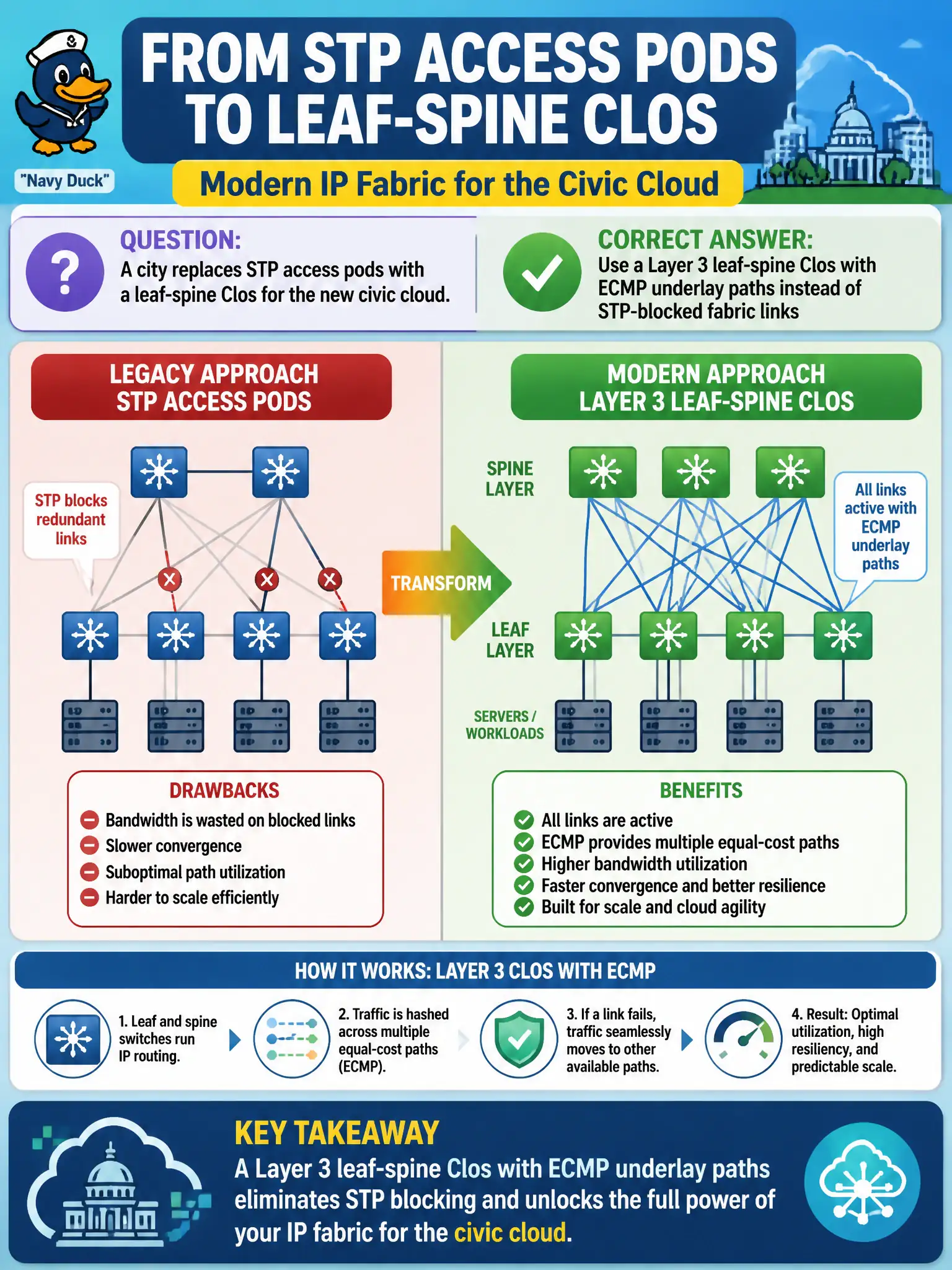
Think of the old STP pods as one-lane bridges with gates half-shut. The civic Clos opens every leaf-to-spine lane and lets Layer 3 ECMP share the load. Spines and leaves talk IP—no blocked fabric links as the architecture story.
Full Explanation
A leaf-spine Clos for the civic cloud uses a Layer 3 underlay with ECMP paths instead of STP-blocked fabric links—the defining IP fabric trait versus old access pods. Keeping a single STP root with blocked links preserves the legacy model the city is leaving. An L2 mesh between leaves relying on MLAG alone is not the Clos underlay architecture. Terminating every tenant VLAN on spines so the underlay never needs IP routing contradicts routed Clos design. Exam caveat: Overlays may still provide L2 adjacency, but the fabric underlay itself is routed. Operational check: Verify leaf-spine links are routing adjacencies with ECMP, not STP blocking-alternate state. In civic data-center operations, record the expected CLI or collector evidence for this concept so the next on-call engineer can validate fabric behavior without re-deriving the design under incident pressure. In civic data-center operations, record the expected CLI or collector evidence for this concept so the next on-call engineer can validate fabric behavior without re-deriving the design under incident pressure. In civic data-center operations, record the expected CLI or collector evidence for this concept so the next on-call engineer can validate fabric behavior without re-deriving the design under incident pressure.