
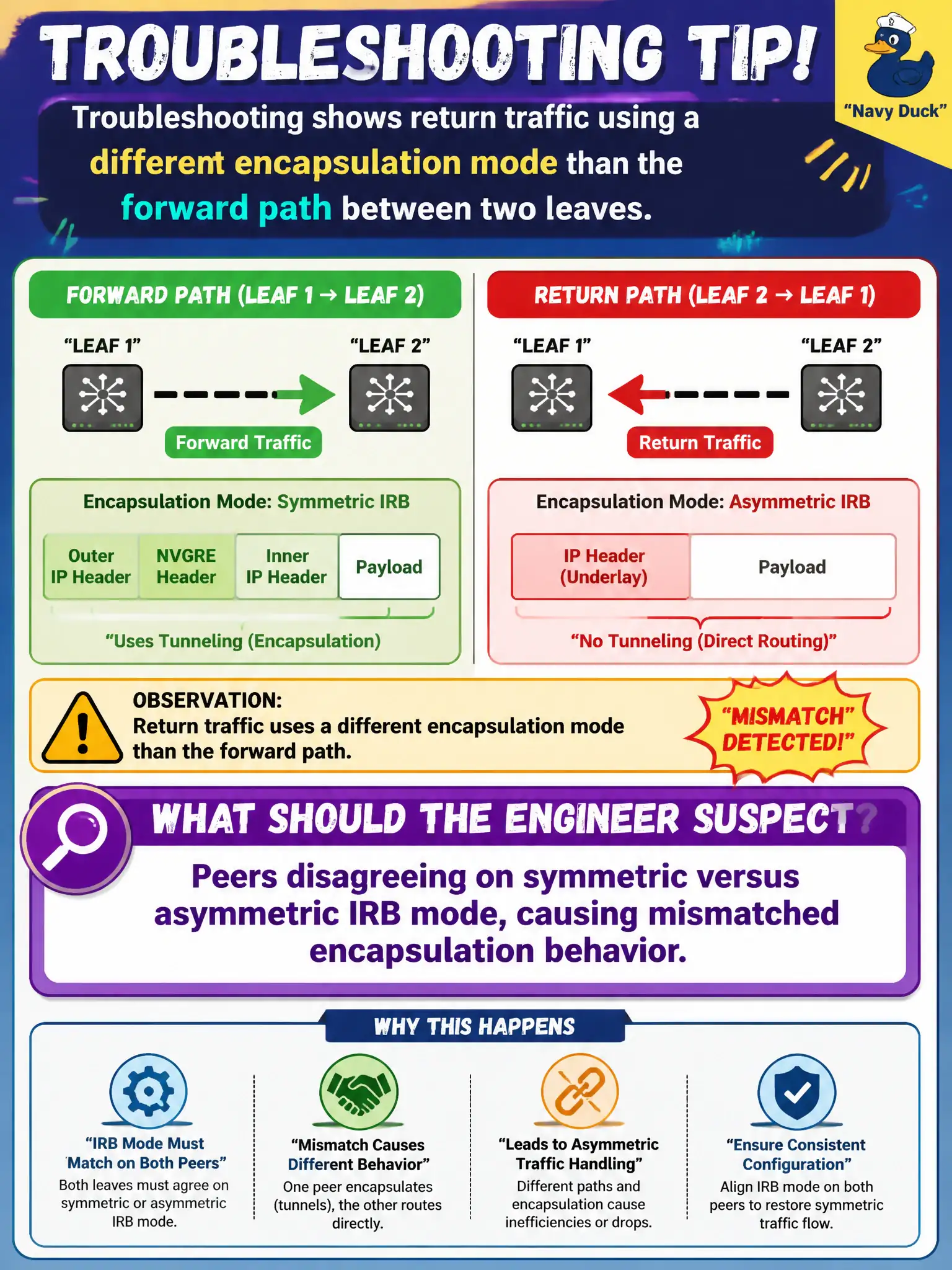
Troubleshooting shows return traffic using a different encapsulation mode than the forward path between two leaves. What should the engineer suspect?
Select an answer to reveal the explanation.
Short Explanation
If the trip there and the trip back speak different encapsulation dialects, the leaves probably disagree on symmetric vs asymmetric. That is not healthy ECMP artistry — fix the mode mismatch, do not rip out RTs or BGP.
Full Explanation
If return traffic uses a different encapsulation mode than the forward path between two leaves, engineers should suspect peers disagreeing on symmetric versus asymmetric IRB mode, producing mismatched encapsulation behavior. Healthy ECMP hashing does not flip VNI models per packet by design. Disabling BGP on one leaf so return traffic uses static VXLAN is not the required interpretation. Removing route targets from all EVPN instances would worsen reachability, not explain a mode mismatch. Exam caveat: firewalls or service chaining inserted on one direction can mimic encapsulation asymmetry—confirm whether the mismatch is truly VTEP IRB mode before redesigning the fabric. Operational check: capture both directions of a municipal inter-subnet flow, compare VNI/VRF encapsulations, check IRB mode configuration on both leaves, align them to the standard, and retest until forward and return match. When forward and return encapsulations differ, freeze routing-policy changes until IRB mode parity is proven on both municipal leaves. When forward and return encapsulations differ, freeze routing-policy changes until IRB mode parity is proven on both municipal leaves. When forward and return encapsulations differ, freeze routing-policy changes until IRB mode parity is proven on both municipal leaves.