
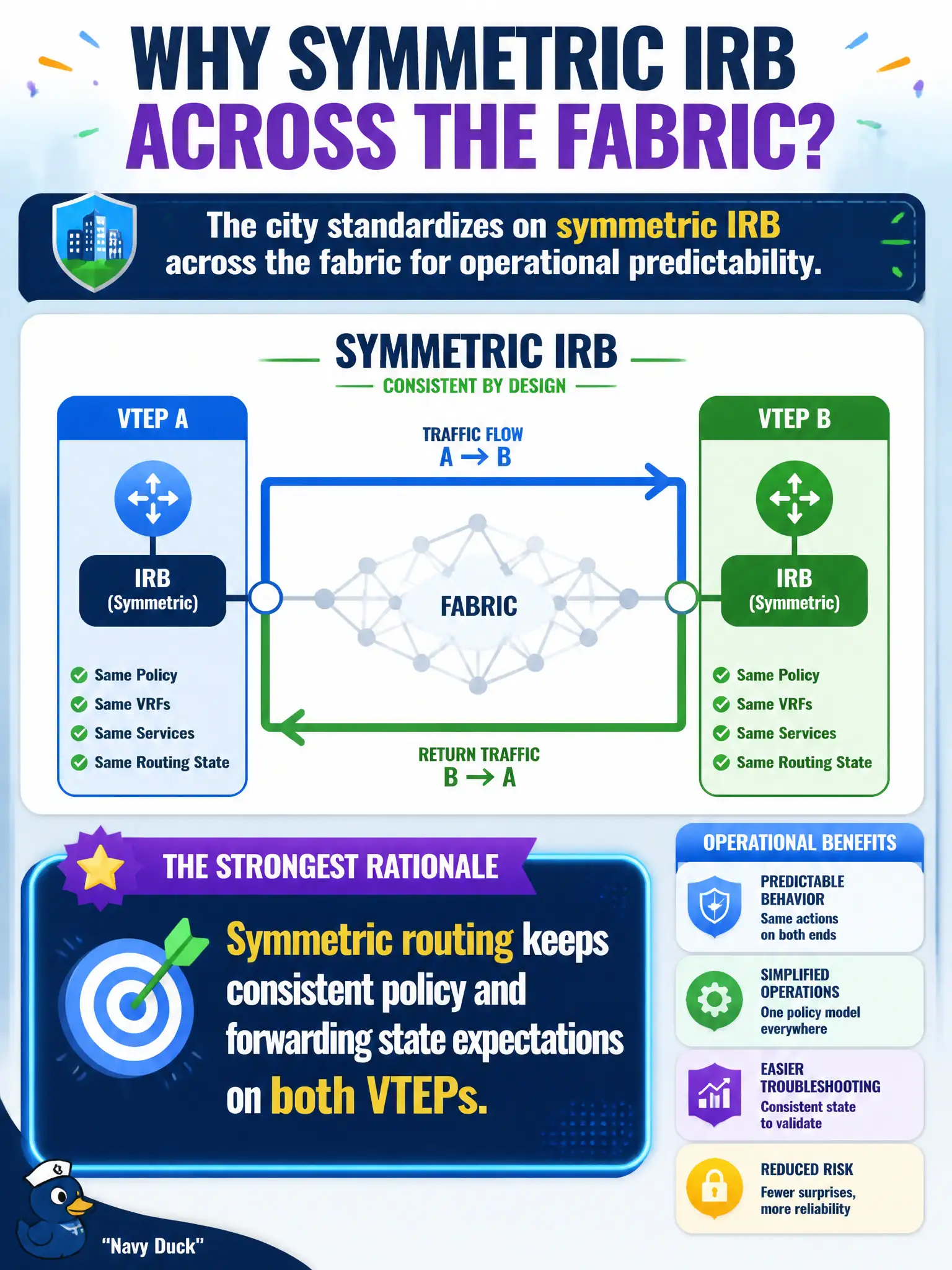
The city standardizes on symmetric IRB across the fabric for operational predictability. What is the strongest rationale?
Select an answer to reveal the explanation.
Short Explanation
Symmetric IRB is the 'same playbook on both benches' choice — policy and state look alike on each VTEP, which is easier to operate citywide. It does not delete Type-2s, force L2 hairpins, or abolish VNIs.
Full Explanation
Standardizing on symmetric IRB across the city fabric improves operational predictability because both VTEPs share consistent policy and forwarding state expectations for inter-subnet traffic—the same L3 VNI/VRF model applies each way. That is the strongest rationale among common choices. Symmetric IRB does not remove the need to advertise EVPN Type-2 routes; host MAC/IP reachability remains essential. Symmetric IRB does not force all traffic to hairpin through a Layer-2-only spine. Symmetric IRB does not disable VNIs in favor of VLAN IDs only. Exam caveat: predictability still requires disciplined VNI/VRF provisioning—symmetric mode with inconsistent route targets or missing L3 VNIs fails just as loudly as asymmetric mismatch. Operational check: audit all municipal leaves for identical IRB mode and L3 VNI maps per tenant, run bidirectional tests, and include IRB-mode agreement in the fabric compliance checklist. Make IRB-mode agreement a gate in fabric compliance scanning alongside RT and VNI checks. Make IRB-mode agreement a gate in fabric compliance scanning alongside RT and VNI checks. Make IRB-mode agreement a gate in fabric compliance scanning alongside RT and VNI checks. Make IRB-mode agreement a gate in fabric compliance scanning alongside RT and VNI checks.