
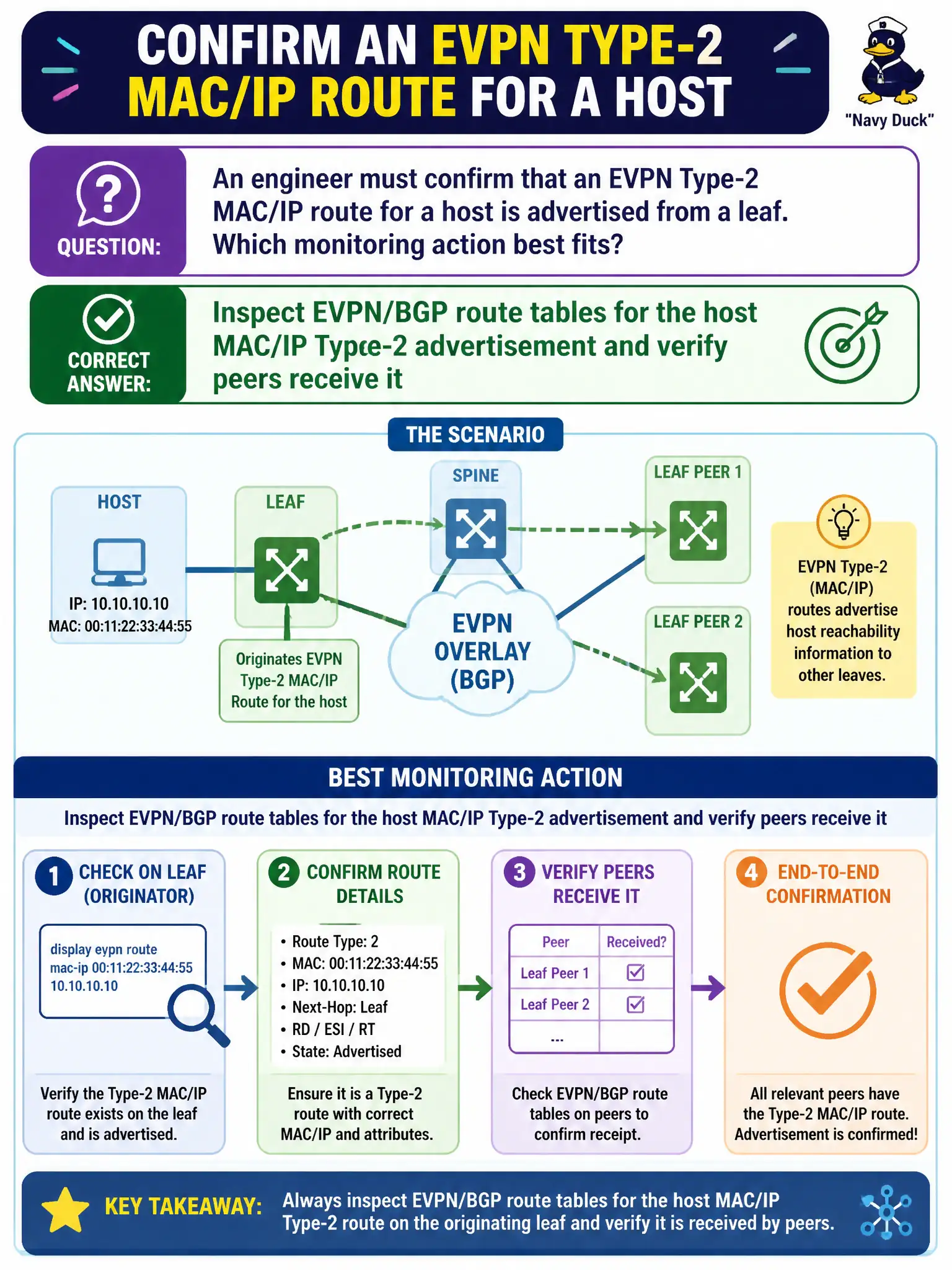
An engineer must confirm that an EVPN Type-2 MAC/IP route for a host is advertised from a leaf. Which monitoring action best fits?
Select an answer to reveal the explanation.
Short Explanation
Want proof the host's Type-2 left the building? Look in the EVPN/BGP tables and see if peers got it — do not just ping a spine and hope. Clearing VLANs or killing the VTEP is chaos, not verification.
Full Explanation
To confirm an EVPN Type-2 MAC/IP route for a host is advertised from a leaf, inspect EVPN/BGP route tables for that MAC/IP Type-2 and verify peers or route reflectors receive it. That monitoring action directly validates overlay host advertisement on the municipal fabric. Pinging only the underlay spine loopback proves underlay reachability, not overlay MAC advertising. Clearing all VLAN memberships to regenerate Type-2 without show commands is reckless and non-diagnostic. Disabling the VTEP source interface to force a fabric-wide MAC flush is disruptive and not a confirmation method. Exam caveat: a Type-2 may be advertised locally but not imported remotely due to RT mismatch—always check both source advertisement and receiver installation. Operational check: on the owning city leaf, show EVPN Type-2 for the host; on the RR and a remote leaf, confirm the NLRI with correct next hop and RT; correlate with successful overlay unicast to that MAC. Automate a check that remote leaves install the same Type-2 the source advertises before closing host-mobility tickets. Automate a check that remote leaves install the same Type-2 the source advertises before closing host-mobility tickets. Automate a check that remote leaves install the same Type-2 the source advertises before closing host-mobility tickets.