
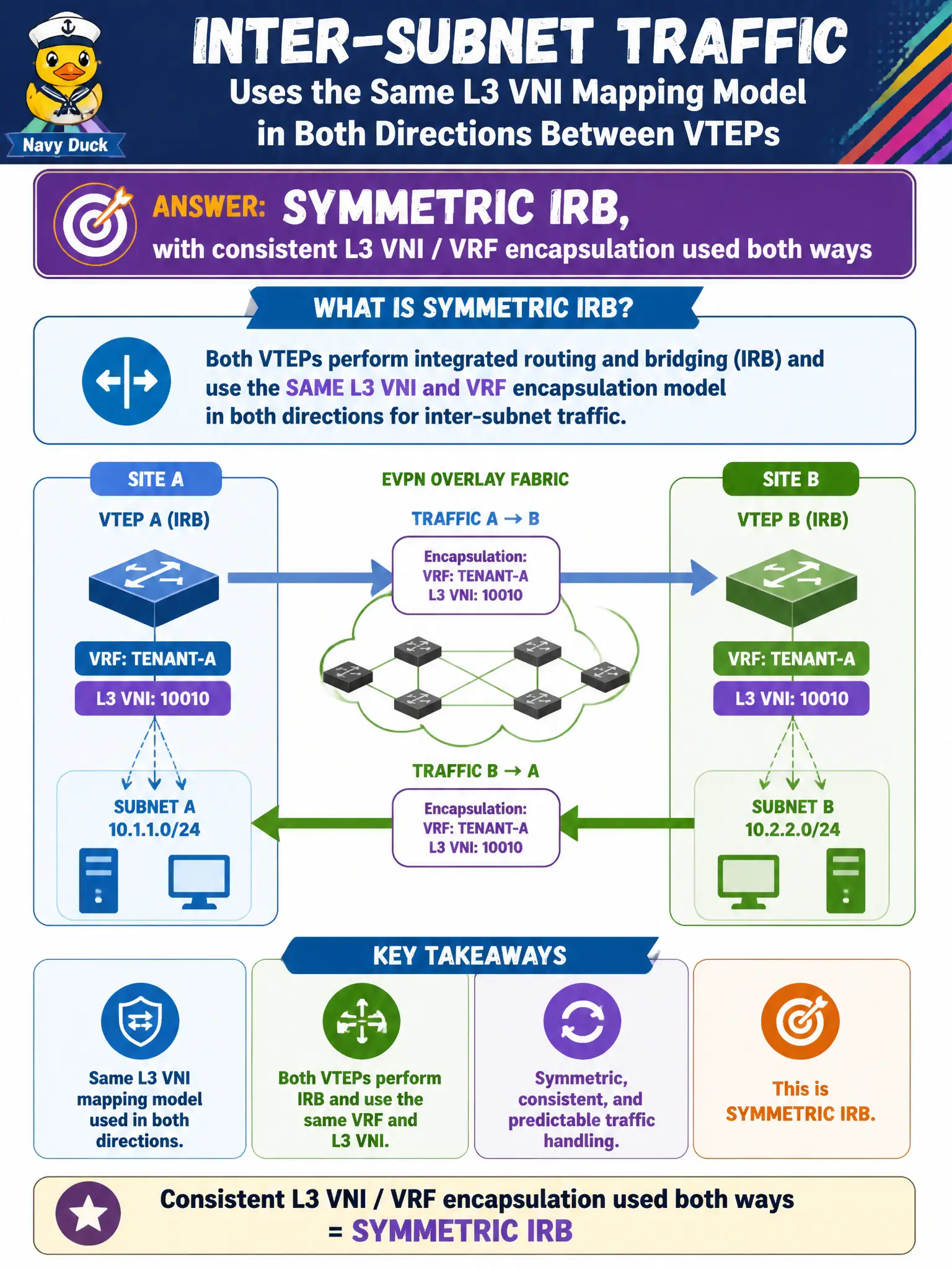
Inter-subnet traffic uses the same L3 VNI mapping model in both directions between VTEPs. Which routing model is that?
Select an answer to reveal the explanation.
Short Explanation
Symmetric means both doors use the same keying — L3 VNI/VRF encapsulation matches each way. Asymmetric is the mix-and-match model where ingress routes and egress may just bridge. Same map both directions = symmetric IRB.
Full Explanation
Symmetric IRB uses a consistent L3 VNI / VRF encapsulation model in both directions between VTEPs for inter-subnet traffic. Ingress and egress both route in the VRF context using the shared L3 VNI mapping, which keeps policy and forwarding expectations aligned across the municipal fabric. That is distinct from asymmetric IRB, where typically only the ingress routes toward a remote MAC while the egress bridges on the L2 VNI. Symmetric IRB is not CRB-only forwarding that forbids L3 VNIs. It is not underlay multicast replication without EVPN host routes. Exam caveat: symmetric mode requires both sides to agree on L3 VNI/VRF mapping—mismatch produces asymmetric behavior or broken return paths even when Type-2s exist. Operational check: traceroute or capture inter-subnet east-west traffic and confirm both directions use the expected L3 VNI; compare VRF policies on both leaves; validate Type-2 MAC/IP presence supporting the IRB model. Lock L3 VNI maps in the source-of-truth so symmetric IRB cannot drift between leaves during emergency changes. Lock L3 VNI maps in the source-of-truth so symmetric IRB cannot drift between leaves during emergency changes. Lock L3 VNI maps in the source-of-truth so symmetric IRB cannot drift between leaves during emergency changes.