
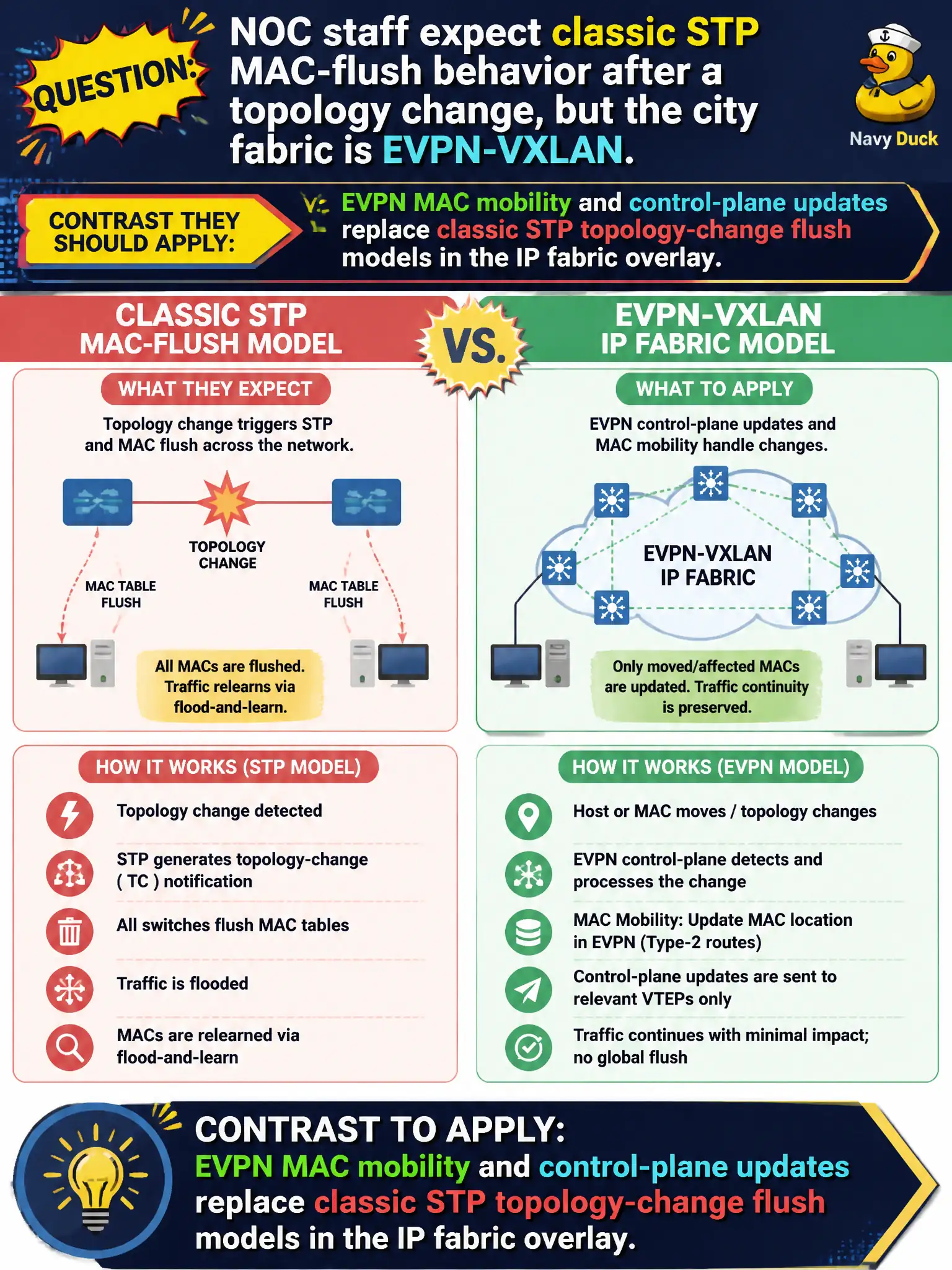
NOC staff expect classic STP MAC-flush behavior after a topology change, but the city fabric is EVPN-VXLAN. What contrast should they apply?
Select an answer to reveal the explanation.
Short Explanation
Old campus thinking waits for STP to yell 'flush!' — EVPN fabrics update MACs with mobility and BGP instead. You do not need PVST TCN theater across the underlay for overlay moves.
Full Explanation
In EVPN-VXLAN IP fabrics, MAC mobility and control-plane Type-2 updates replace classic STP topology-change notification and MAC-flush models for overlay host reachability. NOC staff expecting PVST-style flush across the city fabric need that contrast. Every leaf must not run PVST and flood TCNs across the VXLAN underlay for EVPN correctness. MAC tables do not freeze forever once EVPN is enabled; moves are handled dynamically. STP flush is not mandatory on all VTEP loopbacks before Type-2 can advertise. Exam caveat: Layer 2 access domains south of the leaf may still run variants of STP locally—do not confuse access STP with fabric-wide EVPN MAC distribution. Operational check: move a host between access ports or leaves, confirm EVPN mobility updates without fabric TCN floods, and ensure operators use EVPN show commands rather than STP flush playbooks for overlay MAC issues. Retire STP flush steps from EVPN overlay runbooks while retaining any access-layer STP procedures that still apply south of the leaf. Retire STP flush steps from EVPN overlay runbooks while retaining any access-layer STP procedures that still apply south of the leaf. Retire STP flush steps from EVPN overlay runbooks while retaining any access-layer STP procedures that still apply south of the leaf.