
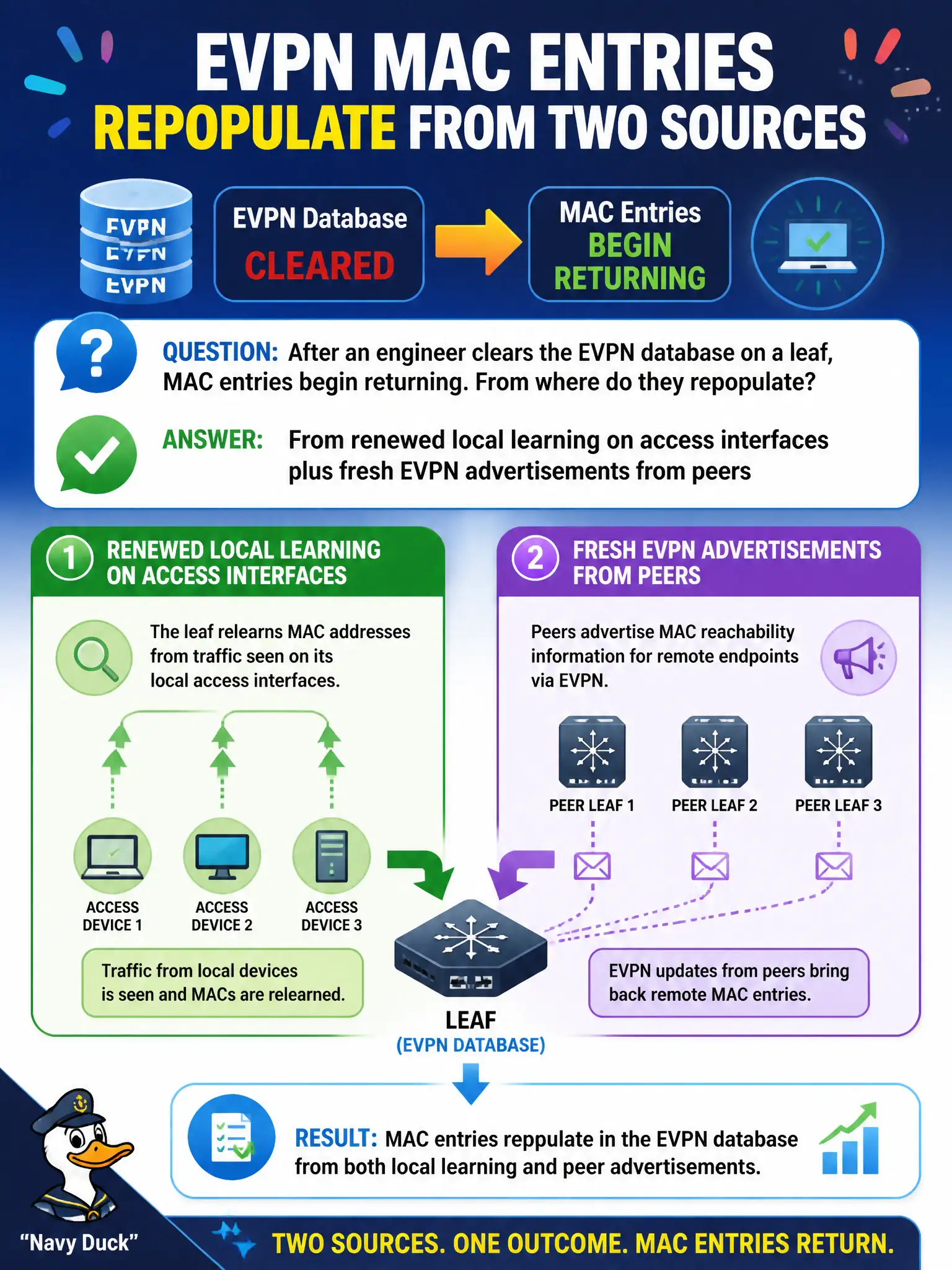
After an engineer clears the EVPN database on a leaf, MAC entries begin returning. From where do they repopulate?
Select an answer to reveal the explanation.
Short Explanation
Wipe the EVPN notebook and it fills back in two ways: hosts talk locally again, and peers re-advertise their Type-2s. The underlay IGP and DHCP option 82 are not your MAC teachers here.
Full Explanation
After clearing the EVPN database on a leaf, MAC entries repopulate from renewed local learning on access interfaces and from fresh EVPN advertisements from peers as BGP EVPN resynchronizes. That dual source is expected on a municipal VTEP. Entries do not come only from the spine underlay IGP redistributing MAC addresses as host routes. They do not come only from DHCP option 82 bindings on the management VRF. They do not come from a one-time static dump file written at first boot solely. Exam caveat: if RT import is broken, only local MACs return after a clear while remote MACs stay missing—use that split symptom to separate learning-path issues from EVPN membership issues. Operational check: clear EVPN/MAC state on a lab leaf, bounce traffic from a local server, confirm local MAC returns, confirm remote Type-2s reinstall from RR/peers, and compare counts to pre-clear baselines. After database clears in lab, compare local-only versus remote-only recovery to classify RT problems versus learning problems quickly. After database clears in lab, compare local-only versus remote-only recovery to classify RT problems versus learning problems quickly. After database clears in lab, compare local-only versus remote-only recovery to classify RT problems versus learning problems quickly.