
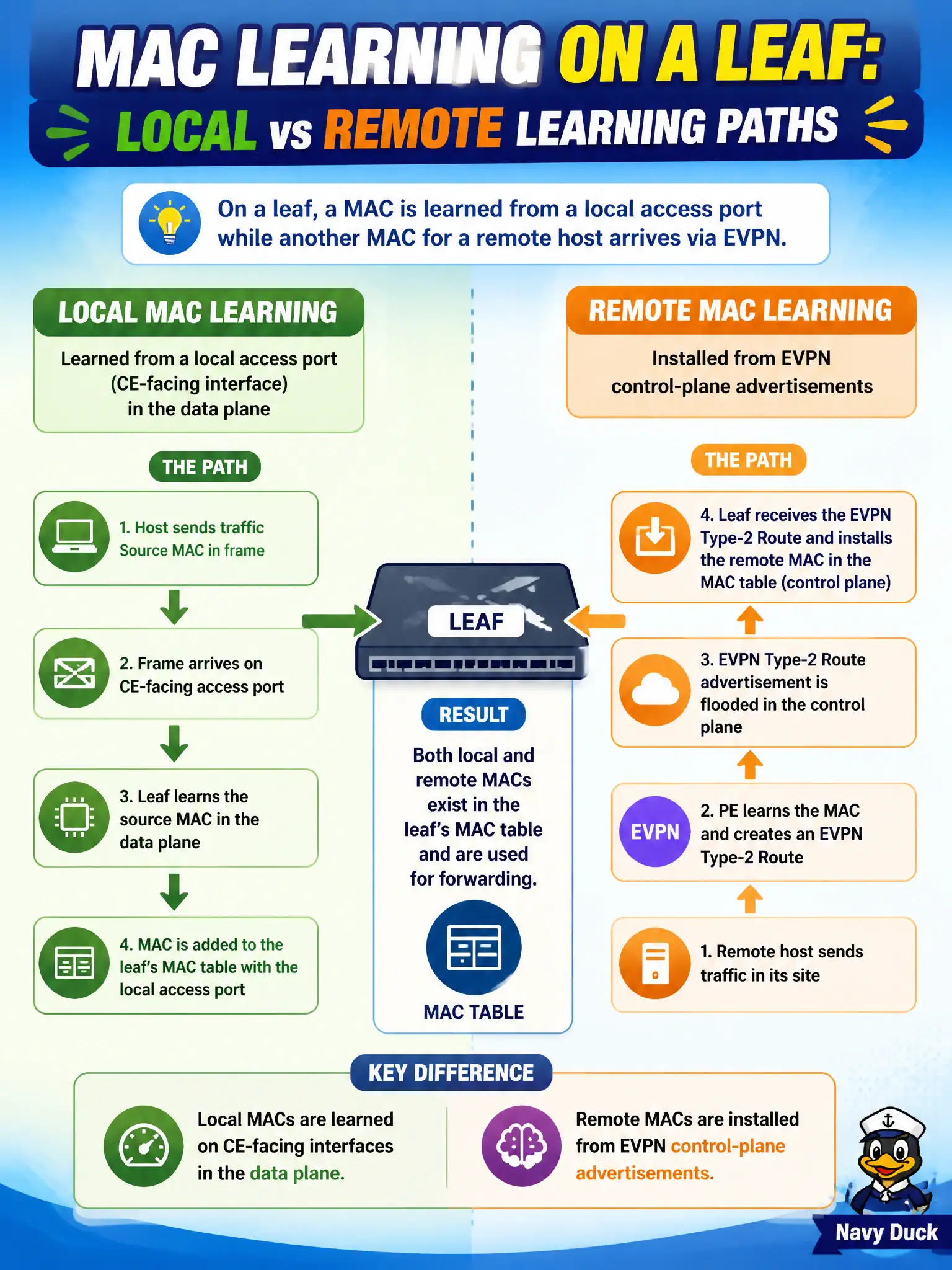
On a leaf, a MAC is learned from a local access port while another MAC for a remote host arrives via EVPN. How do those learning paths differ?
Select an answer to reveal the explanation.
Short Explanation
Local MACs walk in the front door on the access port; remote MACs arrive as EVPN mail (Type-2) from other VTEPs. One is data-plane local learn, the other is control-plane remote install — not underlay IPv4 unicast tricks.
Full Explanation
Local MACs are learned in the data plane on CE-facing access interfaces when the municipal leaf sees frames from attached hosts. Remote MACs are installed from EVPN control-plane Type-2 advertisements describing other VTEPs' hosts. Those learning paths differ by source even though both end up in the MAC table. Both are not learned only from underlay BGP unlabeled IPv4 unicast. Remote MACs are not limited to static configuration, and local MACs do not use Type-5 only. Local MACs are not learned via L3 VNI encapsulation as their primary learning path, and remote MACs do appear in the MAC table. Exam caveat: after mobility, a MAC that was remote can become local and vice versa—operators should check both the local interface binding and the EVPN route, not only one source. Operational check: on a city leaf, show a locally attached host MAC with an access interface next hop, show a remote host MAC with a VXLAN/EVPN next hop, clear one then the other, and watch which source repopulates each entry. Teach NOC staff to read local interface next hops versus EVPN next hops so they stop chasing underlay BGP for overlay MAC misses. Teach NOC staff to read local interface next hops versus EVPN next hops so they stop chasing underlay BGP for overlay MAC misses.