
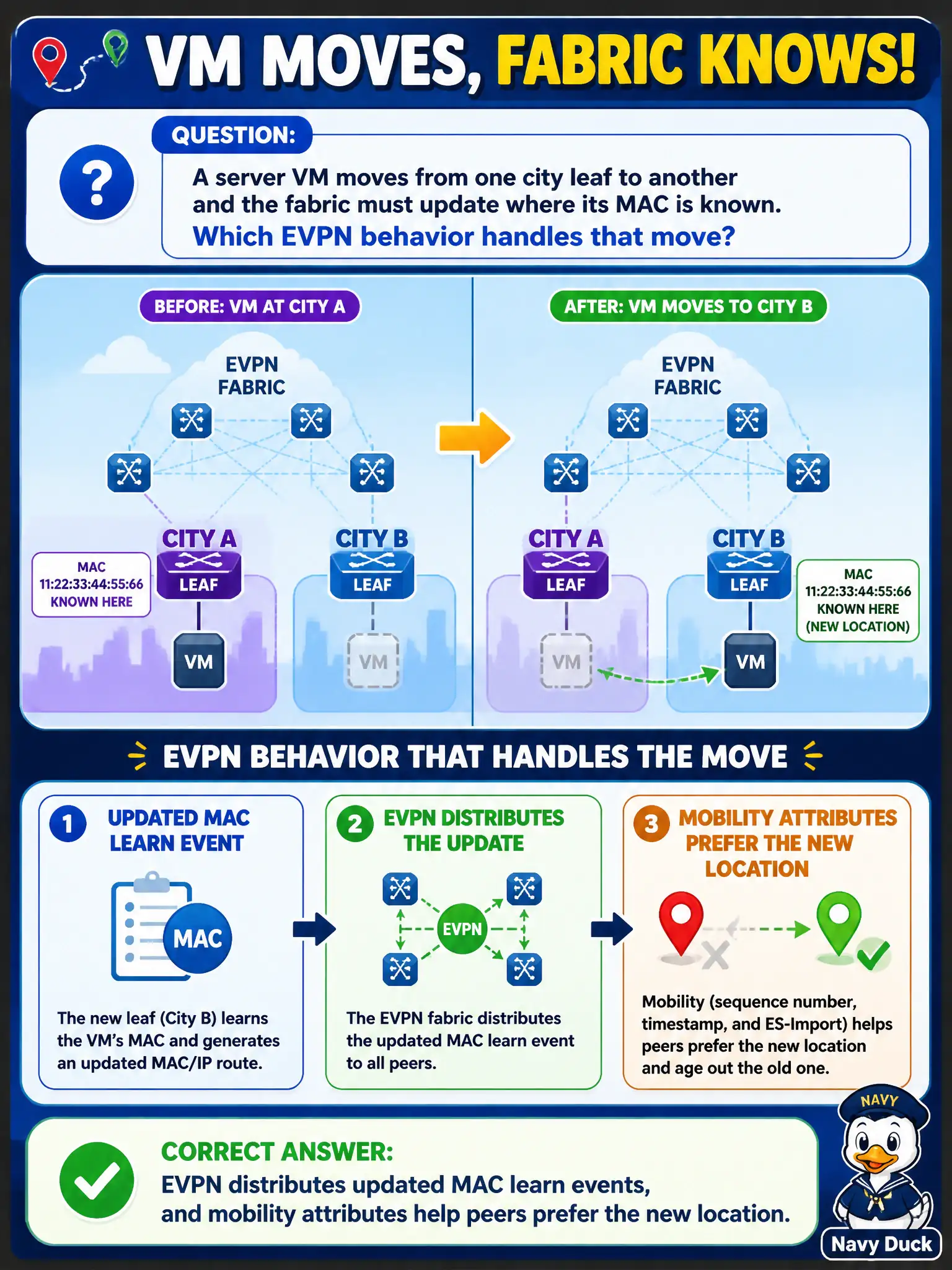
A server VM moves from one city leaf to another and the fabric must update where its MAC is known. Which EVPN behavior handles that move?
Select an answer to reveal the explanation.
Short Explanation
When a server moves apartments, EVPN mails a change-of-address Type-2 with mobility smarts so peers trust the new leaf. STP TCN floods or frozen static pins are the old-school wrong tools here.
Full Explanation
When a server VM moves from one city leaf to another, EVPN distributes updated MAC learn events through Type-2 advertisements, and mobility attributes help peers prefer the new location over stale advertisements from the old VTEP. That control-plane mobility behavior is what handles the move in an EVPN-VXLAN fabric. Spanning Tree Topology Change Notifications flooding the underlay IGP are not the EVPN model. Leaves must not statically pin the MAC to the old VTEP until reboot. Relying on VXLAN data-plane learning alone without BGP Type-2 updates is incomplete for standard EVPN fabrics that expect control-plane MAC distribution. Exam caveat: if the old leaf still sees the MAC because of duplicate attachment or a hairpin loop, mobility sequencing alone may flap—fix duplicates as well as moves. Operational check: live-migrate a municipal VM, watch Type-2 withdraw/update and mobility sequence on the new leaf, confirm remote MAC tables point to the new VTEP, and ping continuously across the move. Correlate hypervisor live-migration events with EVPN mobility counters during DR exercises for the citizen-services clusters. Correlate hypervisor live-migration events with EVPN mobility counters during DR exercises for the citizen-services clusters.