
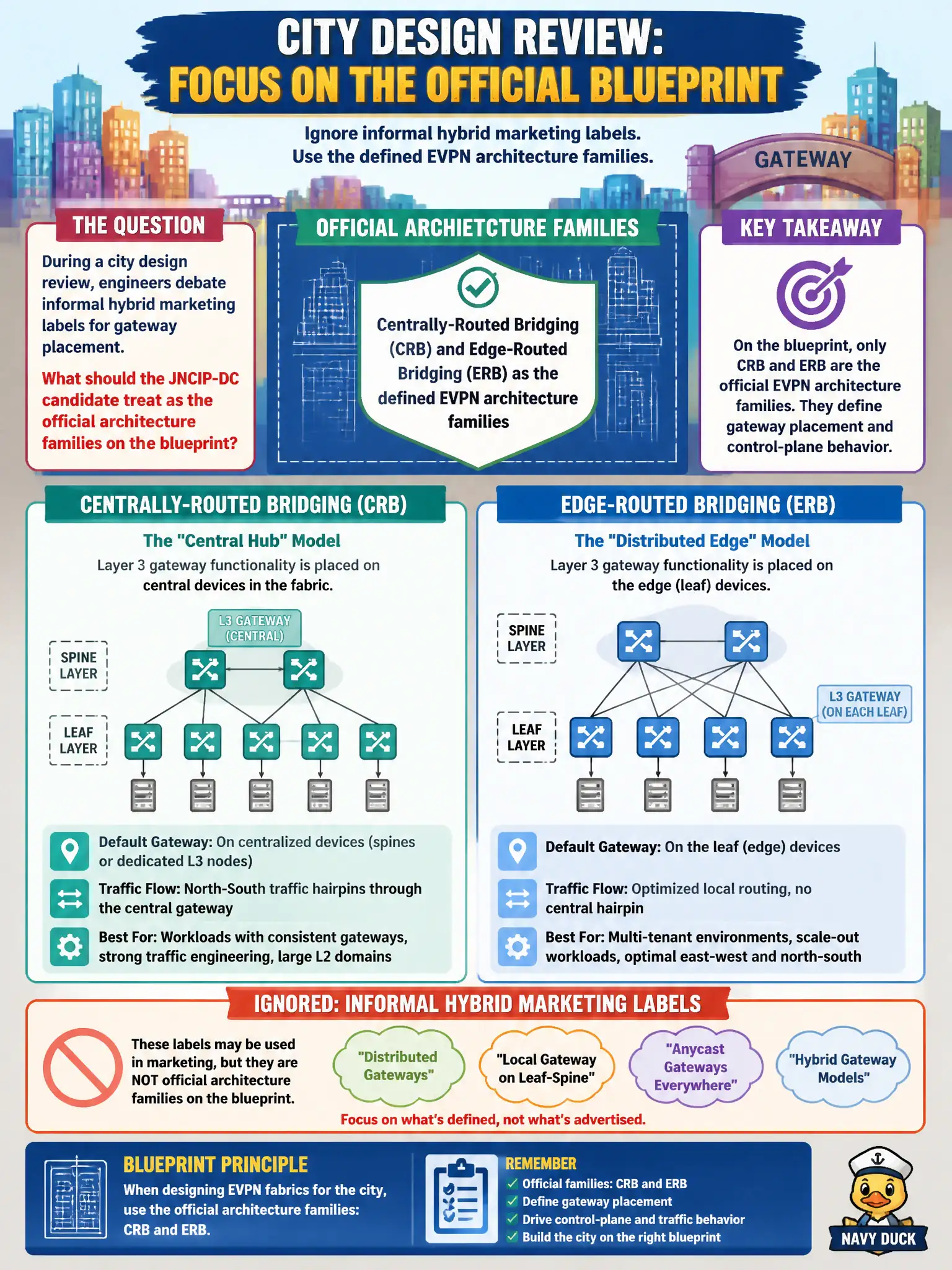
During a city design review, engineers debate informal hybrid marketing labels for gateway placement. What should the JNCIP-DC candidate treat as the official architecture families on the blueprint?
Select an answer to reveal the explanation.
Short Explanation
Stick to the official playbook names: CRB and ERB. Fancy hybrid nicknames from blogs are not the exam families. Keep Apstra day-2 and campus WLAN out of this DC EVPN architecture answer.
Full Explanation
For JN0-683 / JNCIP-DC blueprint purposes, the defined EVPN architecture families to treat as official are Centrally-Routed Bridging (CRB) and Edge-Routed Bridging (ERB). Informal hybrid marketing labels may appear in blogs, but candidates should anchor answers on CRB versus ERB gateway placement and the associated traffic/state tradeoffs. Vendor blog nicknames such as distributed CRB-lite are not exam canon. Apstra day-2 templates, while useful operationally, are not a substitute for knowing CRB/ERB objectives. Campus Mist WLAN architectures are out of scope for data-center EVPN fabric architecture questions. Exam caveat: real city designs can be hybrid (some tenants CRB, some ERB), but you must still describe each tenant in CRB/ERB terms rather than inventing a third official family name. Operational check: in a design review, label each municipal tenant as CRB or ERB based on where IRBs live, reject undefined marketing labels in the runbook, and verify forwarding behavior matches the labeled architecture. Ban undefined marketing architecture names from change tickets; map every design choice back to CRB or ERB for exam and ops clarity. Ban undefined marketing architecture names from change tickets; map every design choice back to CRB or ERB for exam and ops clarity.