
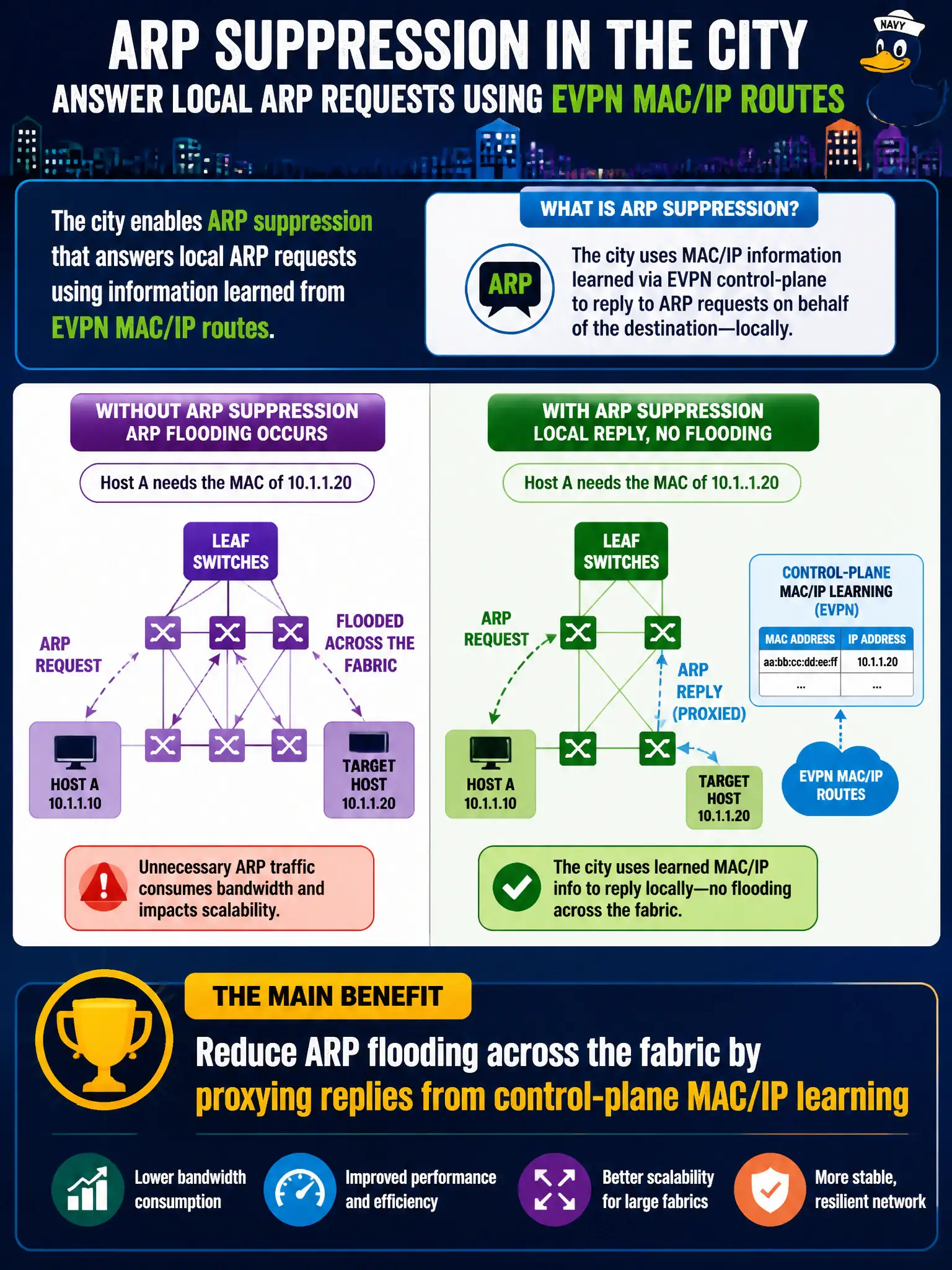
The city enables ARP suppression that answers local ARP requests using information learned from EVPN MAC/IP routes. What is the main benefit?
Select an answer to reveal the explanation.
Short Explanation
ARP suppression is like the receptionist who already knows everyone's desk from the directory — no need to shout down every hallway. EVPN MAC/IP learning feeds those proxy replies and cuts ARP floods. Turning EVPN off or killing Type-2 works against that.
Full Explanation
ARP suppression answers local ARP requests using host IP bindings learned from EVPN MAC/IP Type-2 routes instead of flooding every ARP through the municipal VNI. The main benefit is reducing ARP flooding across the fabric while still returning correct gateway or host mappings when the EVPN database has the binding. Suppression does not replace the need for Type-2 MAC/IP learning; it consumes that information. It is not an underlay IGP feature, and it does not require disabling EVPN. Claiming suppression means ARP is never needed anywhere overstates the feature—missed bindings still flood or fail per platform behavior. Exam caveat: suppression depends on MAC+IP Type-2 completeness; MAC-only Type-2s or asymmetric gaps can leave holes that look like EVPN is broken when only suppression is misaligned. Operational check: clear ARP on a city host, capture whether the leaf answers from EVPN-derived bindings without fabric-wide ARP flood, remove the remote Type-2 binding in a lab, and observe fallback flooding or unresolved ARP to validate the dependency. Validate ARP suppression after every Type-2 policy change; suppression quality tracks MAC/IP completeness on the municipal leaves. Validate ARP suppression after every Type-2 policy change; suppression quality tracks MAC/IP completeness on the municipal leaves.