
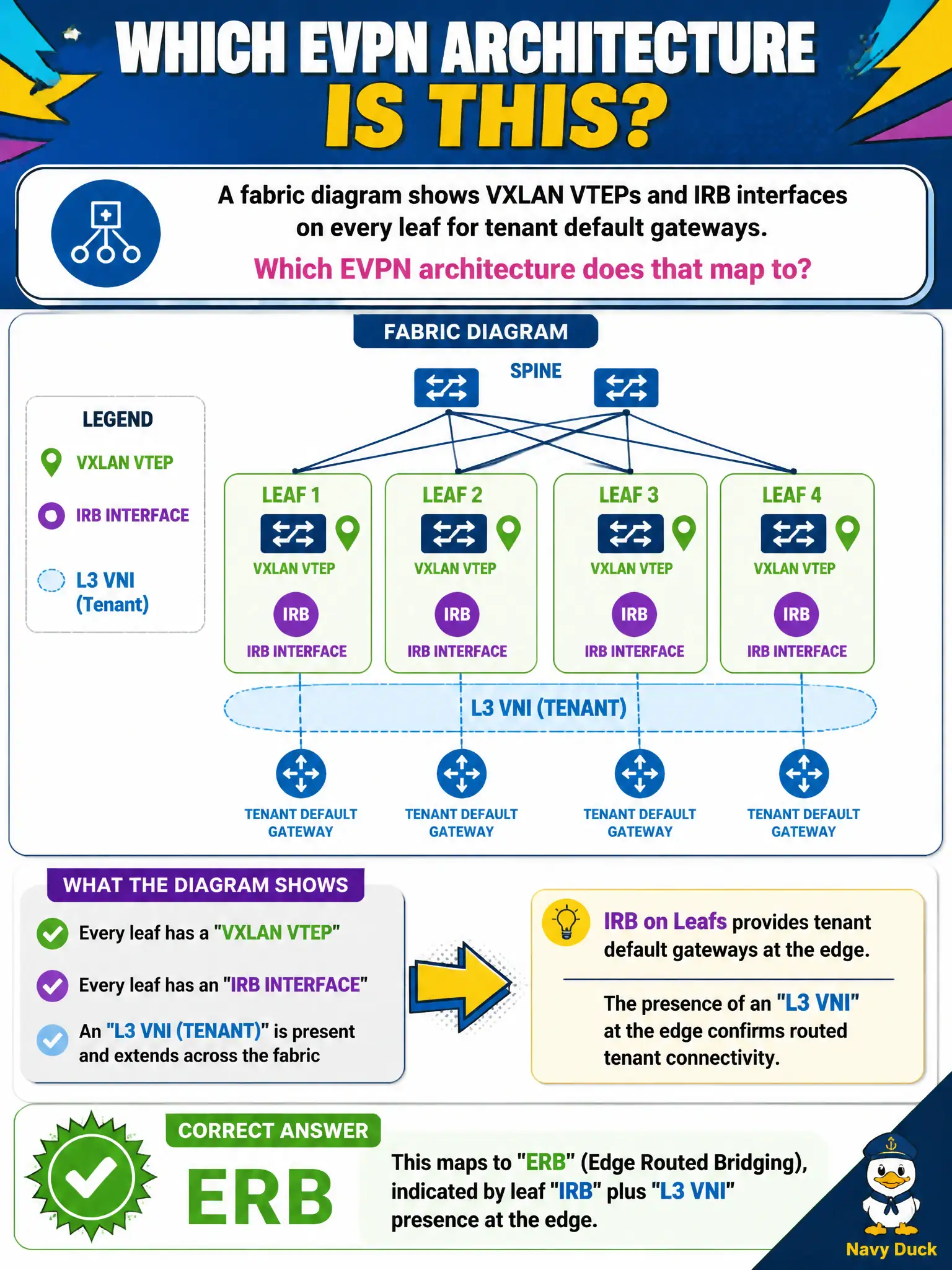
A fabric diagram shows VXLAN VTEPs and IRB interfaces on every leaf for tenant default gateways. Which EVPN architecture does that map to?
Select an answer to reveal the explanation.
Short Explanation
IRB on every leaf is the ERB tell — gateways live at the edge next to the servers. CRB would keep those IRBs up on the spines. STP roots or bridge-only fabrics are not that picture.
Full Explanation
When fabric diagrams show VXLAN VTEPs and IRB interfaces on every leaf for tenant default gateways, the architecture maps to ERB: leaf IRB plus L3 VNI presence at the edge. CRB would centralize those IRBs; spines still carry underlay routes in ERB diagrams, so claiming spines never carry underlay routes is not the ERB tell. Classic STP with per-VLAN root bridges on spines is not EVPN ERB. MAC-VRF bridging only with no inter-subnet routing anywhere would lack leaf IRBs for tenant defaults. Exam caveat: anycast gateway consistency (same IP/MAC virtual gateway on each leaf) is part of making ERB diagrams operationally true—drawing IRBs without anycast alignment causes asymmetric gateway behavior. Operational check: on each municipal leaf, confirm VTEP, tenant IRB, and L3 VNI configuration; compare gateway IP/MAC across leaves; ensure spines are underlay transit without those tenant IRBs if the standard is ERB. Diff leaf templates for VTEP, IRB, and L3 VNI blocks so ERB drawings match what is actually rendered on city devices. Diff leaf templates for VTEP, IRB, and L3 VNI blocks so ERB drawings match what is actually rendered on city devices. Diff leaf templates for VTEP, IRB, and L3 VNI blocks so ERB drawings match what is actually rendered on city devices.