
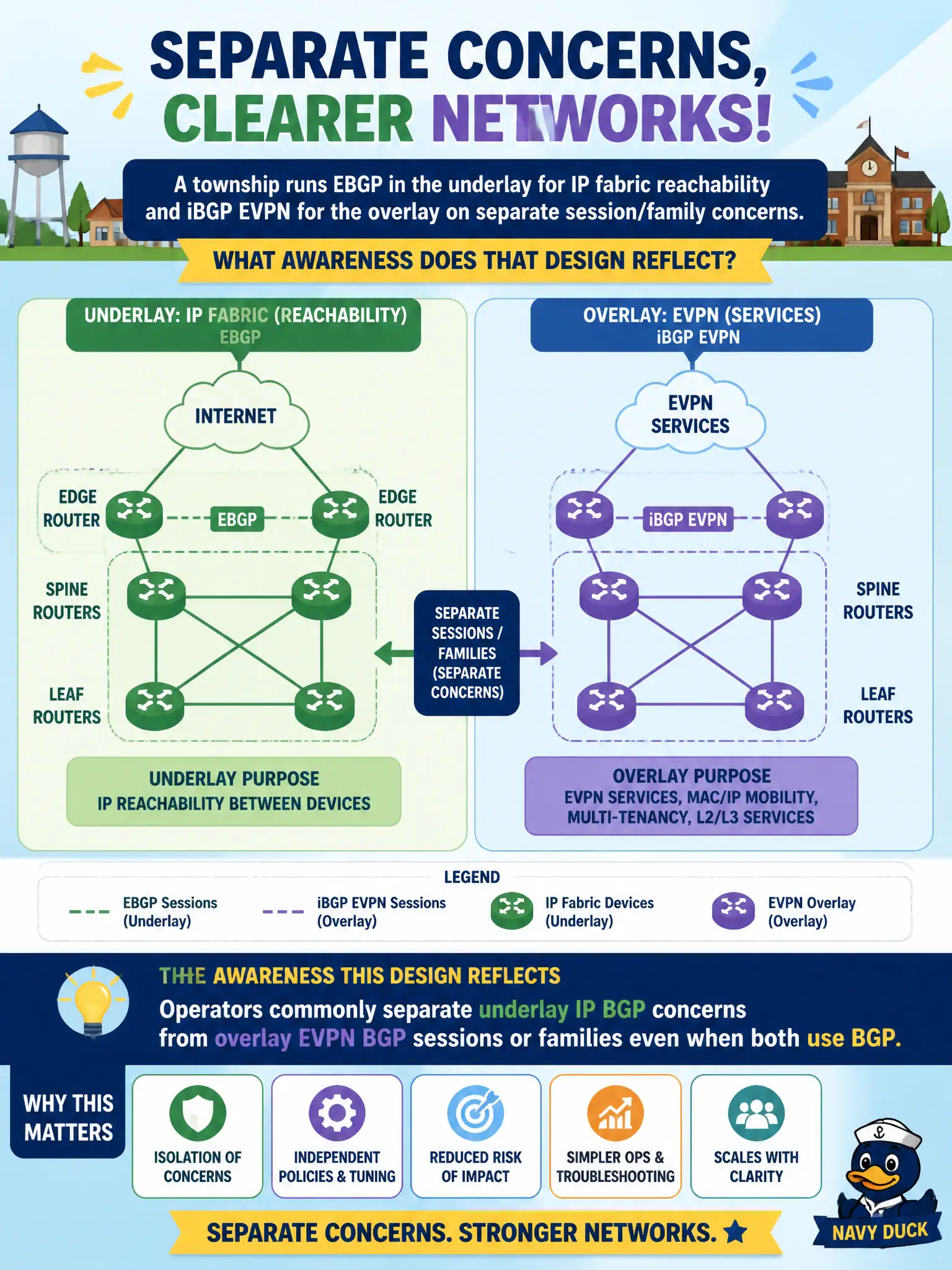
A township runs EBGP in the underlay for IP fabric reachability and iBGP EVPN for the overlay on separate session/family concerns. What awareness does that design reflect?
Select an answer to reveal the explanation.
Short Explanation
Think two conversations: underlay EBGP gets packets between loopbacks; overlay EVPN iBGP swaps MAC/IMET/prefix intel. Separating ASN/session/family concerns is normal fabric hygiene. It does not outlaw iBGP EVPN or strip VXLAN encapsulation.
Full Explanation
Many township fabrics run EBGP or underlay BGP for IP Clos reachability while carrying EVPN overlay routes in iBGP or distinct sessions/families. That separation of concerns—underlay IP BGP versus overlay EVPN BGP—is intentional operational awareness, even though both use BGP as a protocol. Underlay and overlay need not share one ASN and one address family only. Overlay EVPN can use iBGP even when the underlay also uses BGP. iBGP EVPN does not disable VXLAN UDP encapsulation. Exam caveat: separate concerns can mean separate ASNs, separate sessions, or separate families on shared sessions—read the design; the exam idea is not that one BGP switch toggles both planes identically. Operational check: document which process/session carries underlay loopbacks versus EVPN NLRIs on a city leaf, verify a failure in underlay routing blackholes VXLAN outer headers while EVPN tables still look full (or the reverse), and remediate the correct plane. Label underlay versus overlay BGP in runbooks with different owners when WAN and DC teams share the municipal ASN landscape. Label underlay versus overlay BGP in runbooks with different owners when WAN and DC teams share the municipal ASN landscape. Label underlay versus overlay BGP in runbooks with different owners when WAN and DC teams share the municipal ASN landscape.