
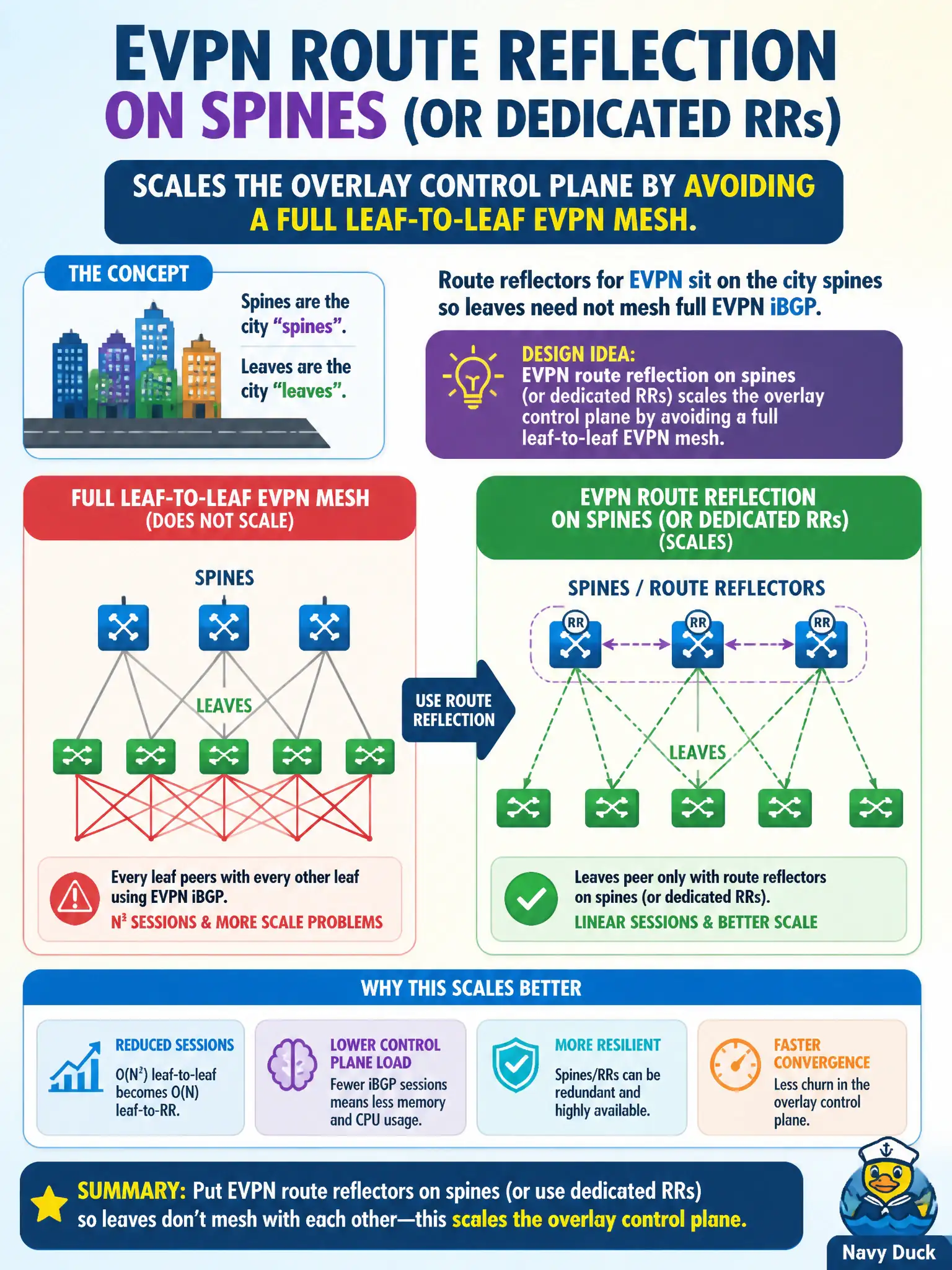
Route reflectors for EVPN sit on the city spines so leaves need not mesh full EVPN iBGP. What design idea does that apply?
Select an answer to reveal the explanation.
Short Explanation
Put EVPN route reflectors on the spines (or dedicated boxes) and leaves peer upward instead of building a hairball mesh. That scales the overlay control plane. Reflection does not delete VTEPs or turn into an STP BPDU sprinkler.
Full Explanation
EVPN route reflection on spines or dedicated route reflectors lets municipal leaves peer with RRs instead of forming a full leaf-to-leaf EVPN iBGP mesh. That scales the overlay control plane as leaf count grows while preserving EVPN NLRI distribution. Spines absolutely may reflect EVPN in common IP-fabric designs; it is false that only leaves may run MP-BGP. Route reflection does not replace VTEPs or remove VXLAN encapsulation. EVPN RRs are not a tool for flooding STP BPDUs across the underlay. Exam caveat: RR design must still honor add-path or multipath needs when multiple equal Type-2 paths should remain visible, and RT/RD design remains the operator's responsibility. Operational check: confirm leaves have EVPN sessions only to RRs/spines, withdraw a Type-2 on one leaf, verify others learn it via reflection, and stress that no full mesh sessions exist among leaves. Size RR CPU and policy for peak Type-2 churn during leaf reloads in large civic fabrics, not only for steady-state MAC counts. Size RR CPU and policy for peak Type-2 churn during leaf reloads in large civic fabrics, not only for steady-state MAC counts. Size RR CPU and policy for peak Type-2 churn during leaf reloads in large civic fabrics, not only for steady-state MAC counts.