
A leaf shows established IPv4 unicast BGP to the spines but installs no EVPN routes for municipal tenants. What should operators check first in MBGP terms?
Select an answer to reveal the explanation.
Short Explanation
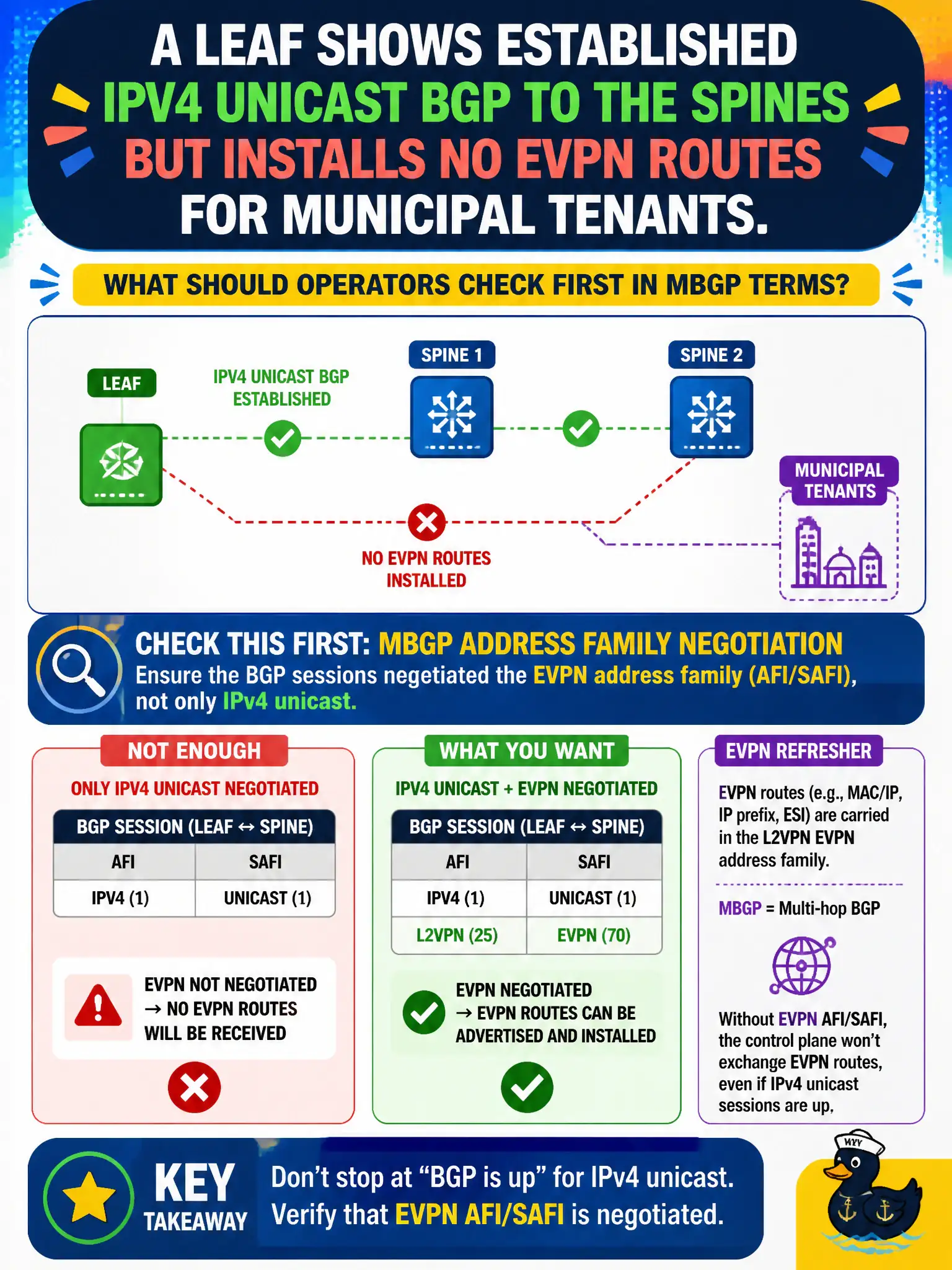
IPv4 unicast UP is necessary underlay chatter, but EVPN is a different address family. If that family never negotiated, tenant routes stay invisible—like having a phone dial tone but no line to the overlay office. Check EVPN AFI/SAFI before blaming RIP or LLDP folklore.
Full Explanation
A leaf can have healthy IPv4 unicast BGP to the spines yet install zero EVPN routes if the sessions never negotiated the EVPN address family. Operators should first verify MP-BGP EVPN AFI/SAFI capability and family configuration, not underlay adjacency alone. RIP v1 redistributing Type-3 into the underlay is not a plausible municipal EVPN fix path. Converting Type-2 into OSPF external Type-5 is not how overlay MAC routes install. Clearing LLDP chassis IDs does not force EVPN convergence of missing families. Exam caveat: family might be configured locally but mismatched or disabled on the RR/spine side—check both ends and route-reflector client settings. Operational check: show BGP neighbor detail for EVPN family state, enable EVPN on both peers if missing, confirm NLRIs increment, and only then debug RT import; pinging underlay loopbacks alone is not proof of overlay EVPN. Distinguish Established IPv4 unicast from Established EVPN in monitoring—green underlay sessions are not green overlay sessions. Distinguish Established IPv4 unicast from Established EVPN in monitoring—green underlay sessions are not green overlay sessions. Distinguish Established IPv4 unicast from Established EVPN in monitoring—green underlay sessions are not green overlay sessions.