
A township enables IGMP snooping on EVPN-VXLAN tenant bridges. How should that state relate to EVPN multicast signaling?
Select an answer to reveal the explanation.
Short Explanation
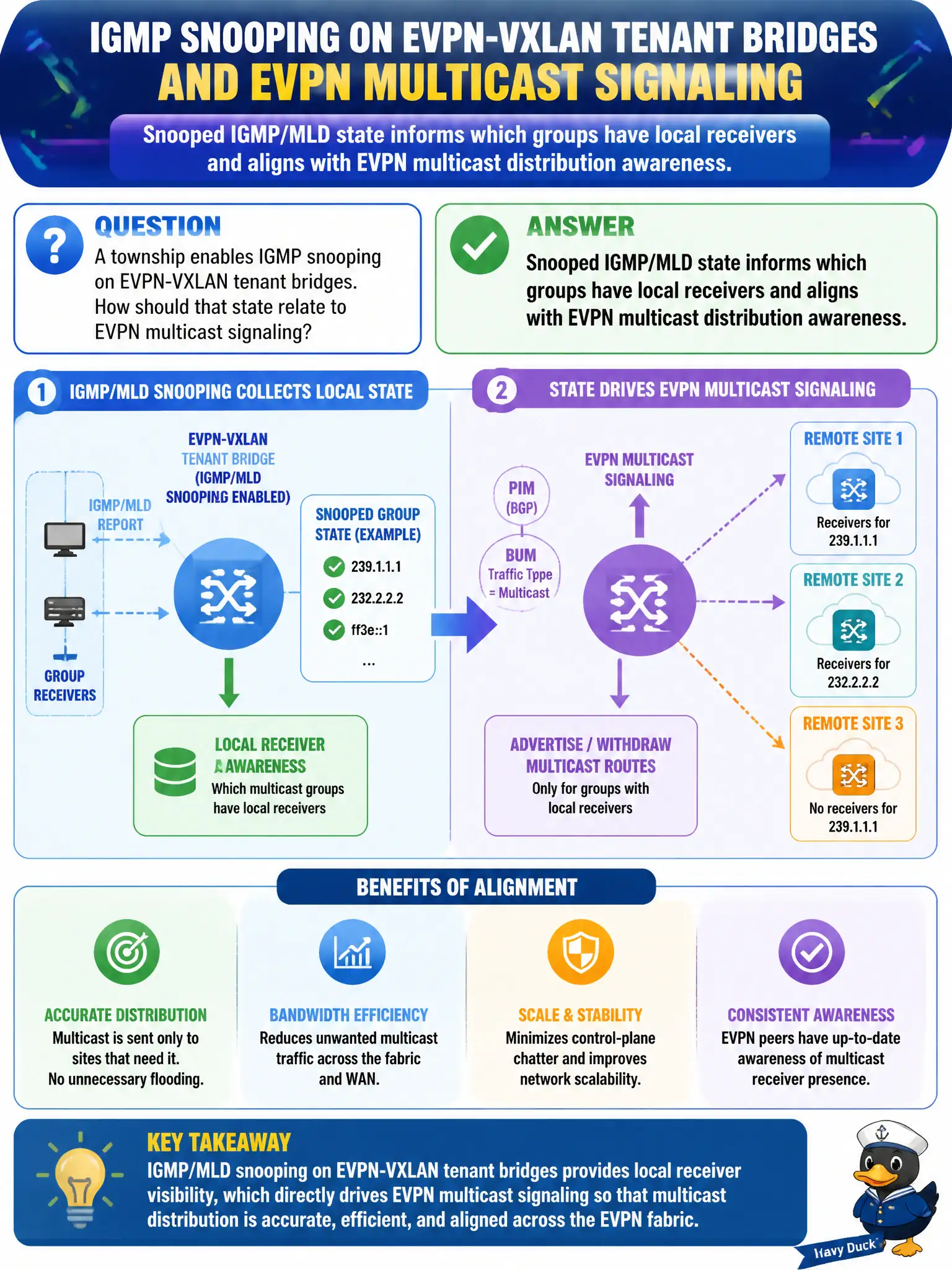
IGMP snooping is the local ear at the leaf—who on this switch asked for the group—while EVPN carries that interest across the fabric. They team up; snooping does not fire EVPN or live only in OSPF. And it should not blow DF rules for multihoming.
Full Explanation
IGMP/MLD snooping on EVPN-VXLAN tenant bridges learns which access ports have receivers for which groups. That local state should align with EVPN multicast distribution awareness so the overlay does not treat every VTEP as interested when the township fabric can be more precise. Snooping informs EVPN; it does not replace EVPN. Type-3 IMET and selective/SMET mechanisms remain relevant for inter-VTEP signaling. IGMP snooping is an overlay bridge feature for tenant VNIs/VLANs, not an underlay OSPF-area control. Enabling snooping must not force multicast out every ESI without DF checks—multihoming DF rules still apply to BUM on a shared segment. Exam caveat: snooping without corresponding EVPN multicast features may only optimize locally while inclusive IMET still replicates to all VNI VTEPs; understand local versus fabric-wide effects on the city design. Operational check: join a multicast group on one access port, verify snooping state on the leaf, confirm EVPN interest/membership updates as designed, fail the DF on a multihomed ESI, and ensure only the new DF injects BUM to the segment. Align snooping timers and EVPN interest advertisements so township receiver moves do not leave stale OILs on remote VTEPs.