
The NOC asks whether classic underlay PIM is mandatory whenever EVPN multicast features are used in the city fabric. What is the accurate contrast?
Select an answer to reveal the explanation.
Short Explanation
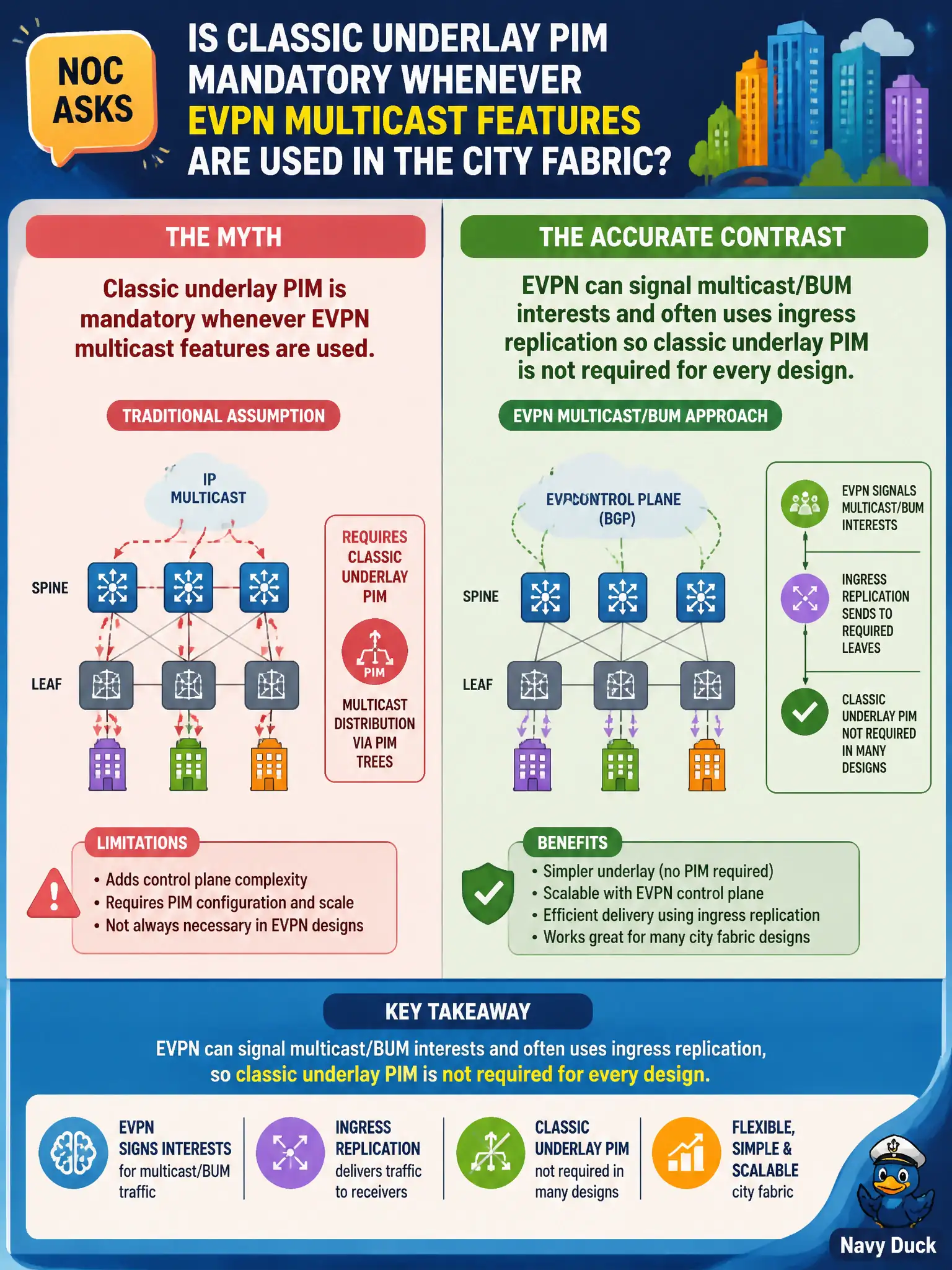
Lots of city fabrics ship BUM with ingress replication and EVPN membership—no underlay PIM choir required. PIM-assisted underlay trees are a design choice, not a universal law. And PIM never takes over Type-2/Type-5's day jobs.
Full Explanation
EVPN can signal multicast and BUM interests in the overlay and very often distributes BUM with ingress replication over the IP fabric. In that common municipal pattern, classic underlay PIM is not mandatory for every EVPN-VXLAN design. Underlay multicast trees are an optional optimization with their own operational cost, not a universal prerequisite. It is false that every EVPN-VXLAN design must run underlay PIM or BUM cannot function. MSDP on every leaf is not a prerequisite for EVPN multicast signaling. Underlay PIM does not replace Type-2 or Type-5 for tenant unicast traffic. Exam caveat: if the design explicitly chooses underlay multicast for BUM efficiency, then PIM and related underlay multicast plumbing become required for that mode—but that is a design choice, not an EVPN tax on all city fabrics. Operational check: document whether the fabric uses ingress replication or underlay multicast; if ingress replication, confirm BUM works with no PIM neighbors on leaves; if underlay multicast, verify PIM adjacencies and that EVPN still provides membership/host context rather than being replaced by PIM. Record the chosen BUM transport in the municipal fabric standard so on-call engineers do not enable PIM mid-incident without a design.