
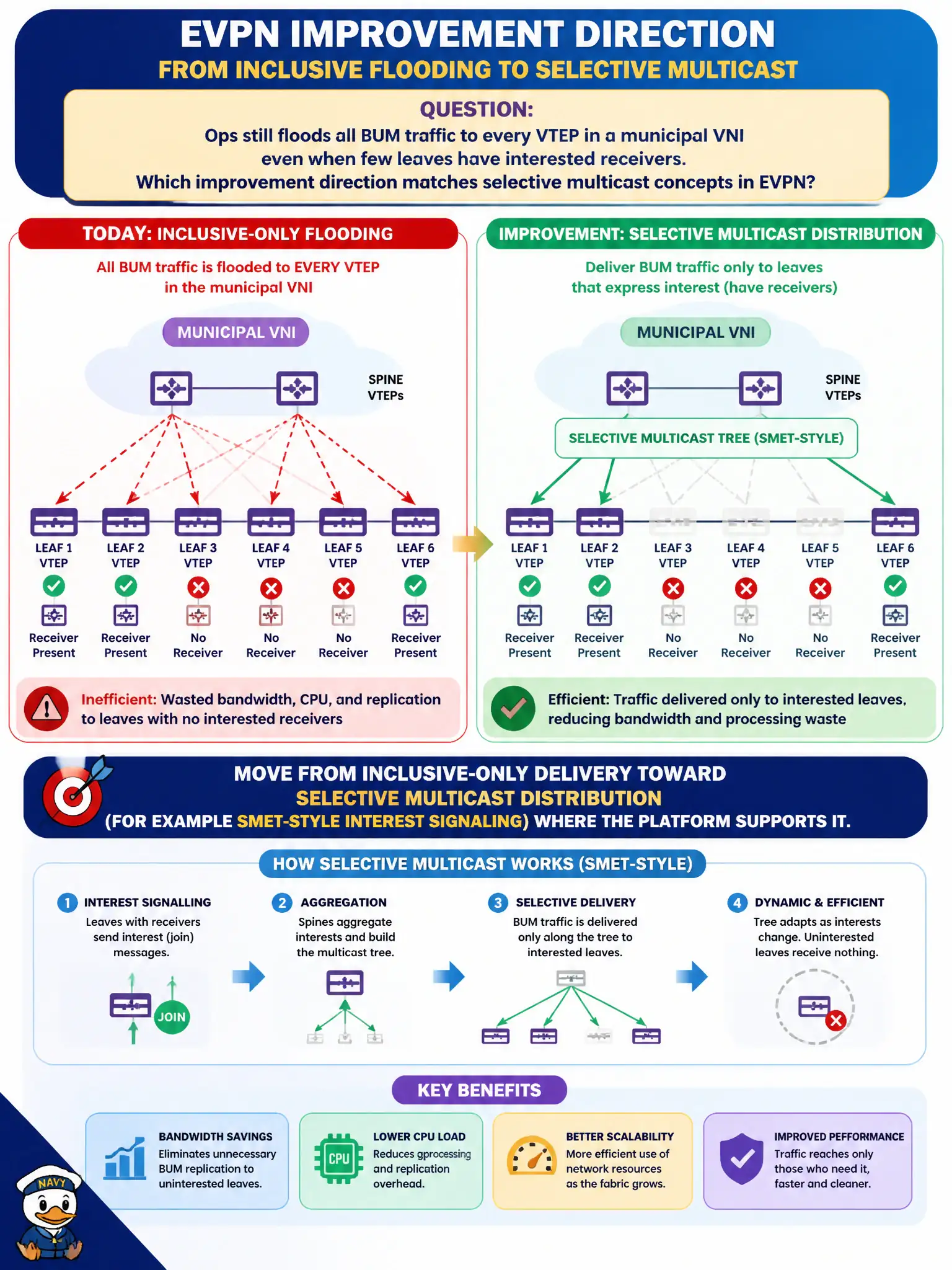
Ops still floods all BUM traffic to every VTEP in a municipal VNI even when few leaves have interested receivers. Which improvement direction matches selective multicast concepts in EVPN?
Select an answer to reveal the explanation.
Short Explanation
If every VTEP still gets the whole BUM hose, the fabric is stuck on inclusive mode. Selective multicast (SMET-style) lets interested leaves raise their hands so quiet leaves stay dry. More Type-5 or killing IMET/IGMP does not magically shrink the flood set.
Full Explanation
Inclusive-only BUM delivery sends copies to every VTEP that advertised IMET for the VNI, which is simple but wasteful when few municipal leaves have interested receivers. Selective multicast distribution—SMET-style or equivalent interest signaling where the Juniper platform supports it—narrows fan-out toward leaves that actually need the groups. That is the improvement direction when ops still floods all BUM to every VNI member. Advertising more Type-5 prefixes does not turn BUM into unicast; Type-5 is prefix routing. Removing Type-3 and relying on unknown-unicast storms for IPTV makes distribution worse and less controlled. Disabling IGMP snooping so every port looks interested forever maximizes flooding rather than selectivity. Exam caveat: selective modes still depend on correct snooping and EVPN interest advertisement; mis-snooping can blackhole multicast even when unicast EVPN looks healthy. Operational check: compare replication lists before and after enabling selective multicast features, generate group traffic with receivers on only two city leaves, and confirm non-interested VTEPs drop out of the fan-out while IMET/SMET state matches the receiver locations. City IPTV and public-alert multicast designs should treat selective fan-out as a capacity and containment control, not as an optional cosmetic knob.