
An engineer reads a blog about an obscure EVPN route type rarely seen in the city's Juniper EVPN-VXLAN fabric. For JNCIP-DC-level focus, which guidance is sound?
Select an answer to reveal the explanation.
Short Explanation
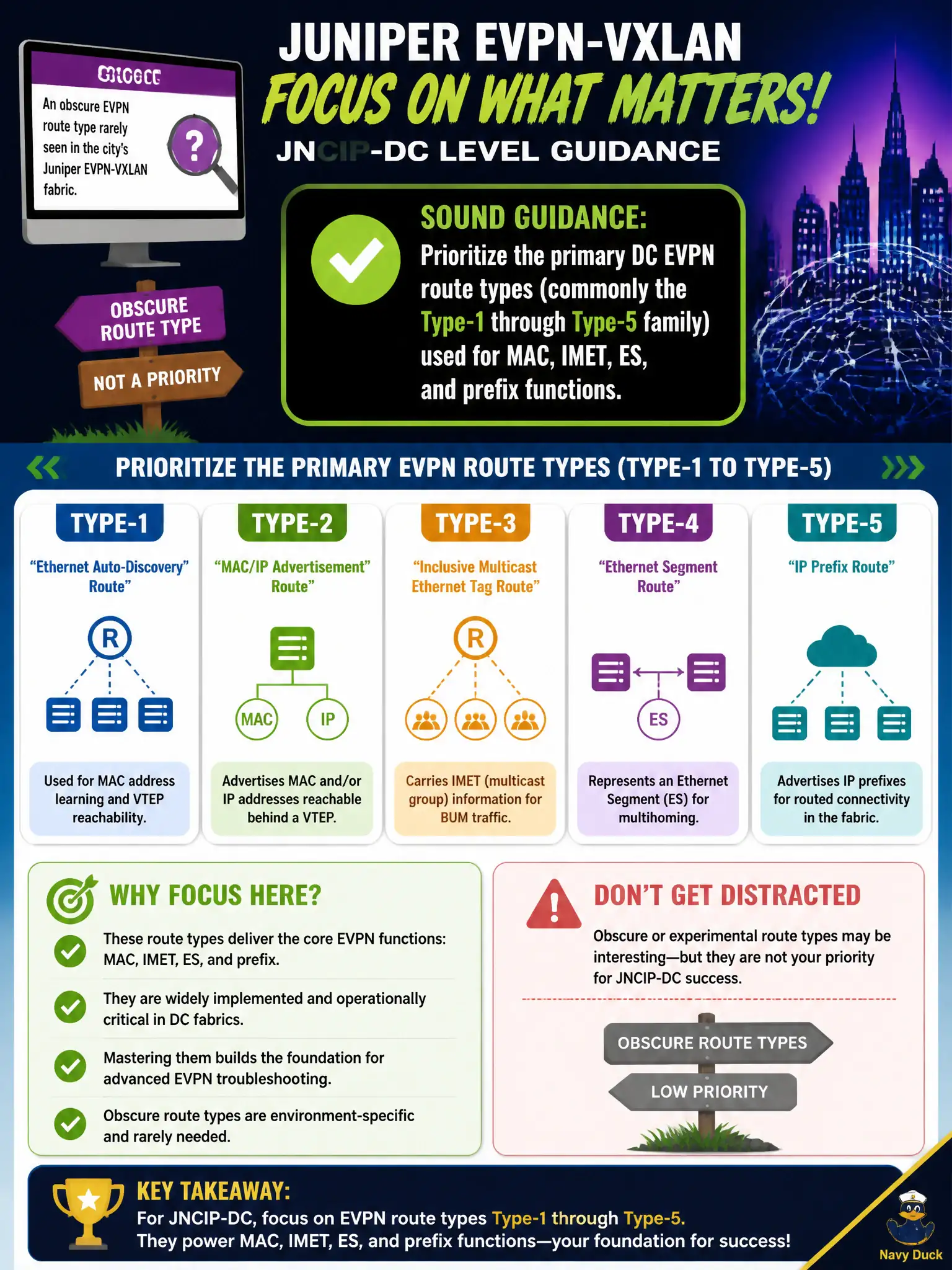
Stay on the main highway: Types 1–5 cover the ES, MAC, IMET, and prefix jobs the city fabric actually runs. Obscure blog trivia is a scenic dirt road—fine for curiosity, not the exam's core map. Do not throw out Type-2 for static flood lists.
Full Explanation
JNCIP-DC EVPN-VXLAN focus centers on the primary data-center route types that operators actually use for host MAC/IP reachability, IMET/BUM membership, Ethernet Segment multihoming, Auto-Discovery behaviors, and IP prefix routing—commonly discussed as the Type-1 through Type-5 family. Obscure or experimental NLRI codes rarely seen on a Juniper municipal fabric are poor exam ROI compared with mastering those workhorse types and how they interact with RT, RD, and IRB architectures. Memorizing every experimental code equally with Type-2 and Type-5 dilutes preparation without matching blueprint emphasis. Ignoring numbered route types and relying on static VXLAN flood lists abandons the EVPN control plane the certification tests. Treating Type-2 as obsolete in favor of proprietary underlay floods contradicts standard EVPN-VXLAN host learning. Exam caveat: vendors may document additional route types for specialized features; recognize them if shown, but default study time to Type-1 through Type-5 behaviors and municipal fabric troubleshooting patterns. Operational check: on a production-like city leaf, list EVPN routes by type, map each active type to a function (MAC, IMET, ES/A-D, prefix), and confirm you can explain a failure when that type is missing—before investing time in rare NLRIs from blogs.