
Public works asks why EVPN defines multiple route types instead of one catch-all NLRI for the municipal fabric. What is the best explanation?
Select an answer to reveal the explanation.
Short Explanation
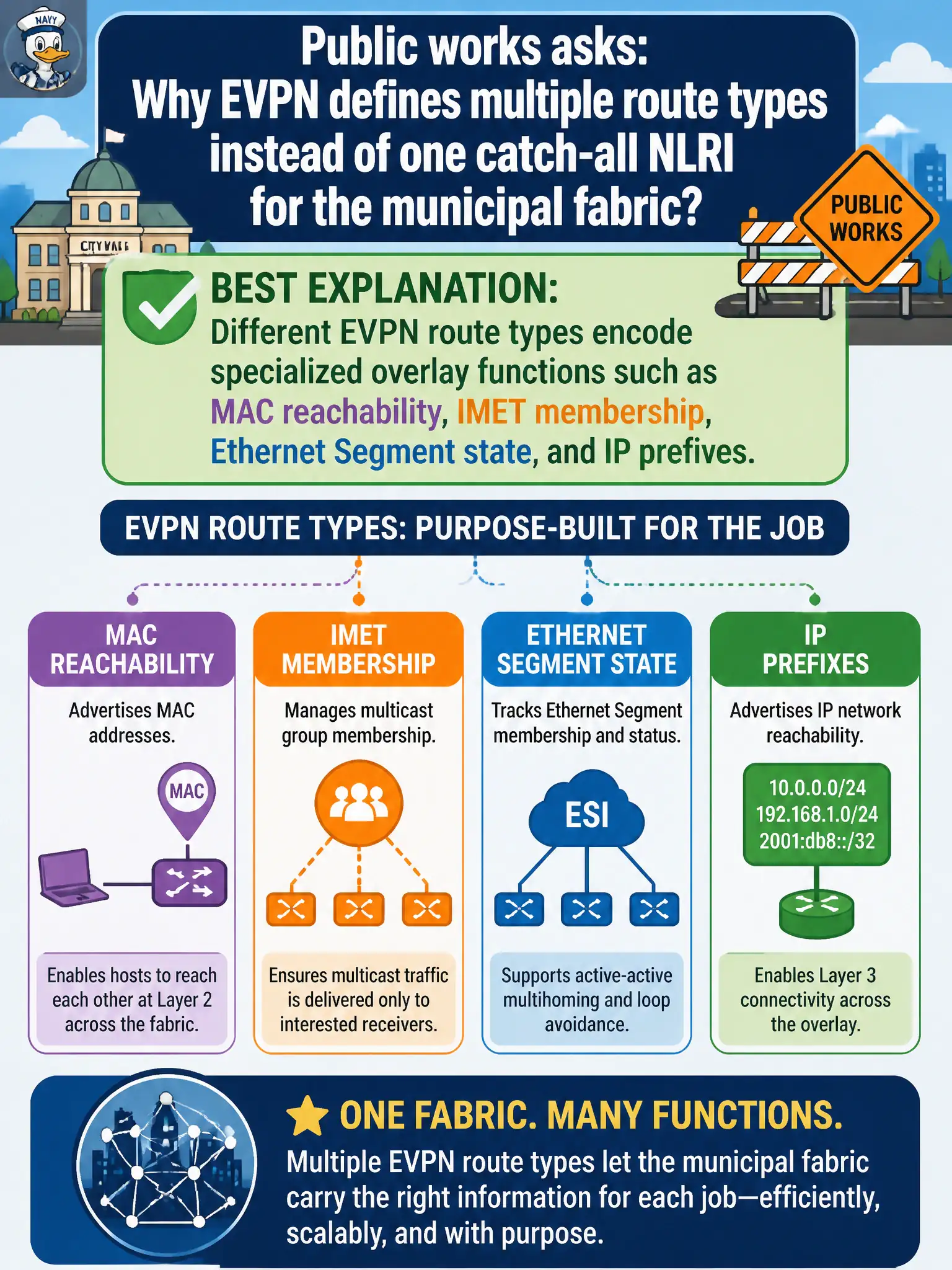
One NLRI shape cannot cleanly hold host MACs, BUM membership, ESI paperwork, and subnet prefixes without becoming a junk drawer. EVPN splits those jobs into specialized route types so each signal stays clear. They are not decorative stickers on ordinary IPv4 unicast.
Full Explanation
EVPN uses multiple route types because overlay networking has multiple specialized jobs: host MAC/IP reachability, inclusive multicast membership, Ethernet Segment multihoming state, Auto-Discovery mass-withdraw/aliasing, and IP prefix routing. Encoding those functions in purpose-built NLRIs keeps the municipal control plane precise instead of overloading one catch-all route. The types do not exist merely to confuse operators, and their payloads are not identical. A single Type-2 does not already encode IMET, ESI, and IP prefixes—those are separate types by design. Route-type labels are not cosmetic: BGP EVPN treats them as distinct NLRI kinds with different attributes, not as plain IPv4 unicast. Exam caveat: knowing the name of a type is insufficient—candidates must connect each type to a failure mode (no Type-3 leads to BUM break; wrong Type-5 policy leads to L3 DCI break; ESI mismatch leads to DF or duplicate BUM). Operational check: pick one city tenant VNI and one multihomed server, then verify Type-2 for the host, Type-3 for VNI membership, Type-4/Type-1 for the ESI as applicable, and Type-5 if L3 prefixes are in scope—documenting which symptom appears when each is withdrawn in a lab.