
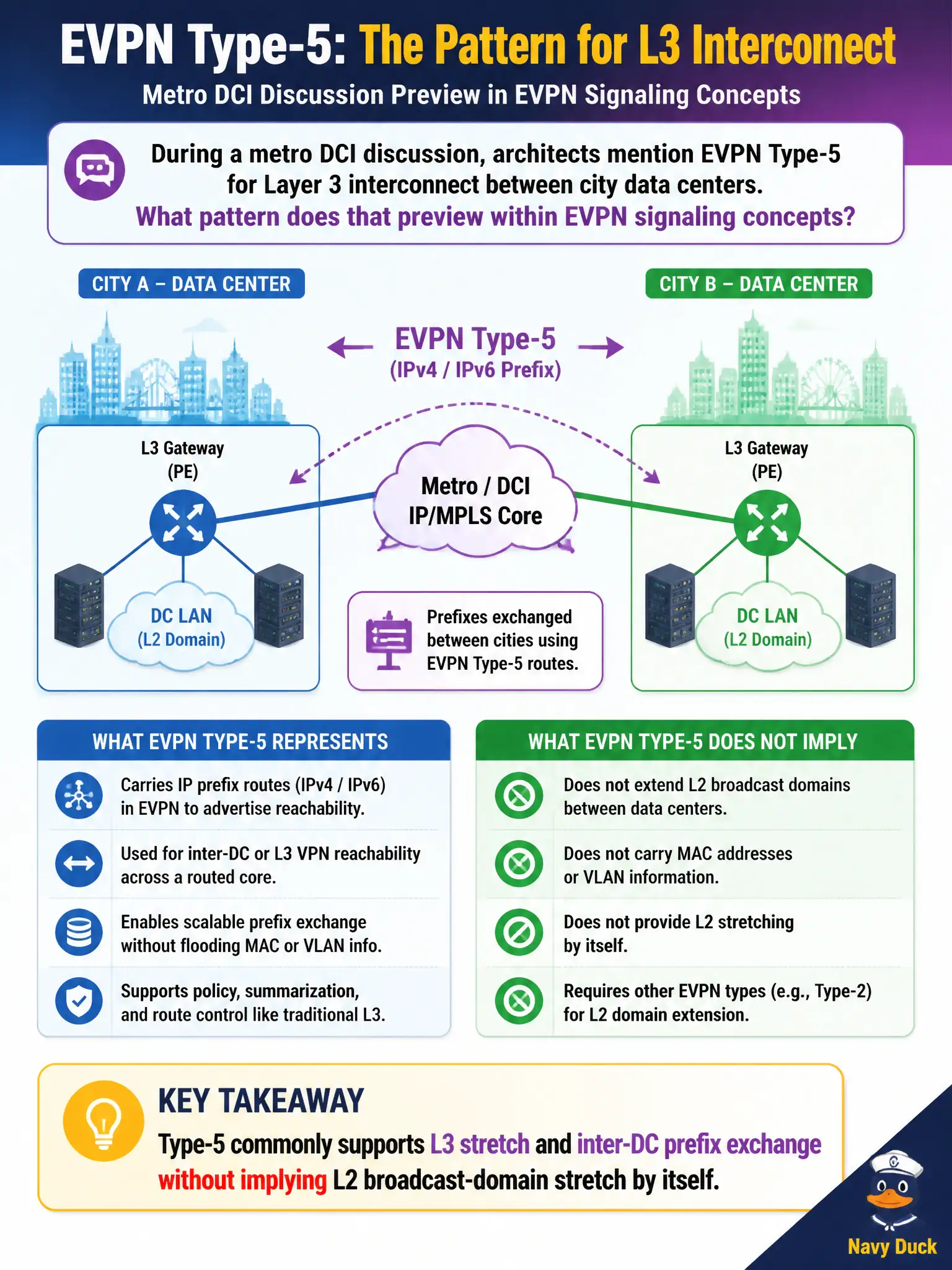
During a metro DCI discussion, architects mention EVPN Type-5 for Layer 3 interconnect between city data centers. What pattern does that preview within EVPN signaling concepts?
Select an answer to reveal the explanation.
Short Explanation
For L3 DCI, Type-5 is the inter-city prefix courier—subnets and VRFs can talk without pretending both halls are one giant Layer 2 dance floor. It is not PIM underlay signaling and not a MAC-only ferry.
Full Explanation
In metro DCI discussions, EVPN Type-5 is commonly the control-plane vehicle for Layer 3 interconnect: borders exchange tenant prefixes so city data centers route to each other without necessarily stretching a broadcast domain. That pattern previews L3 stretch and inter-DC prefix exchange within EVPN signaling concepts and must not be read as automatic L2 stretch. Type-5 is not reserved for underlay PIM join signaling across the metro core; underlay multicast, when used, is a separate fabric concern. Type-5 should not be disabled merely because a DCI link exists—on the contrary, L3 DCI often depends on it. Type-5 advertises IP prefixes, not MACs; MAC reachability between sites for L2 stretch uses Type-2 with an appropriate DCI L2 design. Exam caveat: operators may run Type-5 L3 DCI for most tenants while stretching only specific VNIs at L2—know which model each municipal application actually needs before enabling fabric-wide L2 stretch. Operational check: on DC border devices, confirm Type-5 prefixes for the tenant VRF are advertised and imported across the DCI, that underlay reachability for VTEP loopbacks exists, and that ARP/BUM for that tenant does not cross the WAN unless an L2 stretch VNI is intentionally configured.