
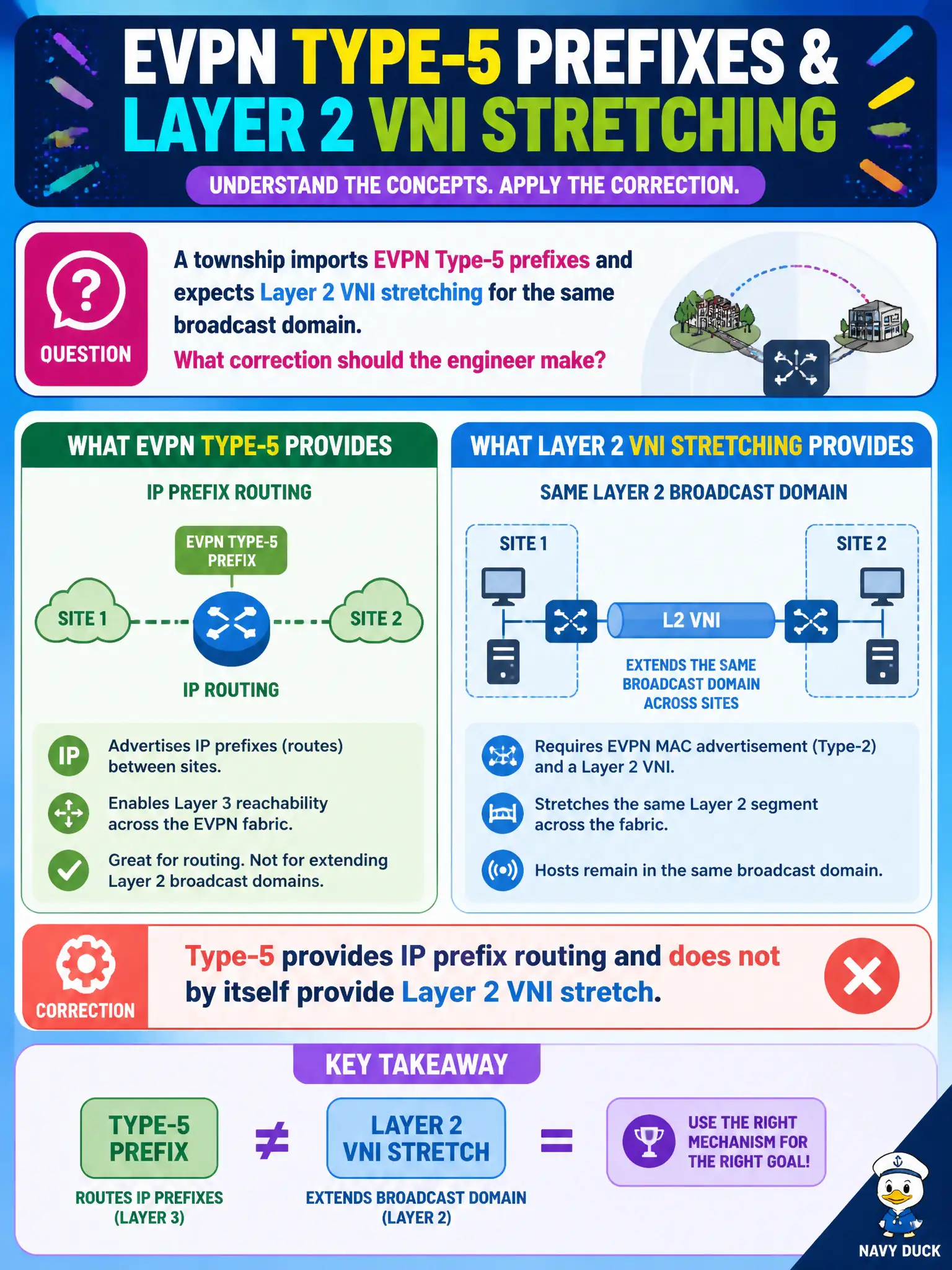
A township imports EVPN Type-5 prefixes and expects Layer 2 VNI stretching for the same broadcast domain. What correction should the engineer make?
Select an answer to reveal the explanation.
Short Explanation
Importing Type-5 is like sharing road maps between towns—great for IP prefixes, not the same as stretching one big LAN party. L2 stretch still needs the Layer 2 EVPN pieces (MAC/IMET and the VNI). Do not expect Type-5 alone to glue broadcast domains together.
Full Explanation
Type-5 EVPN routes provide IP prefix routing in the overlay. Importing Type-5 between township VRFs gives Layer 3 reachability to those prefixes; it does not, by itself, stretch a Layer 2 VNI or merge broadcast domains across sites. Engineers who expect L2 adjacency solely because Type-5 is present are mixing L3 EVPN interconnect with L2 stretch design. Type-5 alone does not stretch the full L2 broadcast domain; that requires L2 VNI constructs, Type-2 MAC learning, and Type-3 BUM membership (plus any DCI L2 stretch architecture). Type-5 does not replace Type-2 and Type-3 for both L2 and L3 overlays—those route types remain specialized. Type-5 also does not force every VTEP to flood unknown unicasts fabric-wide; unknown-unicast behavior is tied to L2 VNI/BUM design, not to prefix advertisement. Exam caveat: some designs combine Type-5 L3 DCI with selective L2 stretch on other VNIs; presence of Type-5 on one VRF says nothing about whether another VNI is stretched. Operational check: after importing Type-5 prefixes between municipal VRFs, confirm IP ping works across sites while broadcast/ARP for that tenant remains site-local unless an explicit L2 stretch VNI and Type-2/Type-3 signaling are also configured and verified.