
In the city lab, engineers observe EVPN Type-2 routes both with and without an IP address. What conceptual distinction do those variants represent?
Select an answer to reveal the explanation.
Short Explanation
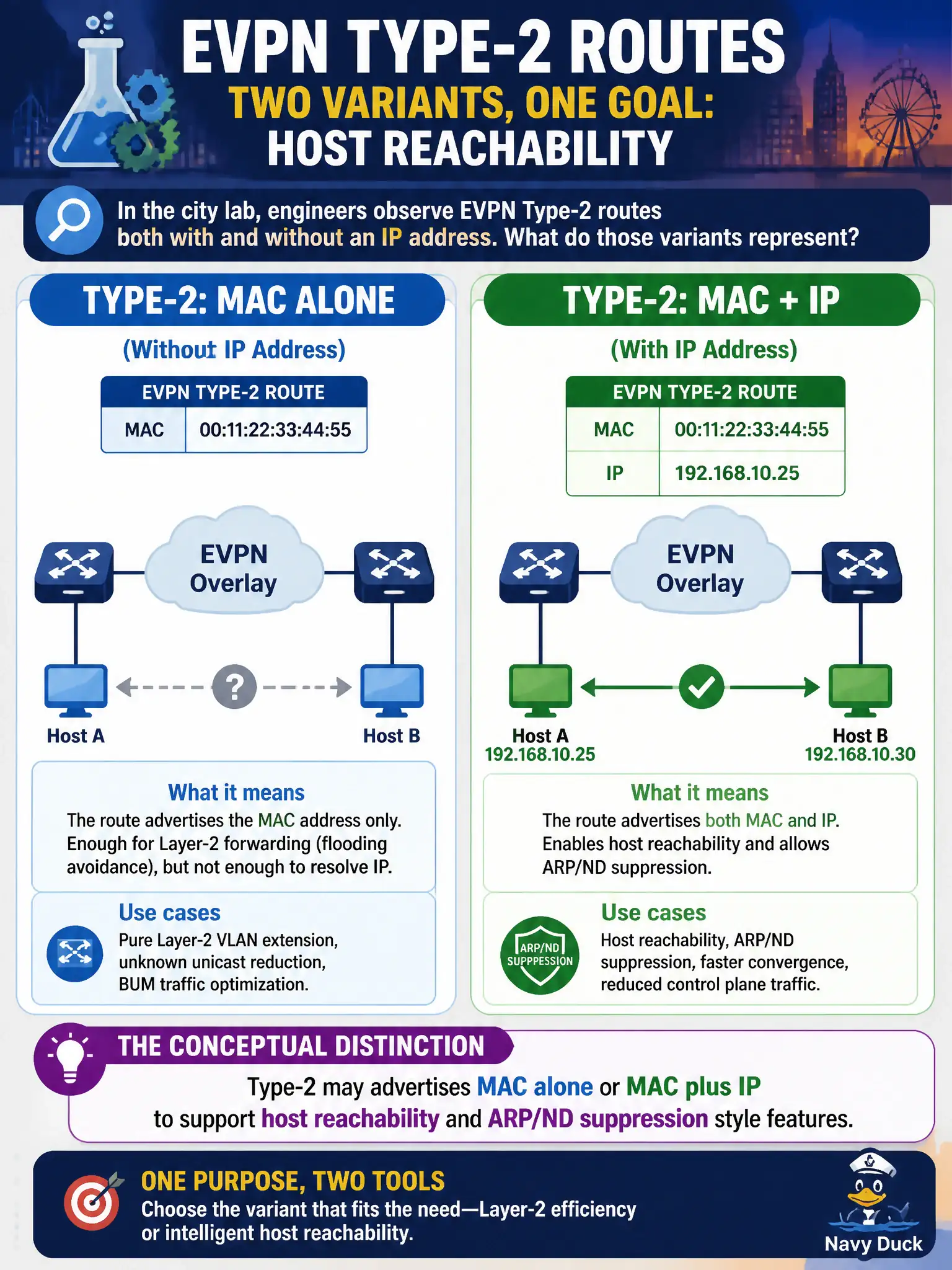
Type-2 can be just the MAC name tag or the MAC-plus-IP combo plate. The IP-inclusive flavor feeds IRB and ARP/ND suppression so the fabric answers "who has this IP?" without flooding every leaf. Neither form is underlay loopback glue.
Full Explanation
A Type-2 route can carry a MAC alone or a MAC plus an IP address. MAC-only advertisements cover Layer 2 host reachability; MAC+IP advertisements additionally bind the host IP for IRB, ARP/ND suppression, and related integrated bridging/routing behaviors on the municipal fabric. Observing both variants in the city lab is expected, not an error. MAC-only Type-2 is legal; EVPN does not require every Type-2 to include IPv6 or any IP. A Type-2 without IP is still Type-2—it does not silently become a Type-5 prefix route, which advertises IP prefixes rather than host MAC bindings. MAC+IP Type-2 is an overlay host/IRB tool, not a mechanism for exchanging underlay loopbacks; underlay loopbacks use IPv4/IPv6 unicast families in the IP fabric. Exam caveat: whether suppression and symmetric IRB consume MAC+IP Type-2 depends on platform features and configuration—do not assume MAC-only means ARP will never flood if suppression is disabled or incomplete. Operational check: learn a host MAC without seeing an IP and confirm a MAC-only Type-2; then generate traffic or configure IRB so the IP is learned and confirm the Type-2 updates to MAC+IP; verify remote leaves show the binding used for suppression or host-route installation as designed.