
The municipal NOC asks which EVPN advertisements carry MAC mobility sequence attributes when a server MAC moves between leaves. Which answer is correct?
Select an answer to reveal the explanation.
Short Explanation
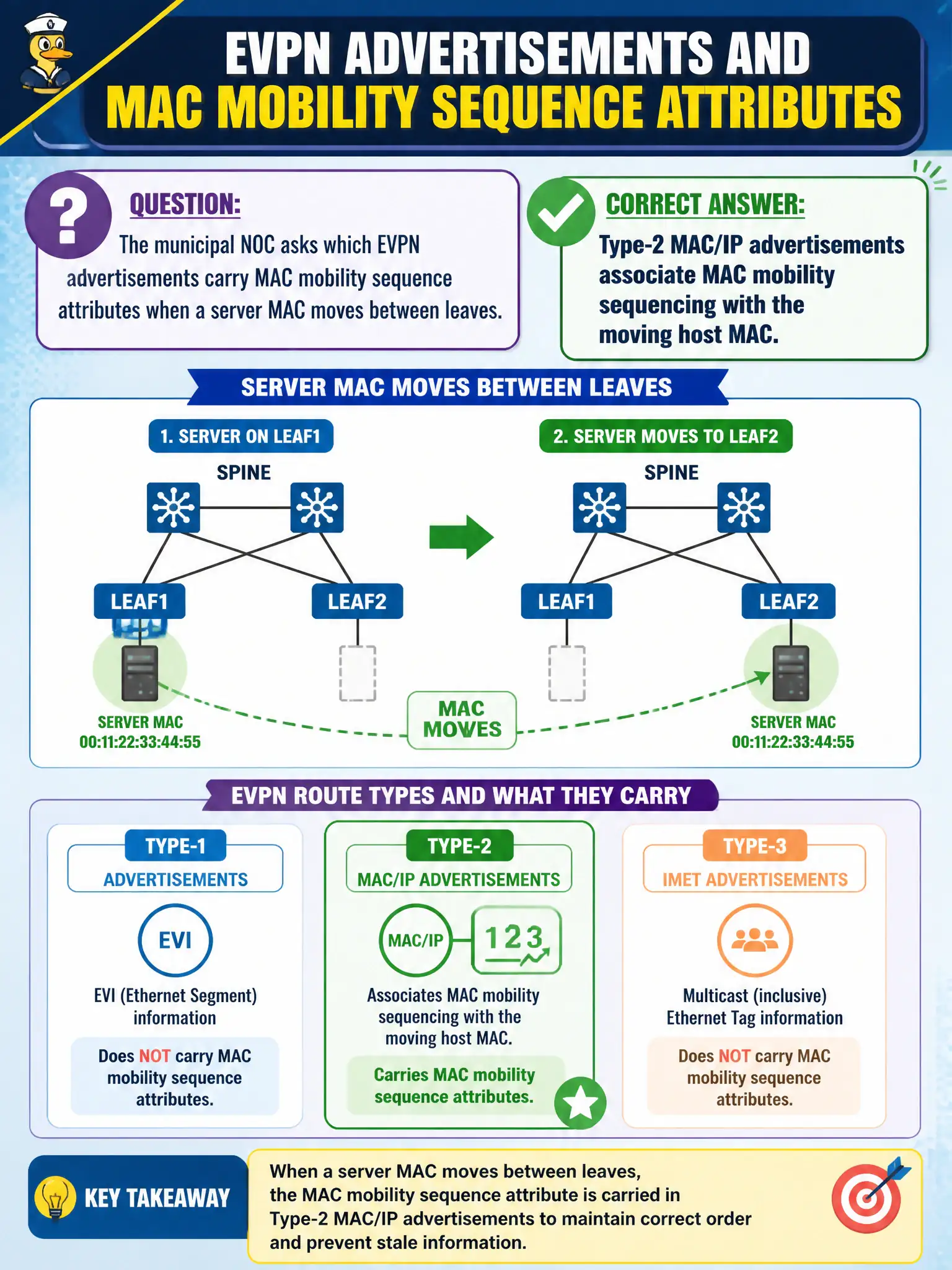
When a MAC packs up and moves to another leaf, the mobility sticky note rides on the Type-2 host ad—sequence numbers help the fabric pick the freshest location. Prefixes, ES routes, and IMET are not the MAC-move ledger.
Full Explanation
MAC mobility sequencing is associated with the host MAC as it moves, and EVPN carries that mobility context with Type-2 MAC/IP advertisements so peers can prefer the newer location when a server or VM relocates between municipal leaves. The sequence attribute lets remote VTEPs dampen or outrank stale MAC advertisements from the previous leaf instead of permanently pinning the MAC to the old VTEP. Type-5 prefix routes advertise subnets and do not increment a per-MAC mobility sequence for every subnet move; treating Type-5 as a mobility counter confuses L3 prefix reachability with L2 host moves. Type-4 ES routes describe Ethernet Segment state for multihoming and DF context; they are not a per-MAC mobility database for all VNIs. Type-3 IMET membership changes affect BUM fan-out lists, not MAC mobility resets for individual hosts. Exam caveat: mobility attributes help, but duplicate-MAC or loop conditions can still produce competing Type-2s—operators must distinguish a legitimate move from two active sources advertising the same MAC. Operational check: migrate a municipal VM from leaf A to leaf B, watch the Type-2 from B appear with a higher mobility sequence, confirm remote leaves update the MAC next hop to B, and verify traffic follows the new VTEP without sticky blackholing toward A.