
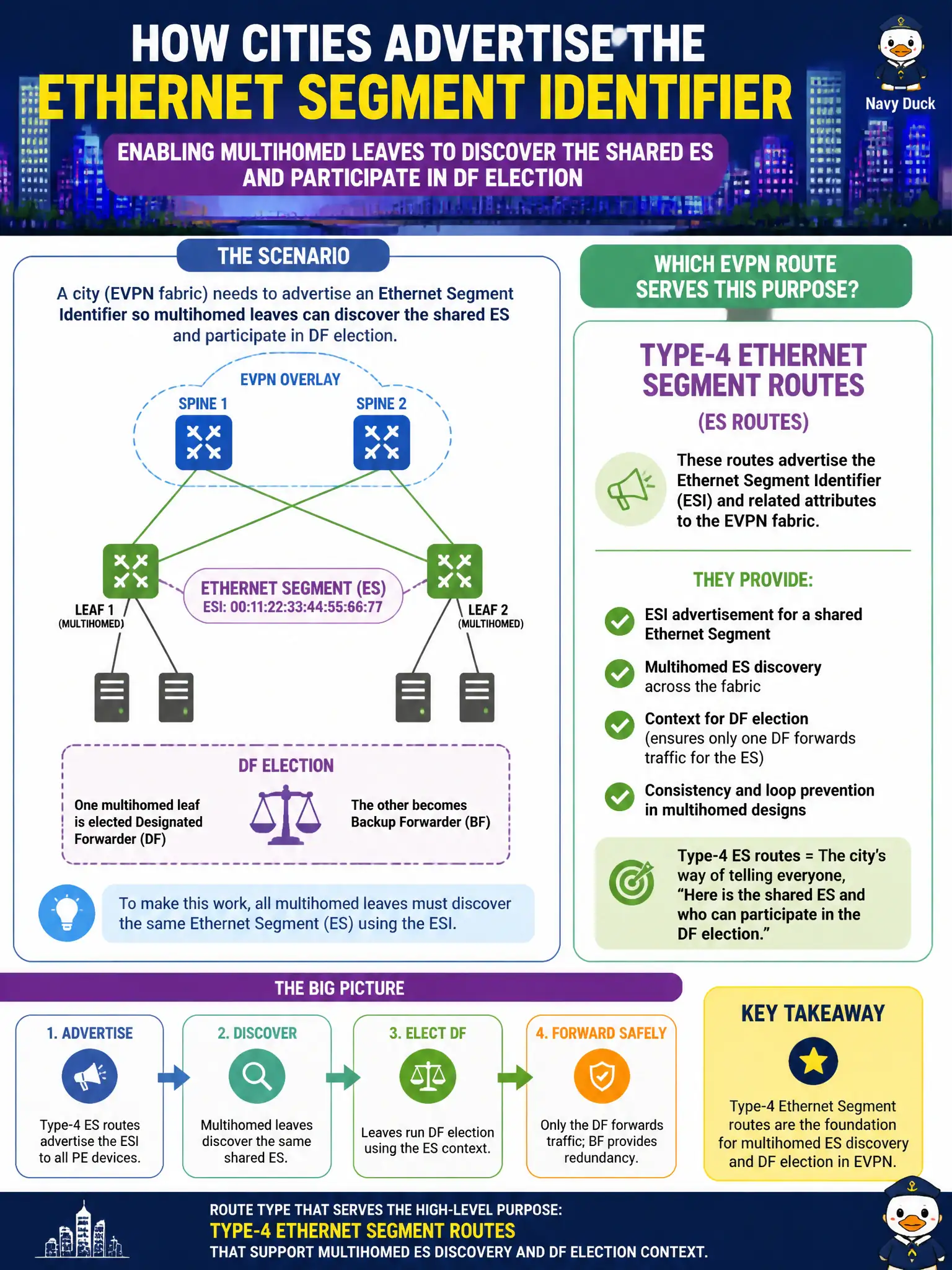
A city design needs to advertise an Ethernet Segment Identifier so multihomed leaves can discover the shared ES and participate in DF election. Which EVPN route type serves that high-level purpose?
Select an answer to reveal the explanation.
Short Explanation
Need to announce "these leaves share this ESI"? That is Type-4 Ethernet Segment territory—the handshake for multihomed ES discovery and DF election context. Type-5 is prefixes, Type-2 is hosts, and Type-3 is VNI BUM membership—not the ESI roll call.
Full Explanation
Type-4 Ethernet Segment routes advertise Ethernet Segment Identifier information so PE/VTEPs that share a multihomed segment can discover one another and participate in Designated Forwarder election context for that ES. When the city design must publish an ESI so multihomed leaves can find the shared segment, Type-4 is the high-level EVPN route type that serves that purpose. Type-5 prefix routes list tenant IP prefixes for L3 EVPN; they do not advertise ESI membership for DF election. Type-2 MAC+IP routes carry host reachability and optional IP bindings; they are not a substitute ESI advertisement mechanism even though multihomed hosts still generate Type-2s from the segment. Type-3 IMET routes signal VNI BUM membership among VTEPs; DF election for a multihomed ES is not an IMET function. Exam caveat: DF election also interacts with Type-1 Auto-Discovery and local ESI configuration consistency—Type-4 discovery alone will not fix mismatched ESI values or unequal DF timers—but the route type that carries ES discovery at this conceptual level remains Type-4. Operational check: configure the same ESI on two city leaves facing a dual-homed server, verify Type-4 ES routes are exchanged, confirm both peers see each other on that ESI, and validate that only the elected DF forwards BUM onto the segment while unicast still follows Type-2 next hops and aliasing rules.