
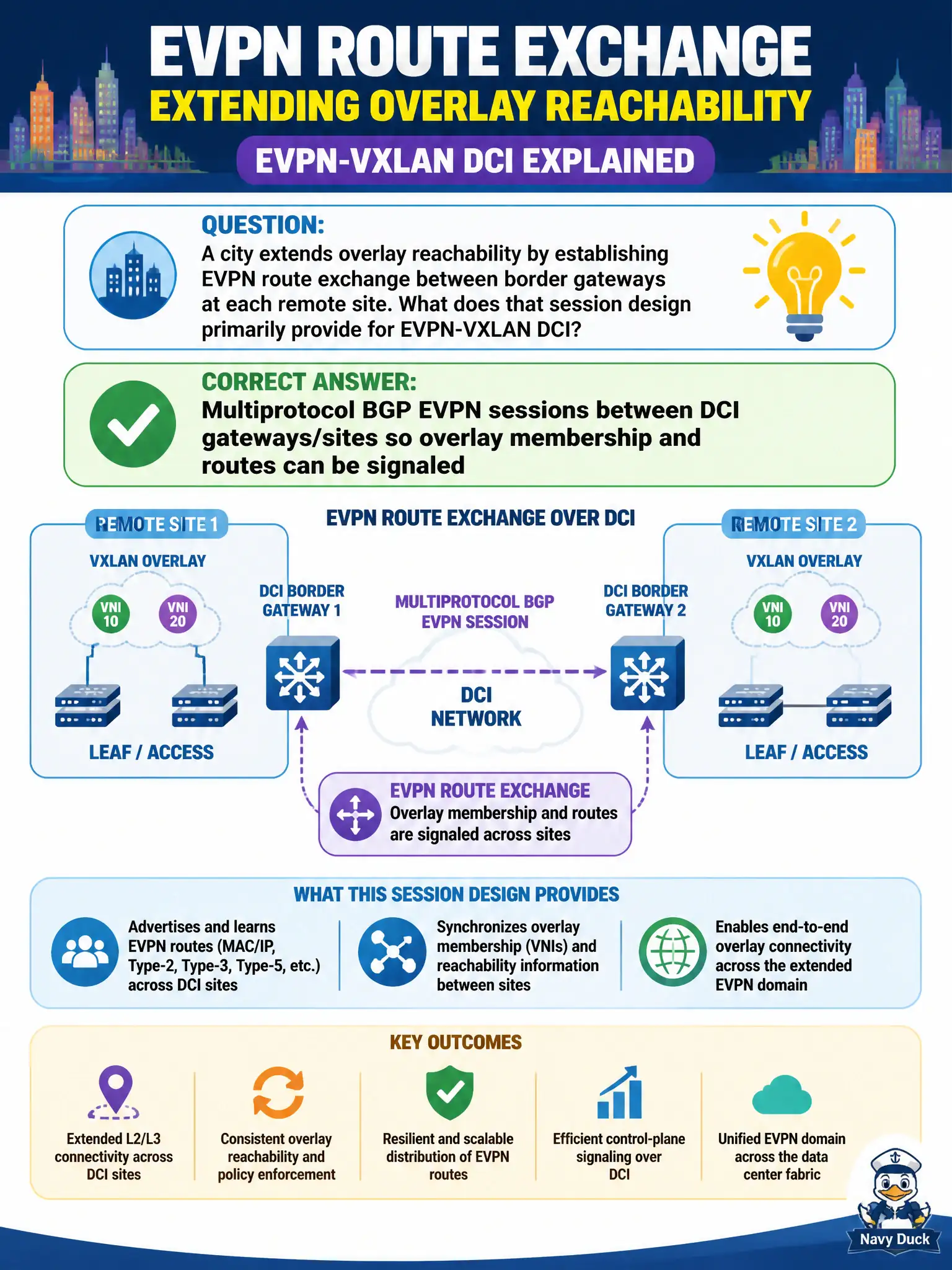
A city extends overlay reachability by establishing EVPN route exchange between border gateways at each remote site. What does that session design primarily provide for EVPN-VXLAN DCI?
Select an answer to reveal the explanation.
Short Explanation
DCI EVPN is the phone call between site borders that shares who lives where in the overlay. MBGP EVPN sessions carry that membership and routing news. Without the call, the VXLAN tunnels have no trustworthy address book.
Full Explanation
When a city extends overlay reachability by establishing EVPN route exchange between border gateways at each remote site, that session design primarily provides multiprotocol BGP EVPN sessions between DCI gateways/sites so overlay membership and routes can be signaled. Those sessions carry Type-2, Type-5, and related EVPN information that lets remote fabrics learn which MACs, IPs, and VNIs belong across the municipal interconnect. Relying only on IGP adjacency between spines so Type-2 routes “flood without BGP” misunderstands EVPN distribution; overlay membership is signaled in BGP EVPN families, not as raw IGP flooding of MAC routes. Claiming EVPN sessions replace the data plane and require disabling VXLAN VNIs confuses control-plane signaling with VXLAN encapsulation—sessions advertise reachability; VNIs still carry tenant frames. Automatic conversion of all underlay EBGP peers into EVPN Type-5 only neighbors is not what establishing DCI EVPN provides; underlay and overlay peering roles remain distinct design choices. Exam caveat: DCI EVPN sessions signal overlay membership—they do not abolish VXLAN or magically rewrite every underlay peer into Type-5-only. Operational check: on each civic border, confirm EVPN BGP neighbors are Established, that intended EVPN route types are advertised/received, and that underlay VTEP reachability still exists independently; store neighbor and route counts in the NOC DCI dashboard.