
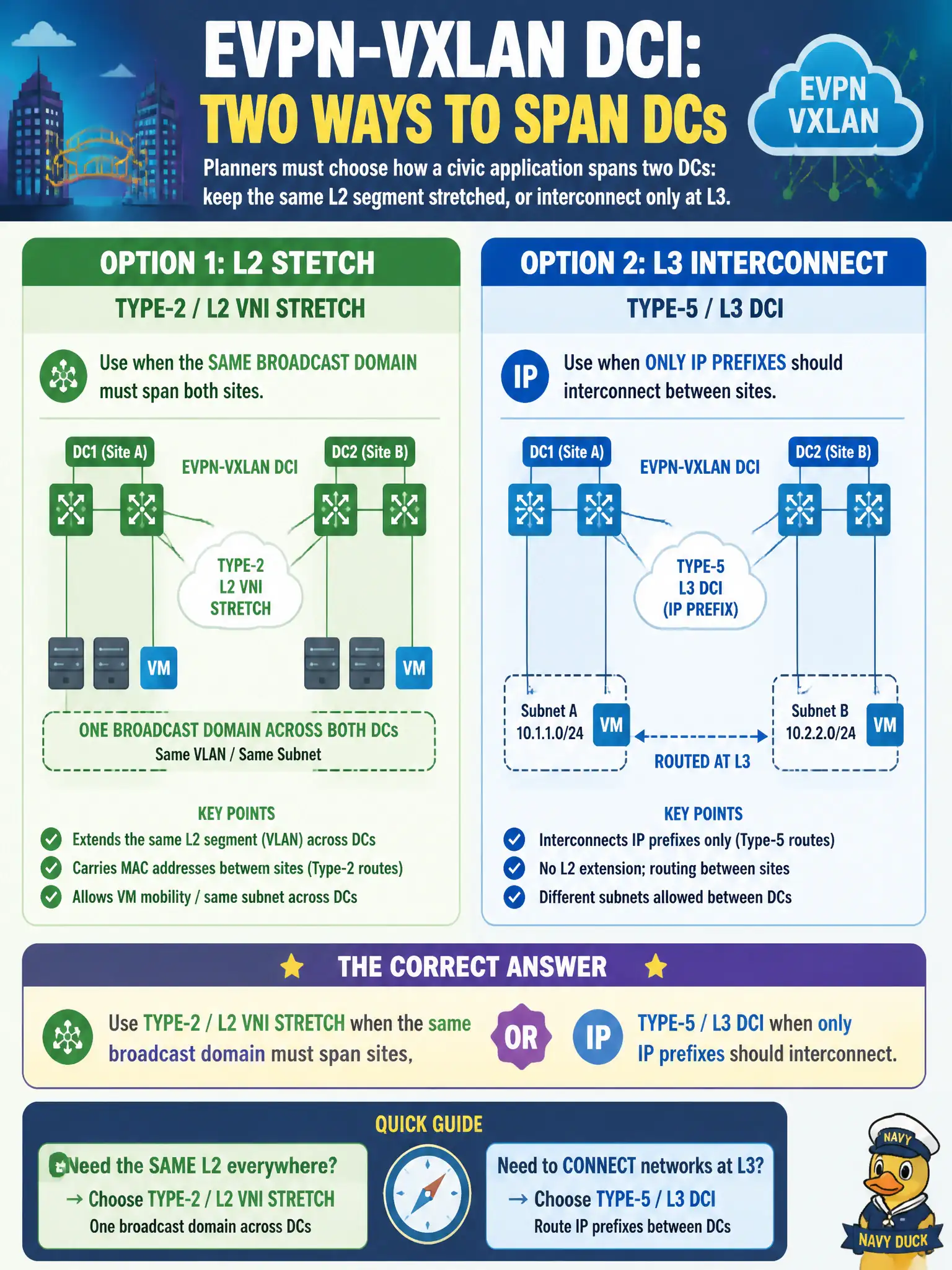
Planners must choose how a civic application spans two DCs: keep the same L2 segment stretched, or interconnect only at L3. In EVPN-VXLAN DCI terms, which statement is correct?
Select an answer to reveal the explanation.
Short Explanation
Need the same Ethernet neighborhood in both buildings? That is L2 stretch with Type-2 style MAC signaling. Just need IP between VRFs? Type-5 L3 DCI keeps the blast radius smaller. Pick the route type that matches the real requirement.
Full Explanation
When planners choose how a civic application spans two DCs, EVPN-VXLAN DCI terms require matching route type to intent: use Type-2/L2 VNI stretch when the same broadcast domain must span sites, or Type-5 L3 DCI when only IP prefixes should interconnect. L2 stretch preserves Ethernet adjacency for apps that truly need one segment across buildings; L3 interconnect limits blast radius by exchanging prefixes without extending BUM domains over the metro. It is incorrect that Type-5 routes always stretch broadcast domains or that Type-2 routes are only for underlay loopbacks—Type-5 is IP prefix interconnect in the overlay, and Type-2 carries MAC/IP host routes for L2 VNIs. Treating Type-2 and Type-5 as interchangeable for every DCI requirement with identical blast-radius outcomes ignores that L2 stretch and L3 interconnect differ sharply in flooding and failure scope for city services. L3 DCI does not require disabling EVPN or configuring only static VXLAN tunnels; Type-5 EVPN is the signaled L3 approach. Exam caveat: pick L2 (Type-2 stretch) versus L3 (Type-5) from application need and blast radius—not from a myth that the route types are synonyms. Operational check: for each municipal application, record whether same L2 domain is mandatory; if not, prefer Type-5 interconnect, then verify only the intended EVPN route types appear on borders and that broadcast storms cannot cross when L3-only was chosen.