
For interconnecting municipal data centers per JNCIP-DC DCI objectives, which model is the preferred blueprint approach?
Select an answer to reveal the explanation.
Short Explanation
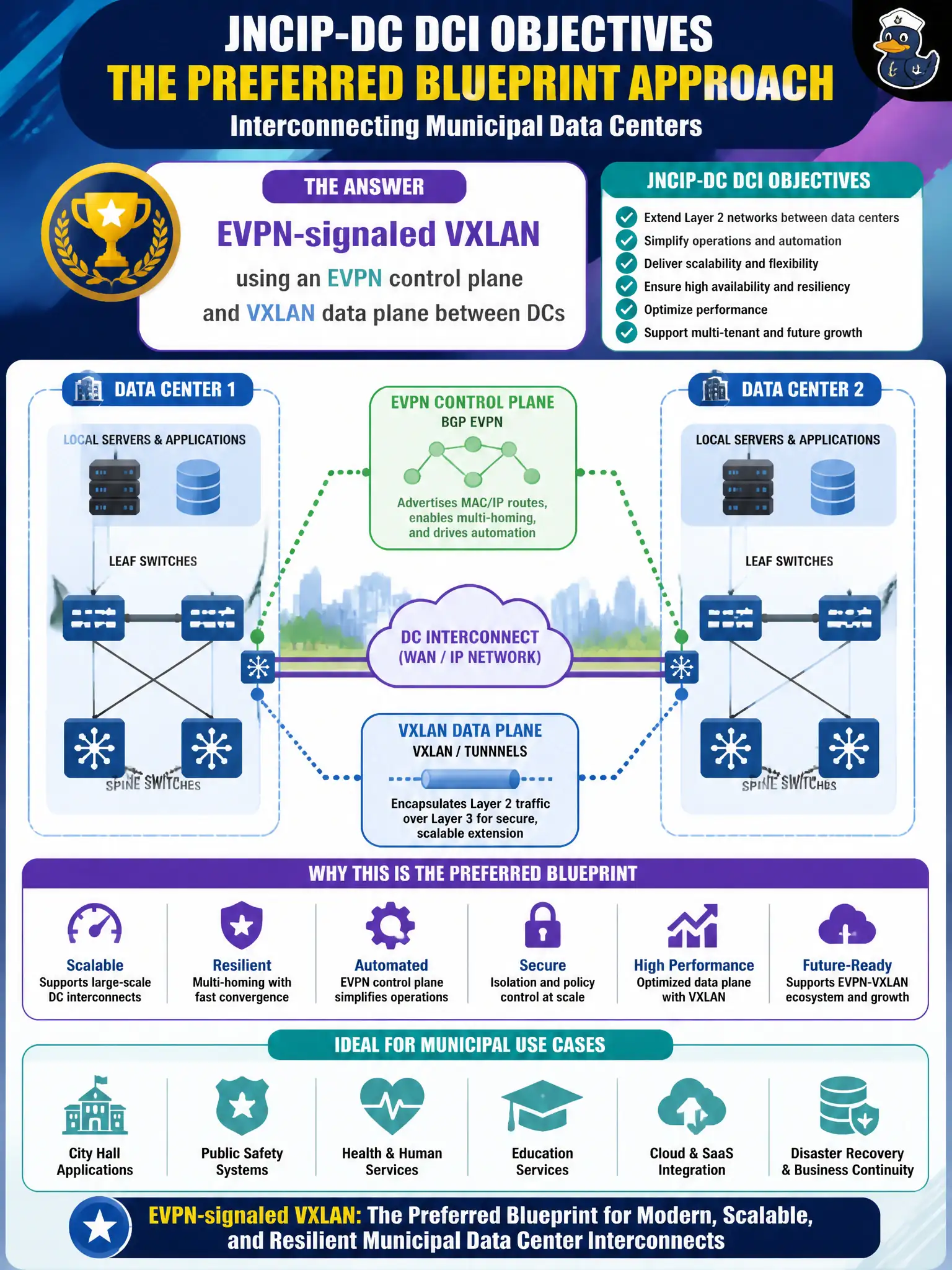
Modern DCI for this exam is EVPN talking and VXLAN carrying—control plane smarts plus overlay tunnels between sites. It beats dragging native VLANs across town or living on static MAC tattoos. That is the blueprint model to memorize.
Full Explanation
For interconnecting municipal data centers per JNCIP-DC DCI objectives, the preferred blueprint approach is EVPN-signaled VXLAN using an EVPN control plane and VXLAN data plane between DCs. That model scales multi-site MAC/IP learning with BGP EVPN while encapsulating tenant traffic in VXLAN between border VTEPs over an IP metro or WAN. Treating legacy VPLS as the only supported multi-site overlay with no EVPN control plane anchors the city on an older MPLS pseudowire mindset that is not the JN0-683 DCI focus. Extending native VLAN trunks hop-by-hop across the metro with no VXLAN encapsulation stretches broadcast domains onto the WAN, couples failure domains, and lacks modern EVPN controls. Installing static MAC entries on every border in lieu of any signaling protocol does not scale for civic mobility and defeats automated EVPN learning. Exam caveat: prioritize EVPN-VXLAN DCI—control plane EVPN plus data plane VXLAN—over VPLS nostalgia or static MAC crafts. Operational check: verify multiprotocol BGP EVPN sessions between municipal DCI borders, confirm Type-2 and/or Type-5 routes for intended tenants, and capture UDP 4789 between VTEPs during a live flow test; archive the validation output with the interconnect acceptance checklist.