
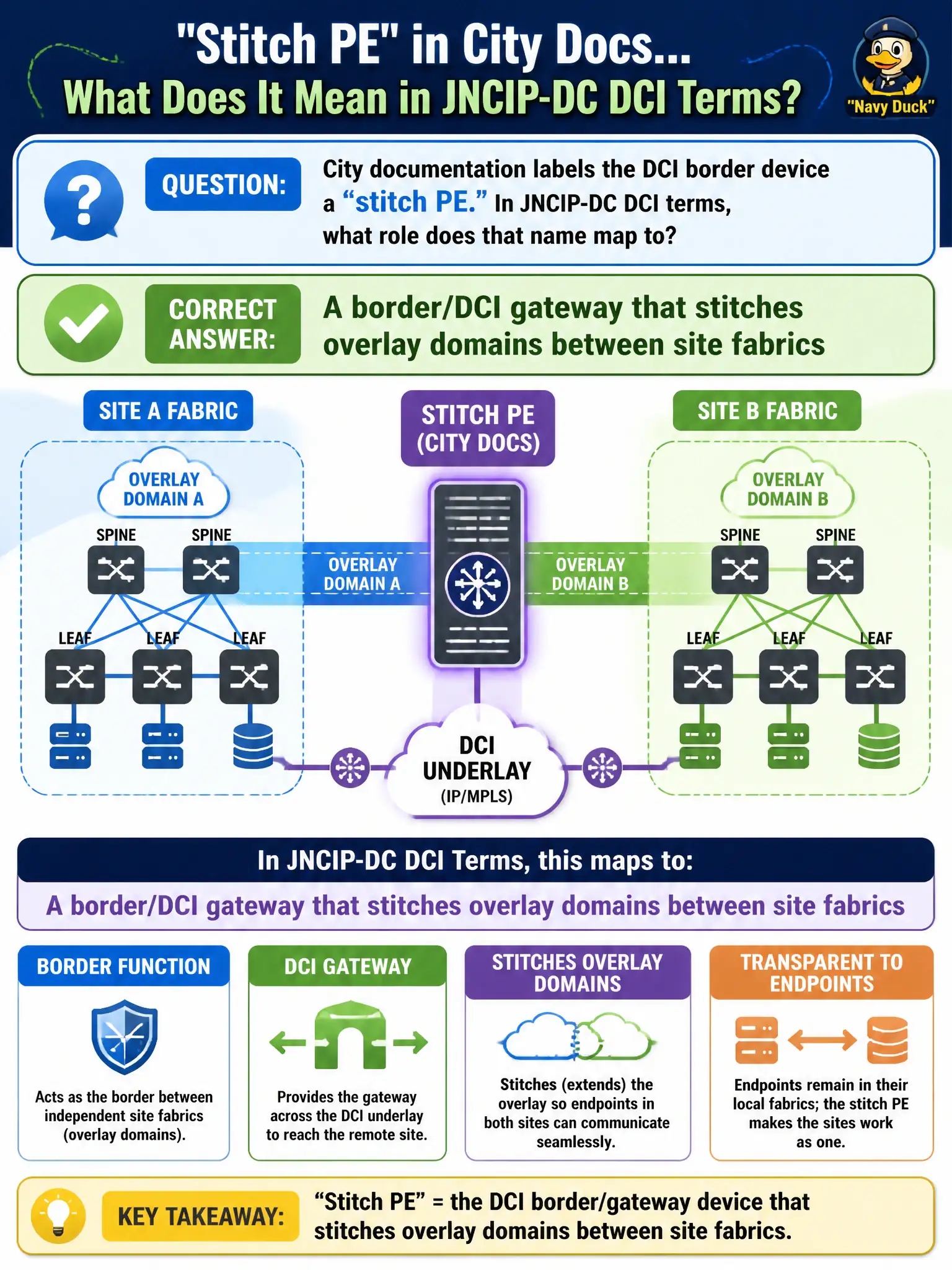
City documentation labels the DCI border device a “stitch PE.” In JNCIP-DC DCI terms, what role does that name map to?
Select an answer to reveal the explanation.
Short Explanation
“Stitch PE” is ops slang for the border that sews two overlay fabrics together. It is the DCI gateway role—not a plain access leaf or a pure underlay spine. When docs say stitch PE, think interconnect border.
Full Explanation
In city documentation, labeling the DCI border device a “stitch PE” maps in JNCIP-DC DCI terms to a border/DCI gateway that stitches overlay domains between site fabrics. That role joins EVPN-VXLAN membership across sites, applies VNI/RT policy, and participates in the interconnect control and data planes for municipal tenants. It is not merely an access leaf that only learns MACs for locally attached servers with no interconnect function; access leafs serve racks, while stitch PEs terminate multi-site overlay joining. It is not a spine that solely reflects underlay BGP routes and never participates in overlay joining; spines mainly provide underlay ECMP, whereas stitch duty is an overlay border function. It is not a management jump host that stores ZTP images for new QFX switches; provisioning hosts are out-of-band operational tools, not EVPN stitch gateways. Exam caveat: “stitch PE” is ops shorthand for the DCI/border overlay stitch role—map the nickname to function, not to access, spine, or ZTP boxes. Operational check: identify which municipal devices import/export multi-site EVPN routes and source/sink VXLAN toward remote VTEPs; confirm those are the documented stitch PEs, verify EVPN session and VNI maps there, and keep inventory labels aligned so NOC escalations reach the correct border pair.