
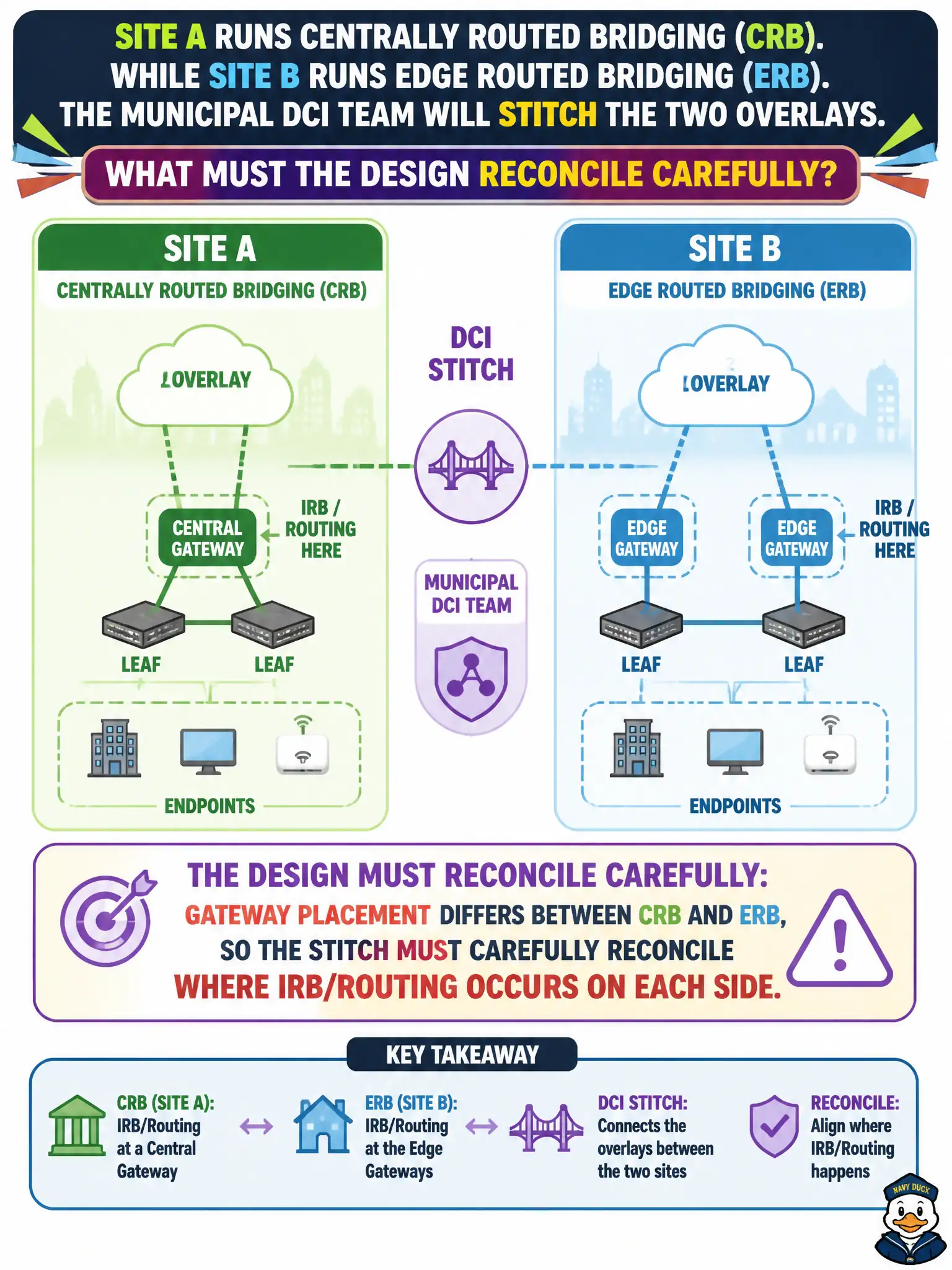
Site A runs Centrally Routed Bridging (CRB) while Site B runs Edge Routed Bridging (ERB). The municipal DCI team will stitch the two overlays. What must the design reconcile carefully?
Select an answer to reveal the explanation.
Short Explanation
CRB keeps the big routers in the middle of the campus; ERB pushes routing out to the leaf edge. Stitching those two is fine—but you have to respect where each side expects the gateway to live. Mismatch the gateway story and the stitch becomes a troubleshooting marathon.
Full Explanation
If Site A runs Centrally Routed Bridging (CRB) while Site B runs Edge Routed Bridging (ERB), a municipal DCI stitch must carefully reconcile where IRB/routing occurs on each side because gateway placement differs between the models. CRB concentrates anycast/IRB routing toward spines or central gateways; ERB places distributed anycast gateways on leafs. Stitching overlays without aligning first-hop gateway location, subnet ownership, and ARP/ND behavior risks asymmetric routing, duplicate gateway claims, or blackholes for civic workloads that move or communicate across sites. It is false that CRB and ERB fabrics can never be interconnected; stitching is supported when designers reconcile gateway and route placement deliberately. Converting every ERB site to CRB before any DCI session can establish is not a prerequisite—the requirement is consistent IP gateway and EVPN route design, not forced architectural homogenization. Stitching does not automatically relocate every anycast gateway to the WAN edge regardless of CRB or ERB; that myth invents a magical border takeover that can break local first-hop behavior. Exam caveat: CRB/ERB mismatch is a gateway-placement problem to design through, not an automatic interconnect prohibition. Operational check: document where the default gateway lives for each stitched subnet on both sites, verify EVPN IP/MAC advertisement for those IRBs, traceroute and capture across the DCI for a test host, and ensure only the intended anycast/IRB owners respond on each municipal fabric.