
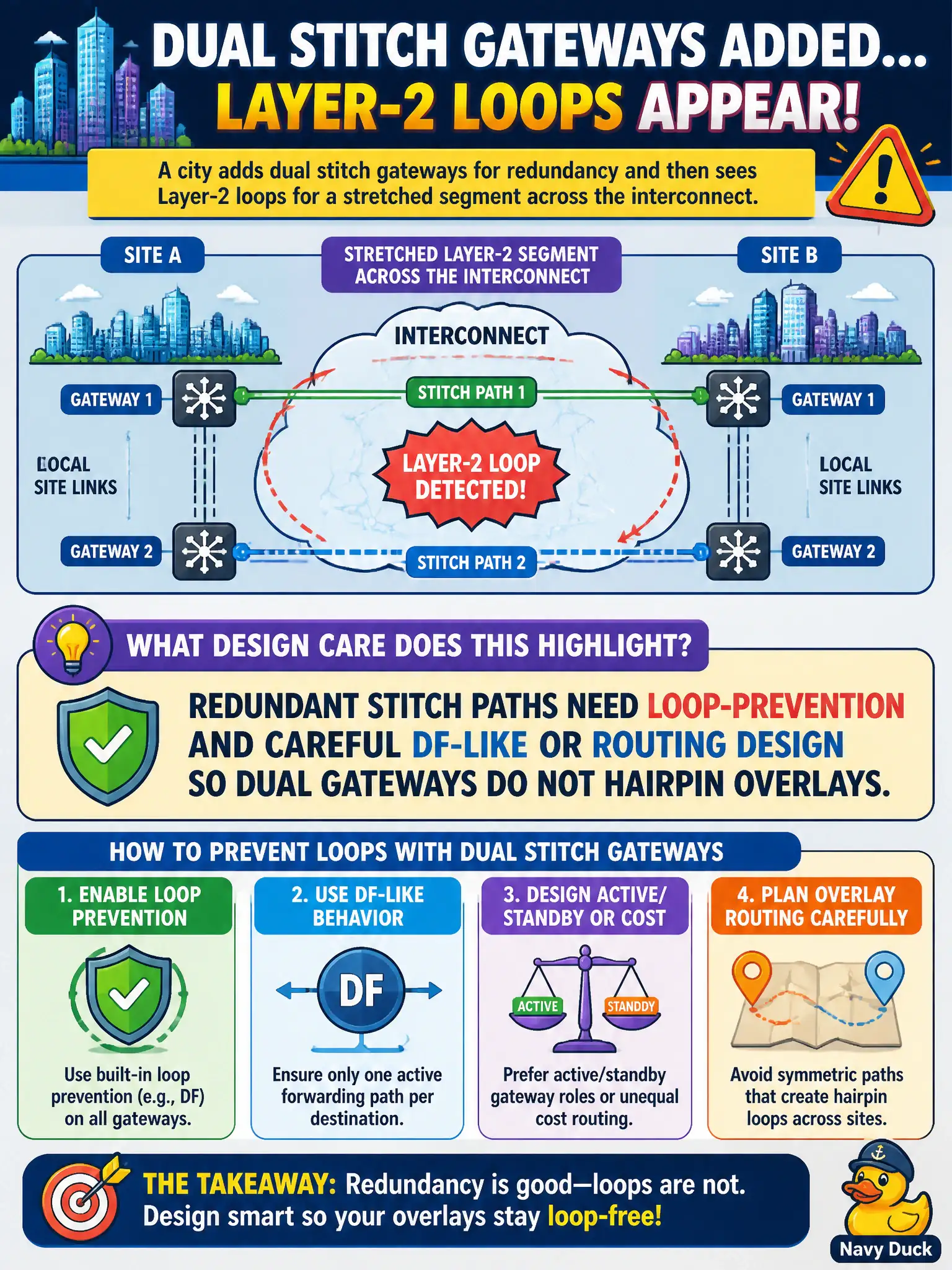
A city adds dual stitch gateways for redundancy and then sees Layer-2 loops for a stretched segment across the interconnect. What design care does this highlight?
Select an answer to reveal the explanation.
Short Explanation
Two bridges side by side without traffic rules will cheerfully loop your city buses forever. Redundant stitch gateways need designated-forwarder style thinking or routing discipline. Redundancy without loop care is just a faster loop.
Full Explanation
When a city adds dual stitch gateways for redundancy and then observes Layer-2 loops on a stretched segment across the interconnect, the design care highlighted is that redundant stitch paths need loop-prevention and careful DF-like or routing design so dual gateways do not hairpin overlays. Two active L2 stitch paths without Ethernet Segment / DF discipline or equivalent loop controls can replicate frames between sites and melt the civic WAN with looping BUM. Dual stitch gateways do not automatically eliminate loops; redundancy without split-horizon, DF election, or L3-oriented interconnect discipline is a classic multi-path L2 hazard. Resolving DCI loops only by disabling spanning tree everywhere in both fabrics misunderstands VXLAN/EVPN loop control and can remove useful edge protection without fixing dual-active stitch hairpins. Advertising the same Ethernet Segment with no multi-homing controls on both gateways is the opposite of a fix—it invites duplicate designated-forwarder behavior and unstable multi-homing. Exam caveat: redundant L2 stitch equals multi-homing design work, not “two boxes means no loops.” Operational check: verify ES/DF (or L3 stitch alternative) configuration on both municipal stitch gateways, generate controlled broadcast and confirm a single DF forwards BUM across the DCI, and monitor for MAC flaps and duplicate frame counters during failover testing recorded in the change ticket.