
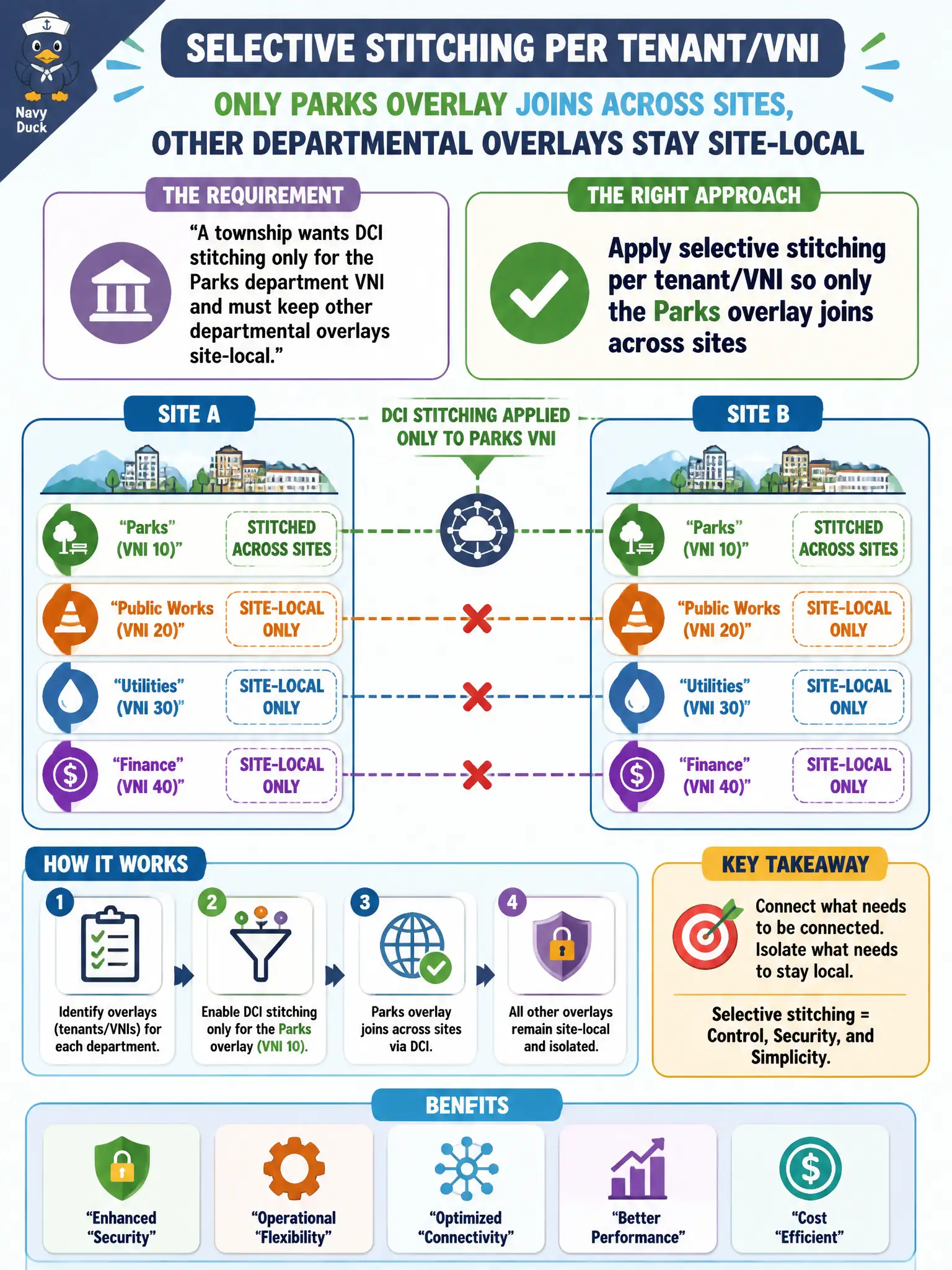
A township wants DCI stitching only for the Parks department VNI and must keep other departmental overlays site-local. Which approach matches that requirement?
Select an answer to reveal the explanation.
Short Explanation
Not every department needs a bridge between campuses—Parks might, Finance might not. Selective stitching is the deliberate on-ramp for one VNI. Keep the rest parked local until policy says otherwise.
Full Explanation
When a township wants DCI stitching only for the Parks department VNI and must keep other departmental overlays site-local, the matching approach is selective stitching per tenant/VNI so only the Parks overlay joins across sites. Selective stitch preserves civic isolation: Finance, Courts, and other agencies remain local while Parks gains multi-site connectivity through explicit border policy. Stitching every VNI on the border by default so selective exclusion is “unnecessary” maximizes blast radius and violates least-privilege interconnect design for municipal tenants. Disabling EVPN entirely and using a single stretched VLAN for all departments including Parks regresses to flat Layer-2 extension, loses EVPN controls, and couples unrelated agencies on one broadcast domain. Translating all municipal VNIs into one shared interconnect VNI to “simplify” operations collapses tenant separation at the WAN edge and creates a single shared overlay failure and security domain. Exam caveat: selective per-VNI/per-tenant stitch is a first-class design choice—default-all stitch is not required. Operational check: on the stitch gateways, confirm only the Parks VNI/RT set is imported/exported across the DCI, verify other departmental Type-2/Type-5 routes remain site-local, and test Parks endpoints across sites while confirming Finance endpoints cannot resolve or flood across the interconnect.