
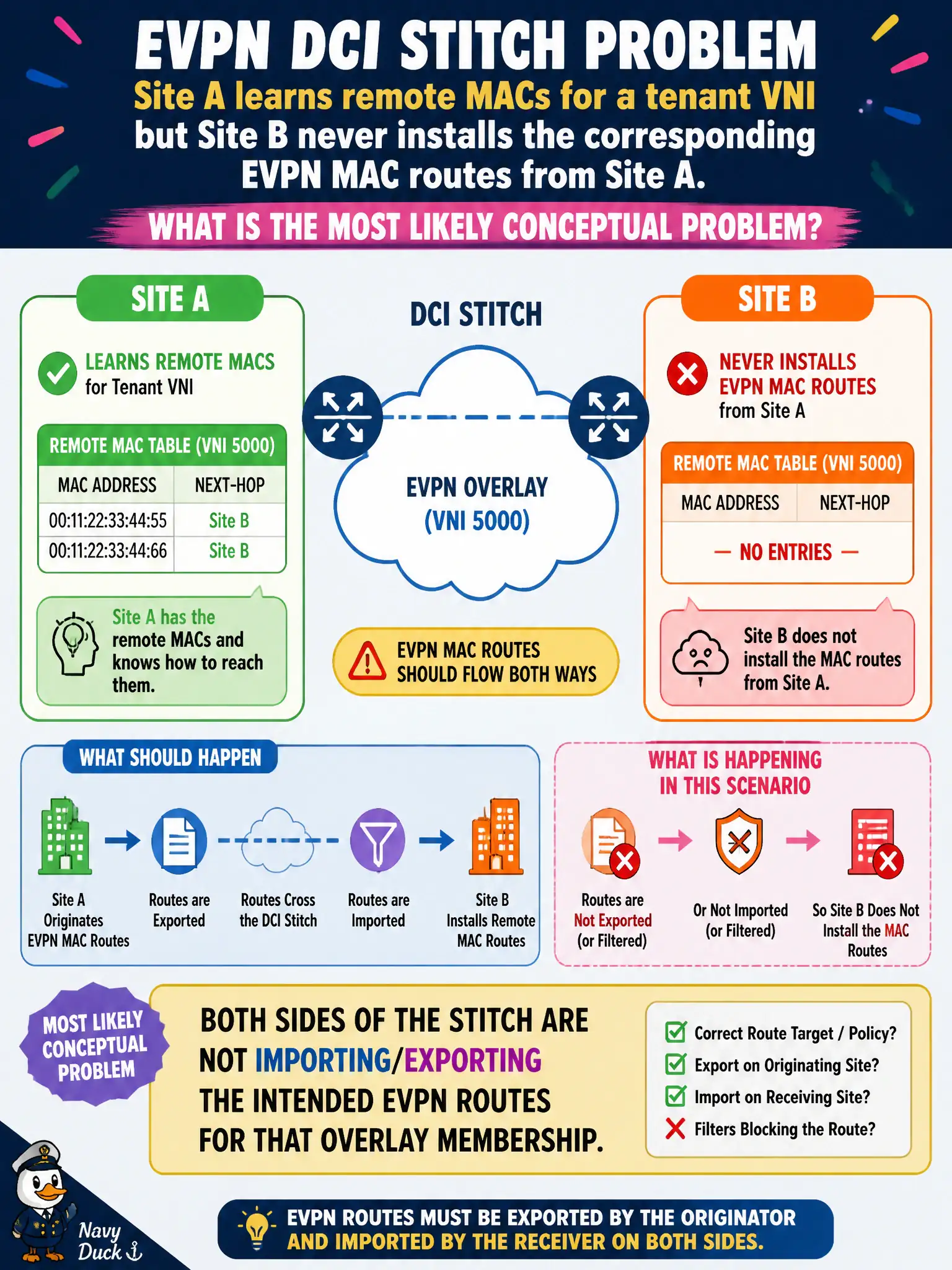
After a township DCI stitch change, Site A learns remote MACs for a tenant VNI but Site B never installs the corresponding EVPN MAC routes from Site A. What is the most likely conceptual problem?
Select an answer to reveal the explanation.
Short Explanation
A one-way MAC view is like a two-way street where only one side painted the lane lines. Stitch membership has to export and import the right EVPN routes on both borders. If Site B never takes Site A’s routes, the control-plane join is incomplete.
Full Explanation
After a township DCI stitch change, if Site A learns remote MACs for a tenant VNI but Site B never installs the corresponding EVPN MAC routes from Site A, the most likely conceptual problem is asymmetric EVPN import/export: both sides of the stitch are not importing and exporting the intended EVPN routes for that overlay membership. Stitch membership is a control-plane contract; one-way learning usually means route-target or export policy mismatch, missing VRF/MAC-VRF attachment on one border, or filters dropping Type-2 routes in one direction. VXLAN UDP 4789 absolutely can carry encapsulated frames when EVPN is configured; blaming the UDP port for missing MAC routes confuses data-plane encapsulation with control-plane route installation. Claiming one side never needs EVPN import because flooding alone completes the join abandons the EVPN learning model and invites unbounded BUM across the civic WAN. Asserting MAC routes only ever exist inside a single site and that DCI stitching cannot advertise Type-2 information contradicts the purpose of multi-site EVPN L2 stretch and stitch designs. Exam caveat: asymmetric MAC views after a stitch change point first at RT/policy/membership, not at “UDP cannot learn MACs.” Operational check: on both township borders, compare EVPN Type-2 advertisements and import policies for the tenant, confirm matching route targets and VRF membership, then verify the missing MAC appears in the remote EVPN database after a controlled host generate; document the fix in the interconnect runbook.