
A township runs active/passive DR with warm standby servers and needs only routed connectivity until failover. Which DCI stretch model is typically simpler?
Select an answer to reveal the explanation.
Short Explanation
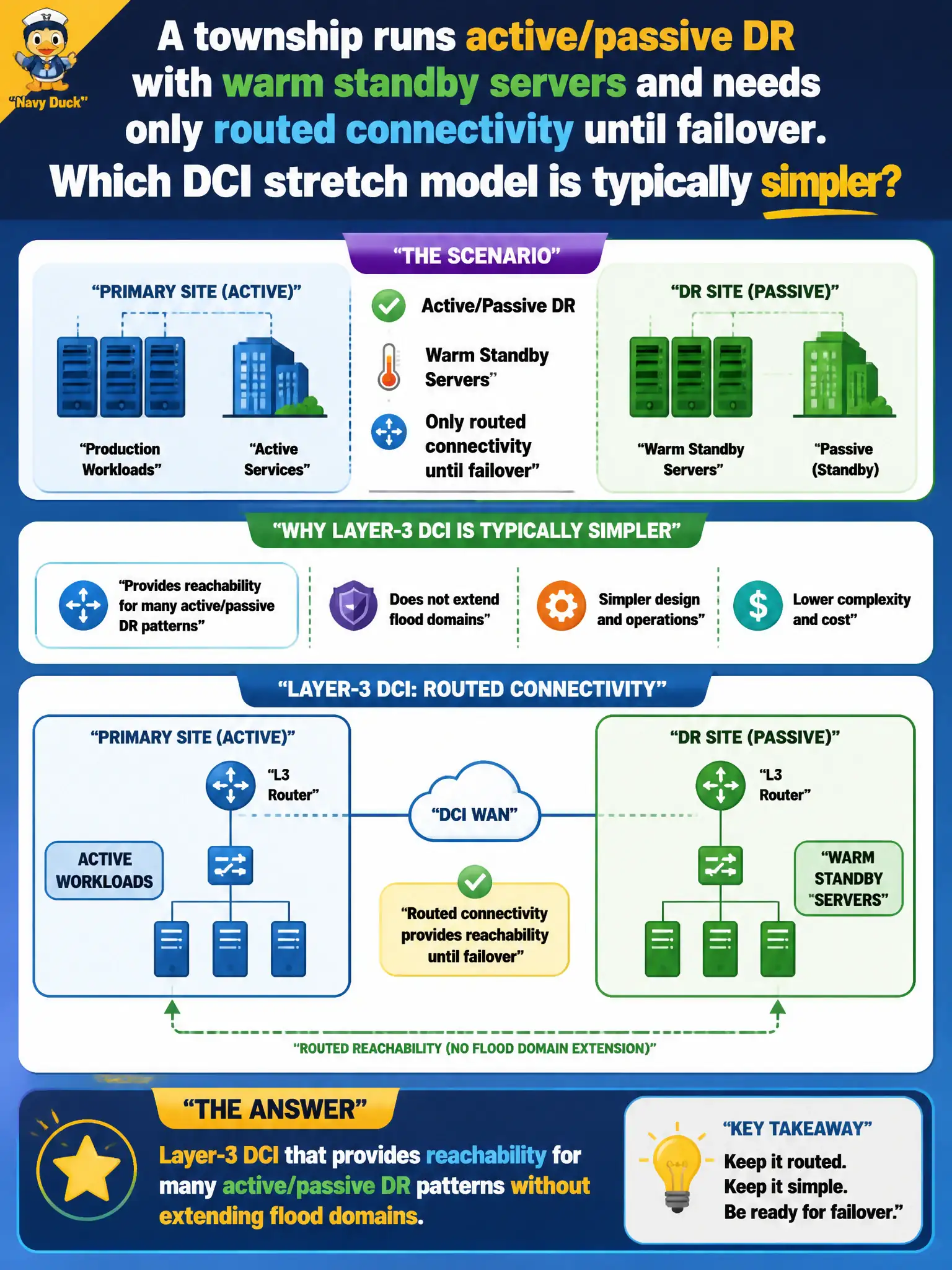
Warm standby with routed reachability is a friendly fit for L3 DCI. You get connectivity for DR patterns without lighting up a stretched flood domain on day one.
Full Explanation
Active/passive DR with warm standby servers that need only routed connectivity until failover is typically simpler with Layer-3 DCI: provide IP reachability without extending flood domains between township halls. Full active/active L2 stretch of every VLAN with dual anycast gateways from day one adds complexity the DR pattern may not need. Native metro L2 E-LAN for all tenants plus unrestricted BUM flooding maximizes risk. Merging both DC fabrics into one underlay ASN so standby servers share ARP tables live is an oversized underlay merge. Exam caveat: when failover requires identical MAC/IP without re-IP, a limited L2 stretch exception may still be warranted—keep it narrow. Operational check: implement L3 DCI for the warm-standby apps, rehearse failover with DNS/routing cuts, and add selective L2 stretch only if a named application fails the L3 rehearsal. Rehearse warm-standby failover on L3 DCI first; add narrow L2 stretch only when a named app fails that rehearsal. Rehearse warm-standby failover on L3 DCI first; add narrow L2 stretch only when a named app fails that rehearsal. Rehearse warm-standby failover on L3 DCI first; add narrow L2 stretch only when a named app fails that rehearsal.