
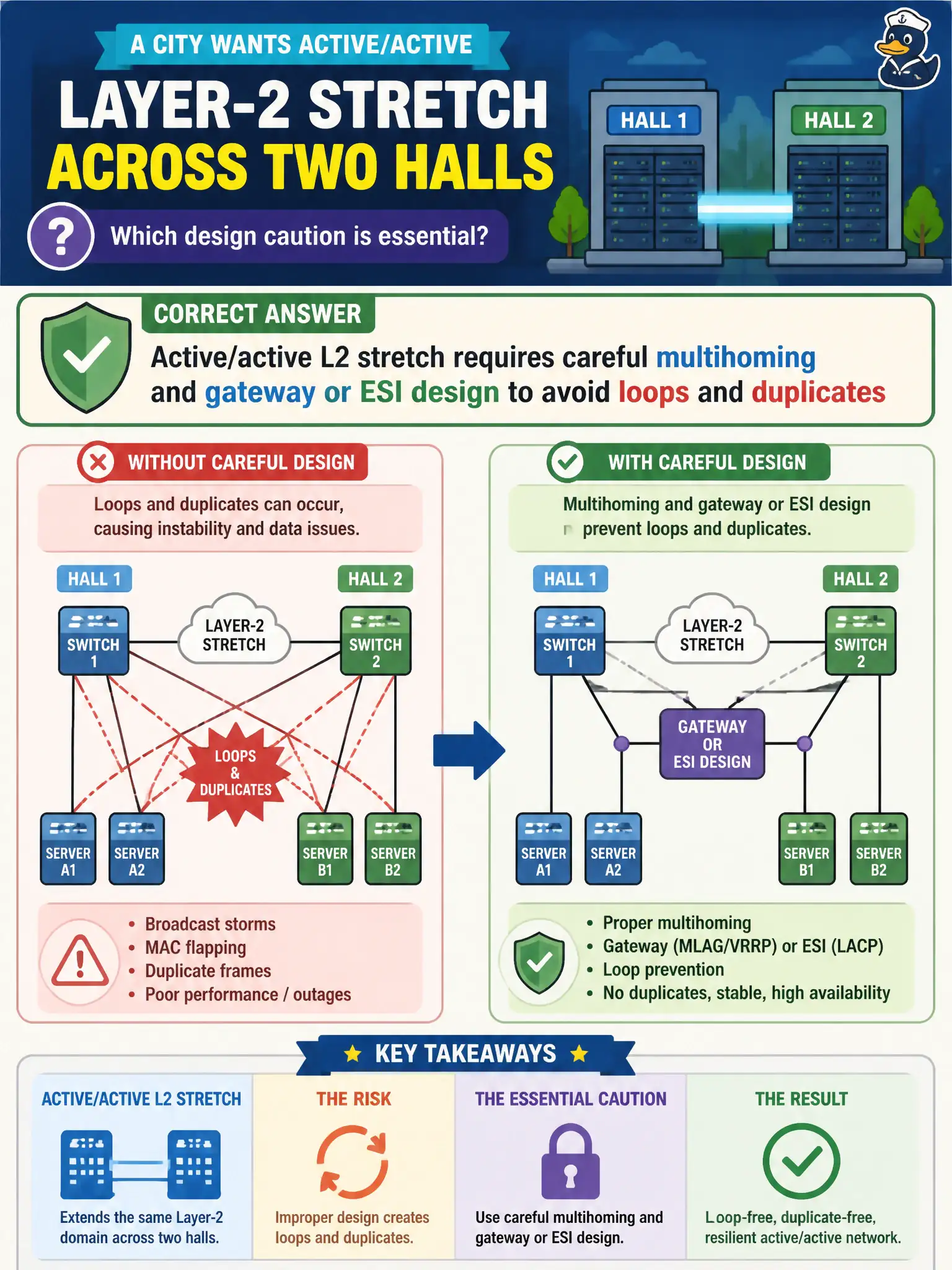
A city wants active/active Layer-2 stretch across two halls. Which design caution is essential?
Select an answer to reveal the explanation.
Short Explanation
Active/active L2 stretch without careful ESI and gateway design is how you invent loops and duplicate packets. Multihoming detail is not optional.
Full Explanation
Active/active Layer-2 stretch across two halls demands careful multihoming and gateway or ESI design to avoid loops and duplicate frames. EVPN provides tools, but it does not make active/active L2 stretch free of gateway/ESI engineering. It is false that active/active L2 stretch never needs gateway or multihoming design because EVPN forbids loops by magic. ESI and gateway design are not only for L3 Type-5 stretch. Advertising the same underlay ASN from every leaf does not solve active/active L2 stretch. Exam caveat: anycast gateways plus ESI DF behavior must be validated under failure—partial failures create the ugliest municipal split-brain cases. Operational check: build active/active L2 stretch in a lab with consistent ESI/gateway design, fail one DCI path and one leaf, check for duplicates/loops, and only then promote to city production. Do not declare active/active L2 stretch production-ready until ESI/gateway failure drills show zero sustained duplicates. Do not declare active/active L2 stretch production-ready until ESI/gateway failure drills show zero sustained duplicates. Do not declare active/active L2 stretch production-ready until ESI/gateway failure drills show zero sustained duplicates.