
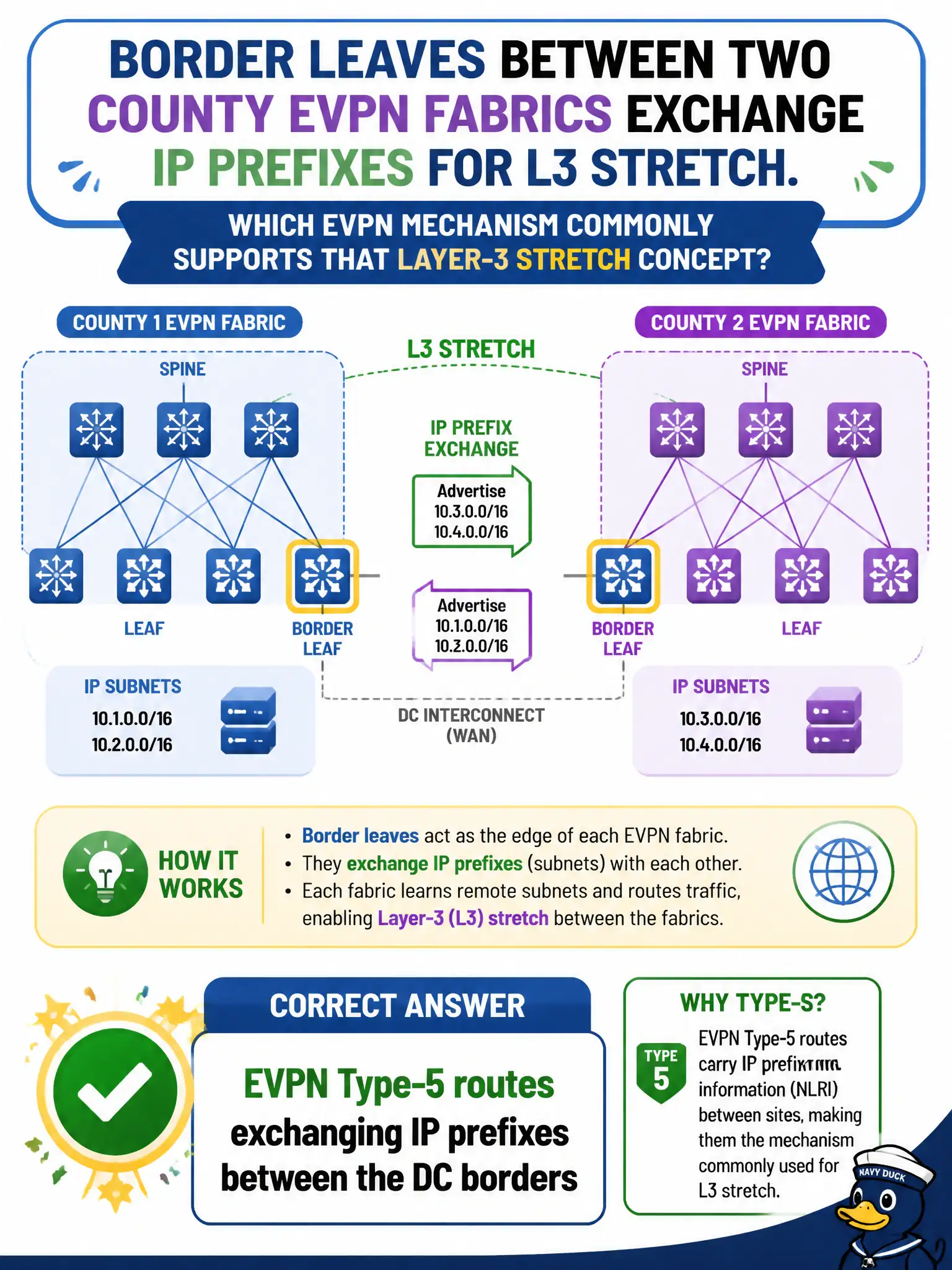
Border leaves between two county EVPN fabrics exchange IP prefixes for L3 stretch. Which EVPN mechanism commonly supports that Layer-3 stretch concept?
Select an answer to reveal the explanation.
Short Explanation
Type-5 is the common EVPN tool for saying "here are IP prefixes" between borders. That is L3 stretch signaling in the EVPN-VXLAN DCI toolkit.
Full Explanation
Border leaves exchanging IP prefixes for L3 stretch between county EVPN fabrics commonly use EVPN Type-5 routes as the inter-DC prefix mechanism. That is the EVPN signaling concept behind Layer-3 stretch in this blueprint area. Type-1 Ethernet A-D routes are not the only allowed inter-DC prefix tool; they serve multihoming Auto-Discovery roles. Disabling MBGP and flooding host routes as Layer-2 MAC-only entries abandons L3 stretch. Stretching the underlay IGP into every tenant VRF without EVPN breaks isolation patterns. Exam caveat: Type-2 host routes can contribute to some L3 host-based designs, but the standard prefix-between-borders answer for L3 stretch centers on Type-5—know your city's chosen model. Operational check: on both county borders, confirm Type-5 advertisement/import for the tenant VRF, ping across sites, and verify no L2 VNI stretch is required for that traffic. Confirm Type-5 on both county borders as the acceptance test for L3 stretch before applications are cut over. Confirm Type-5 on both county borders as the acceptance test for L3 stretch before applications are cut over. Confirm Type-5 on both county borders as the acceptance test for L3 stretch before applications are cut over.