
After a city enables Layer-2 stretch DCI, ARP floods are observed crossing the WAN. What BUM impact should operators expect from L2 stretch?
Select an answer to reveal the explanation.
Short Explanation
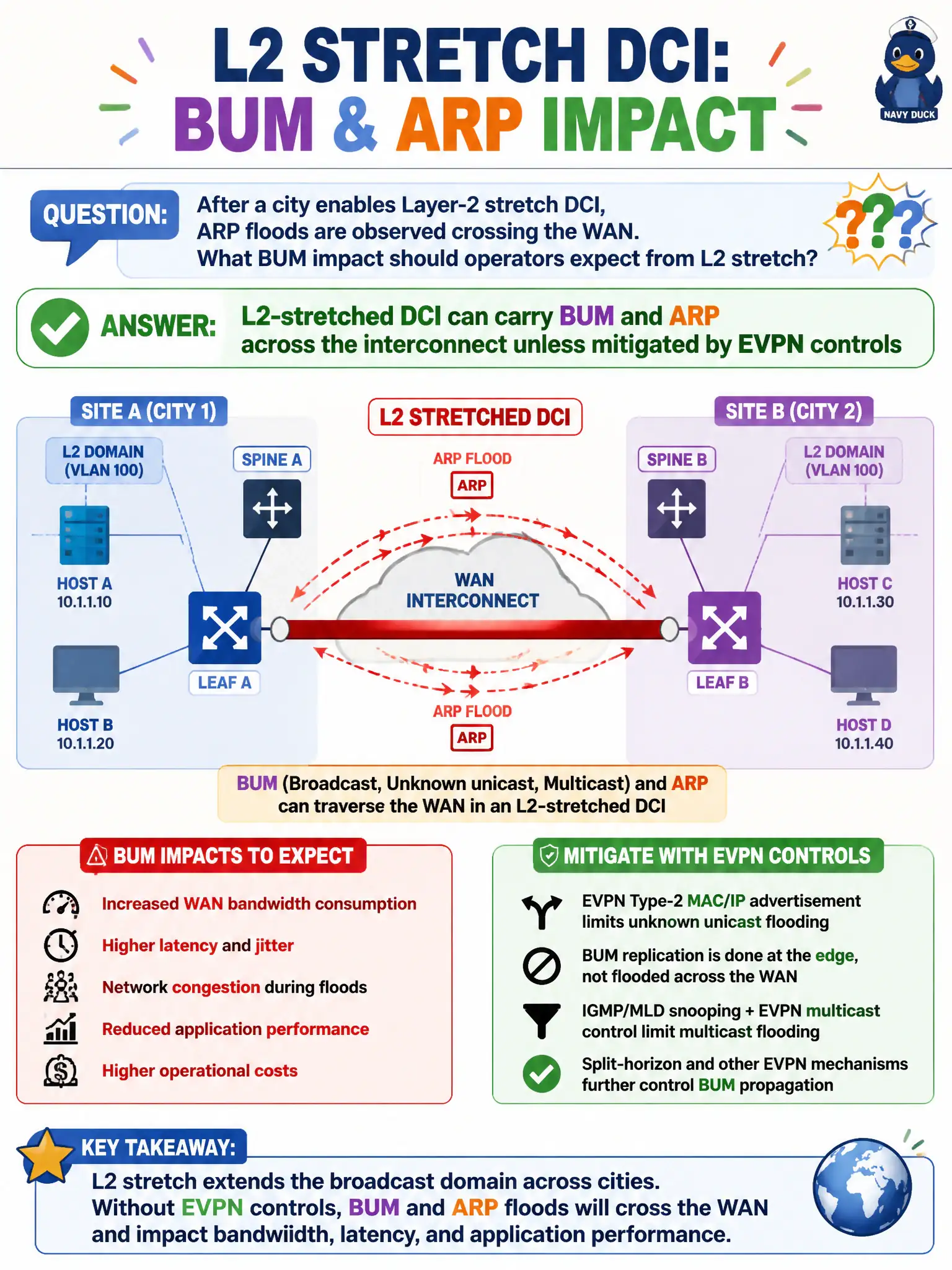
Once L2 stretch is on, BUM and ARP can hitch a ride across the WAN unless EVPN controls rein them in. Expect that behavior; design for it.
Full Explanation
After enabling Layer-2 stretch DCI, operators should expect that L2-stretched segments can carry BUM and ARP across the interconnect unless mitigated by EVPN controls such as ARP suppression, proxy, or selective multicast features. Observing ARP floods on the WAN is consistent with L2 stretch behavior, not a mystery. L2 stretch can forward ARP/BUM between sites. ARP floods are not redirected only to the underlay RR. BUM behavior is not limited to Type-5 routes and can absolutely appear on L2-stretched VNIs. Exam caveat: mitigation reduces but may not eliminate all BUM; capacity planning for municipal DCI must include worst-case storms on stretched VNIs. Operational check: capture ARP/BUM on the DCI when stretch is enabled, enable suppression/controls, quantify reduction, and set alerting when BUM rates exceed baselines. Baseline ARP/BUM rates on L2-stretched DCI links and alert when municipal storm controls are clearly losing. Baseline ARP/BUM rates on L2-stretched DCI links and alert when municipal storm controls are clearly losing. Baseline ARP/BUM rates on L2-stretched DCI links and alert when municipal storm controls are clearly losing. Baseline ARP/BUM rates on L2-stretched DCI links and alert when municipal storm controls are clearly losing.