
A municipal design needs some VNIs Layer-2 stretched between DCs while other tenants need Layer-3 reachability only. Which stretch approach is appropriate?
Select an answer to reveal the explanation.
Short Explanation
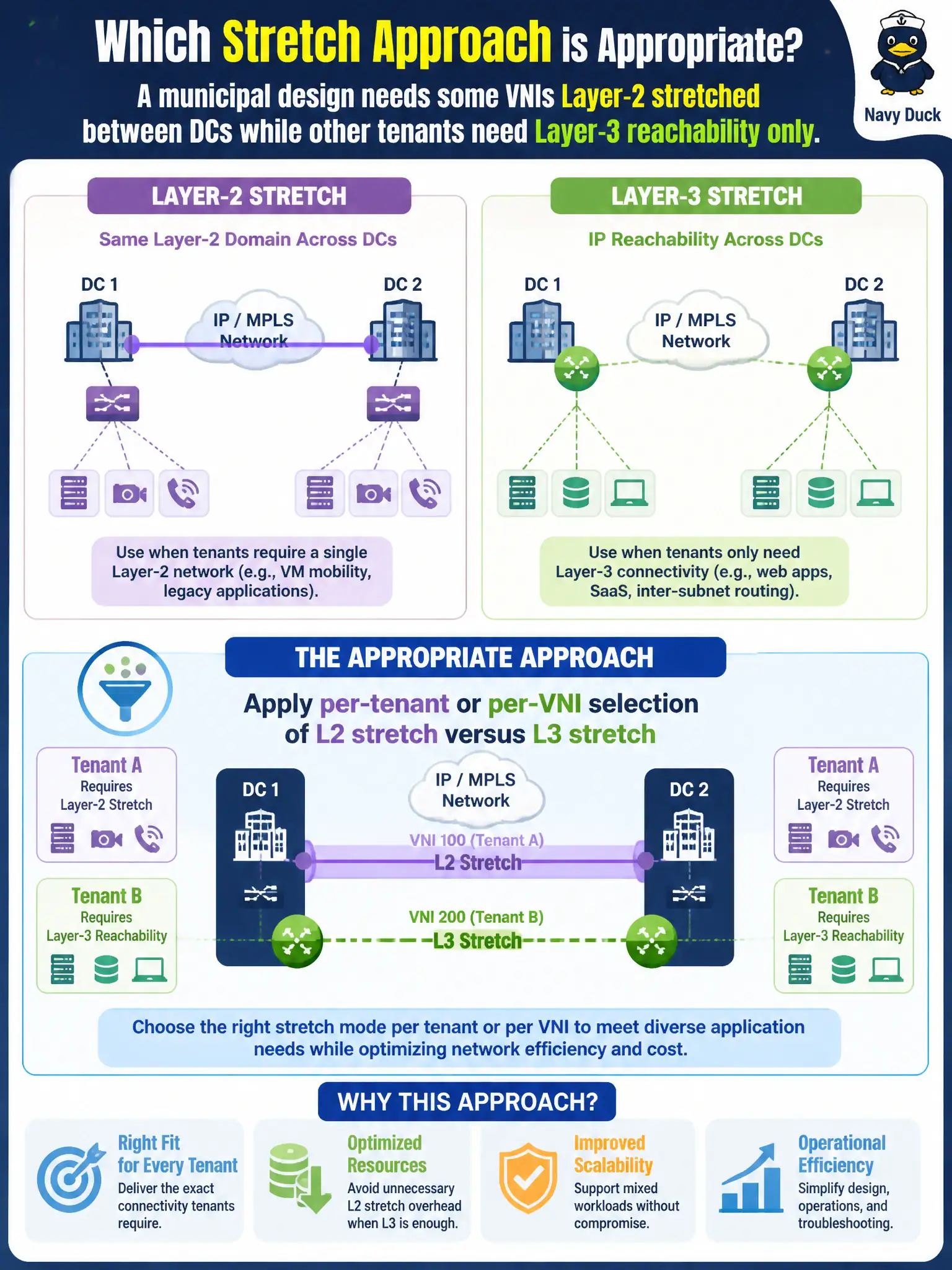
Tenants are not a monolith. Stretch the VNIs that truly need L2; give the rest L3-only—per VNI, on purpose.
Full Explanation
Municipal designs commonly apply per-tenant or per-VNI selection of L2 stretch versus L3 stretch: some VNIs extend broadcast domains between DCs while other tenants exchange only prefixes. That selective approach is appropriate and expected. It is false that all VNIs must use the same stretch mode once any L2 stretch exists. Selective stretch is not impossible, nor is it tied to choosing only dark fiber or only Internet DCI. L3-only tenants do not need to leave EVPN for static GRE on the spines. Exam caveat: operational complexity rises with mixed modes—document each tenant's mode in the runbook so NOC does not troubleshoot L3 tenants with L2 stretch playbooks. Operational check: label each city tenant as L2-stretched or L3-only, verify signaling (Type-2/3 versus Type-5) matches the label, and test failover per class without cross-applying procedures. Publish a per-tenant stretch-mode matrix so mixed L2/L3 DCI does not produce mismatched troubleshooting during incidents. Publish a per-tenant stretch-mode matrix so mixed L2/L3 DCI does not produce mismatched troubleshooting during incidents. Publish a per-tenant stretch-mode matrix so mixed L2/L3 DCI does not produce mismatched troubleshooting during incidents.