
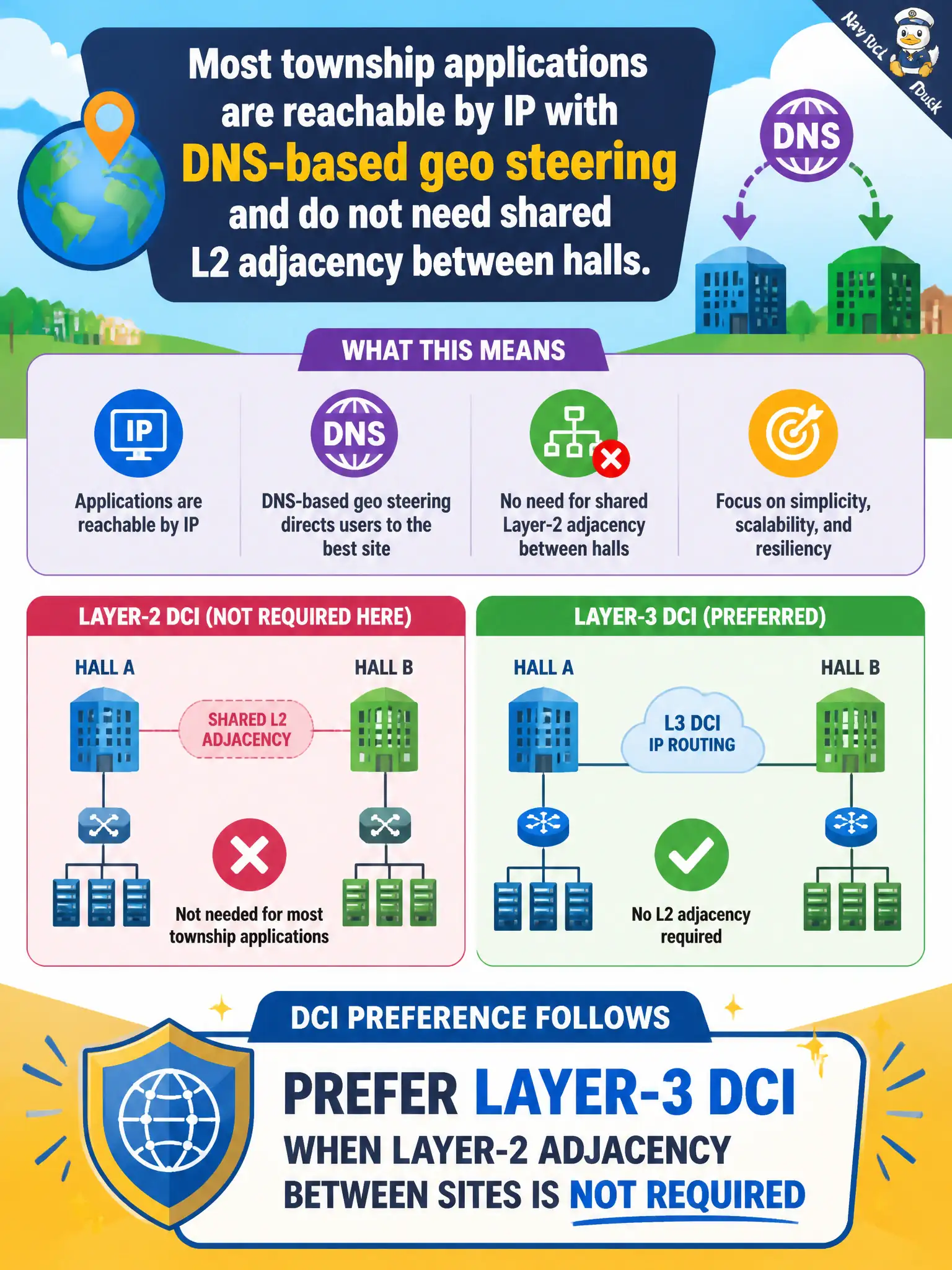
Most township applications are reachable by IP with DNS-based geo steering and do not need shared L2 adjacency between halls. Which DCI preference follows?
Select an answer to reveal the explanation.
Short Explanation
If apps are happy with IP reachability and DNS geo, do not gift them a stretched flood domain. Prefer L3 DCI when L2 adjacency is not on the requirement list.
Full Explanation
When most township applications are reachable by IP with DNS-based geo steering and do not need shared L2 adjacency between halls, prefer Layer-3 DCI. Extending flood domains adds risk without application benefit. Stretching every VNI at Layer 2 to maximize flood-domain consistency is the opposite of good judgment here. Forcing active/active anycast gateways on every VLAN even without L2 stretch confuses gateway design with stretch requirements. Collapsing both fabrics into one underlay so DNS geo is unnecessary creates a larger failure domain. Exam caveat: a minority of apps may still need L2 stretch—use per-VNI exceptions rather than abandoning the L3 default. Operational check: inventory municipal apps for true L2 adjacency needs; default them to Type-5/L3 DCI; enable DNS geo tests across halls; approve L2 stretch only with a named owner and expiry review. Default township apps to L3 DCI and DNS geo, and track L2 stretch exceptions with owners and review dates. Default township apps to L3 DCI and DNS geo, and track L2 stretch exceptions with owners and review dates. Default township apps to L3 DCI and DNS geo, and track L2 stretch exceptions with owners and review dates. Default township apps to L3 DCI and DNS geo, and track L2 stretch exceptions with owners and review dates.