
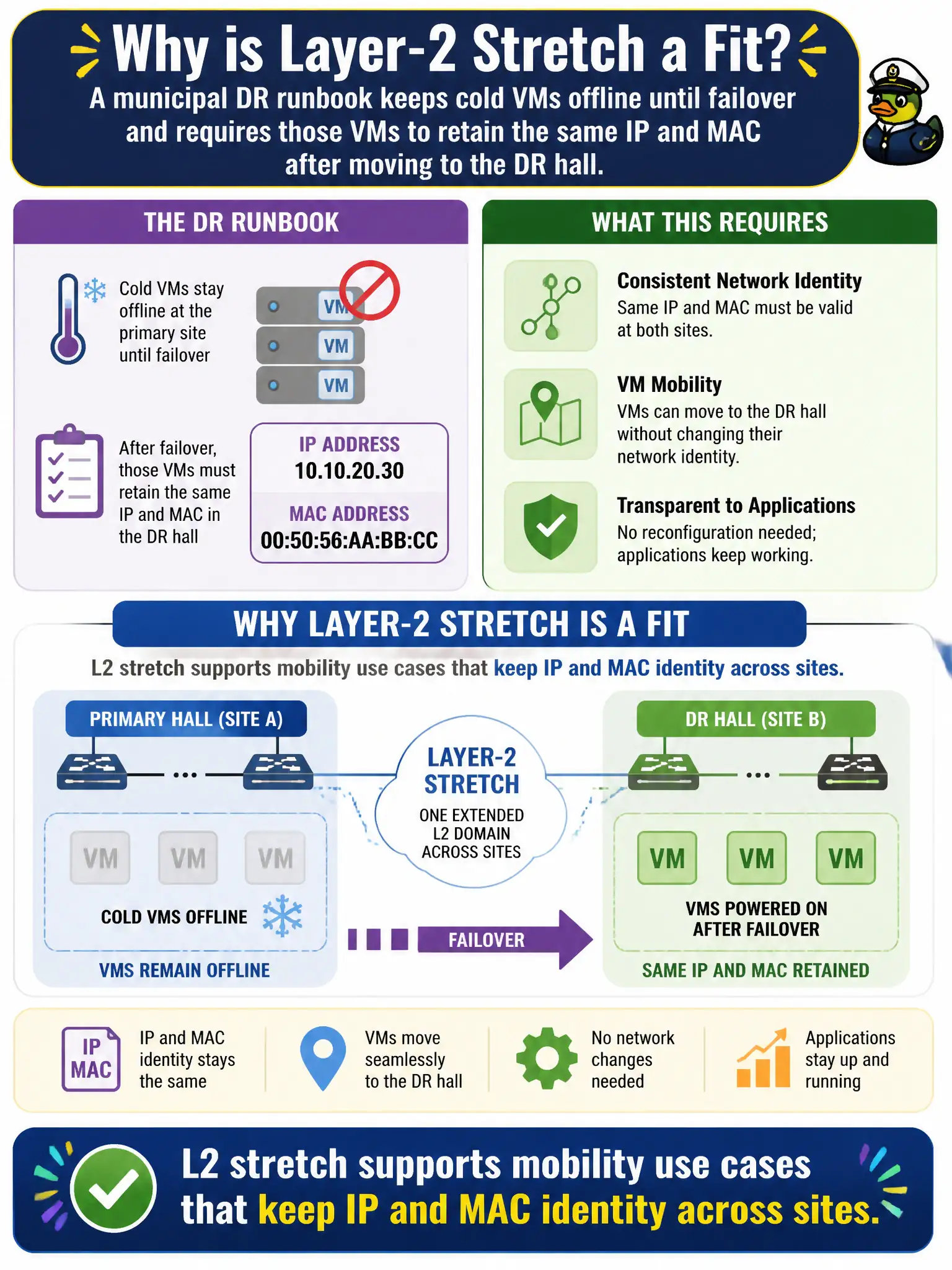
A municipal DR runbook keeps cold VMs offline until failover and requires those VMs to retain the same IP and MAC after moving to the DR hall. Why is Layer-2 stretch a fit?
Select an answer to reveal the explanation.
Short Explanation
Cold VMs that must wake up with the same IP and MAC are the textbook L2-stretch mobility story. Keep the Layer-2 identity continuous across the DR move.
Full Explanation
Cold VMs that must retain the same IP and MAC after moving to a DR hall fit Layer-2 stretch because the stretched broadcast domain preserves L2 identity across municipal sites when the VMs come online at DR. That mobility use case is a classic justification for selective L2 stretch. L2 stretch is not only for underlay BGP sessions between spines. Cold VMs are not limited to Type-5-only L3 stretch if they must keep MAC/IP identity without re-IP or NAT. Filter-based forwarding on the WAN PE alone does not preserve EVPN L2 identity across sites. Exam caveat: cold/standby mobility still needs controlled activation so both sites do not simultaneously bridge the same MACs—pair L2 stretch with runbooks that prevent split-brain. Operational check: stretch only the DR-relevant VNI, boot a standby VM at the DR hall with the same IP/MAC, confirm EVPN MAC mobility updates, and verify the primary hall is offline for that MAC during test failover. Pair cold-VM L2 stretch with hard split-brain guards so primary and DR halls never bridge the same MAC concurrently. Pair cold-VM L2 stretch with hard split-brain guards so primary and DR halls never bridge the same MAC concurrently. Pair cold-VM L2 stretch with hard split-brain guards so primary and DR halls never bridge the same MAC concurrently.