
A city fears broadcast storms if it stretches Layer-2 segments between data centers. Which L2-versus-L3 stretch tradeoff should guide the decision?
Select an answer to reveal the explanation.
Short Explanation
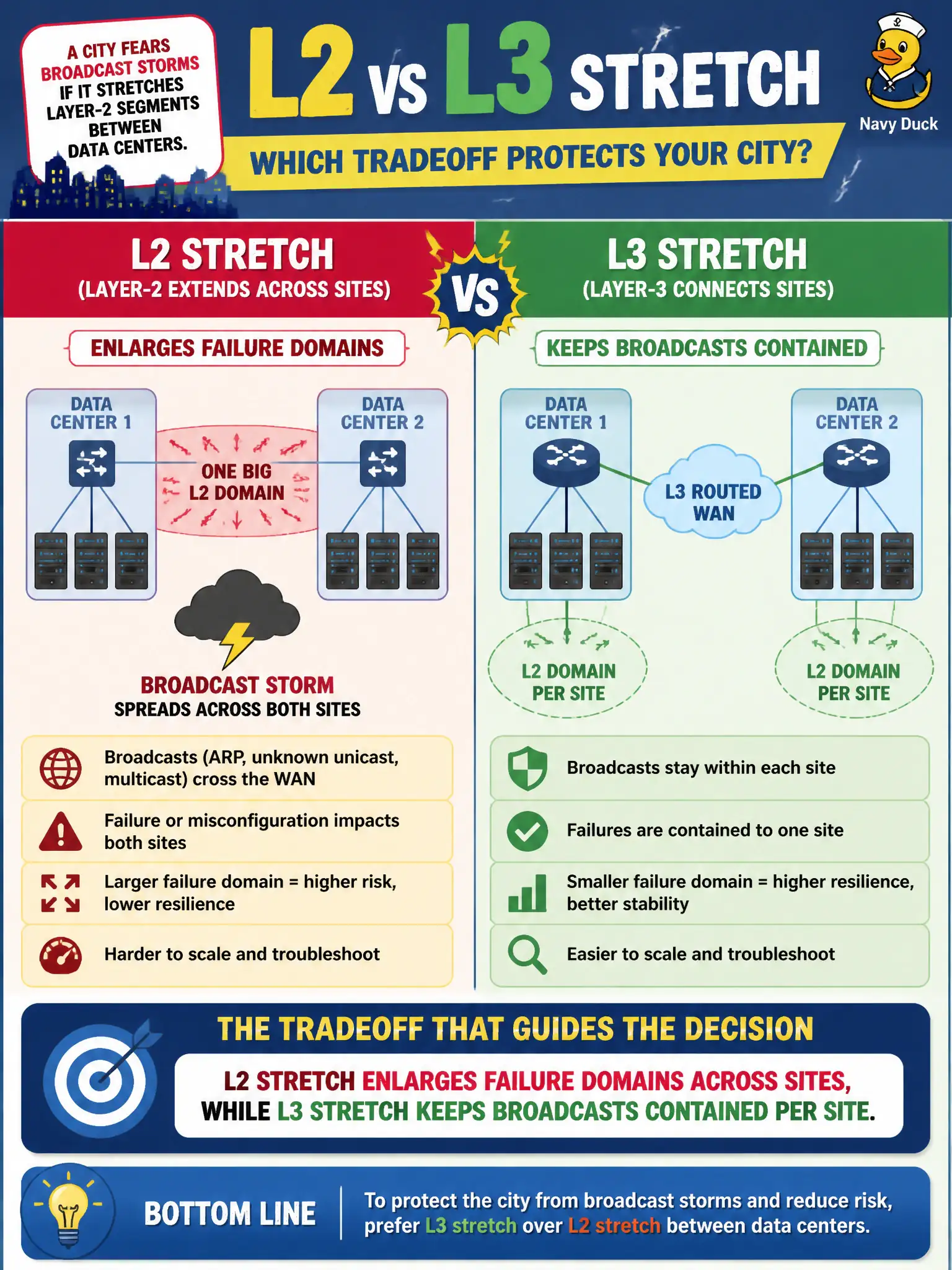
Stretching L2 is stretching the storm radius. L3 stretch keeps broadcasts local per site; that is the core risk tradeoff the city is worrying about.
Full Explanation
The core L2-versus-L3 stretch tradeoff is that L2 stretch enlarges failure domains across sites—BUM, loops, and storms can span the city WAN—while L3 stretch keeps broadcasts contained per site and exchanges only routed reachability. That tradeoff should guide fear of broadcast storms. L2 stretch does not shrink failure domains, and L3 stretch does not always flood ARP across the WAN. L3 stretch does not enlarge Layer-2 risk domains more than L2 stretch. Stretch model absolutely affects broadcast/BUM behavior across DCI. Exam caveat: EVPN ARP suppression and selective multicast mitigate but do not erase L2 stretch risk—mitigations are not a license to stretch every VLAN. Operational check: for a candidate VNI, compare BUM volume with L2 stretch enabled versus L3-only DCI in a municipal lab, document storm blast radius, and require written exception approval for any L2 stretch into production. Use blast-radius comparisons in design reviews whenever someone proposes stretching another VLAN between city halls. Use blast-radius comparisons in design reviews whenever someone proposes stretching another VLAN between city halls. Use blast-radius comparisons in design reviews whenever someone proposes stretching another VLAN between city halls.