
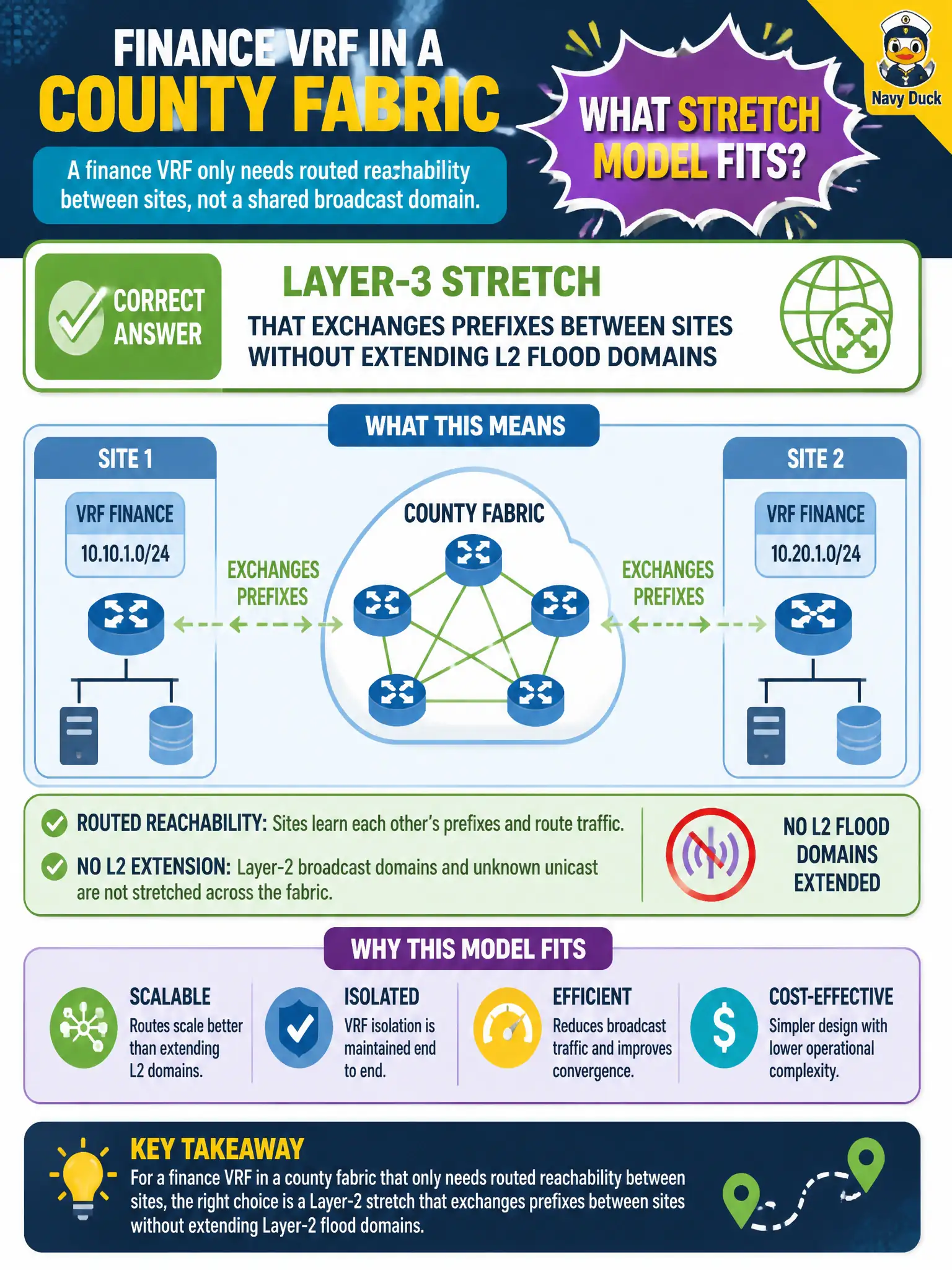
A finance VRF in a county fabric only needs routed reachability between sites, not a shared broadcast domain. Which stretch model fits?
Select an answer to reveal the explanation.
Short Explanation
Finance only needs to dial the other site by IP, not share the same Ethernet party line. L3 stretch exchanges prefixes and leaves flood domains at home.
Full Explanation
A finance VRF that only needs routed reachability between county sites should use Layer-3 stretch that exchanges prefixes between sites without extending L2 flood domains. That keeps ARP and broadcasts site-local while still providing IP connectivity for applications. Layer-2 stretch of every finance VLAN across the metro handoff is unnecessary risk. Merging both DC underlays into one ASN so ARP floods everywhere is the wrong boundary design. Disabling EVPN and bridging finance traffic as raw Ethernet on the WAN is unsafe and unmanaged. Exam caveat: host /32 Type-2-based routing differs from subnet Type-5 L3 stretch—pick the L3 mechanism the municipal design standardized on, but still avoid L2 stretch when not required. Operational check: advertise finance prefixes with Type-5 or agreed L3 DCI, confirm inter-site TCP/IP works, capture that ARP storms do not cross the DCI, and keep finance VNIs site-scoped. Keep finance and similar routed tenants on Type-5 L3 DCI with site-local broadcast domains unless a waiver exists. Keep finance and similar routed tenants on Type-5 L3 DCI with site-local broadcast domains unless a waiver exists. Keep finance and similar routed tenants on Type-5 L3 DCI with site-local broadcast domains unless a waiver exists.