
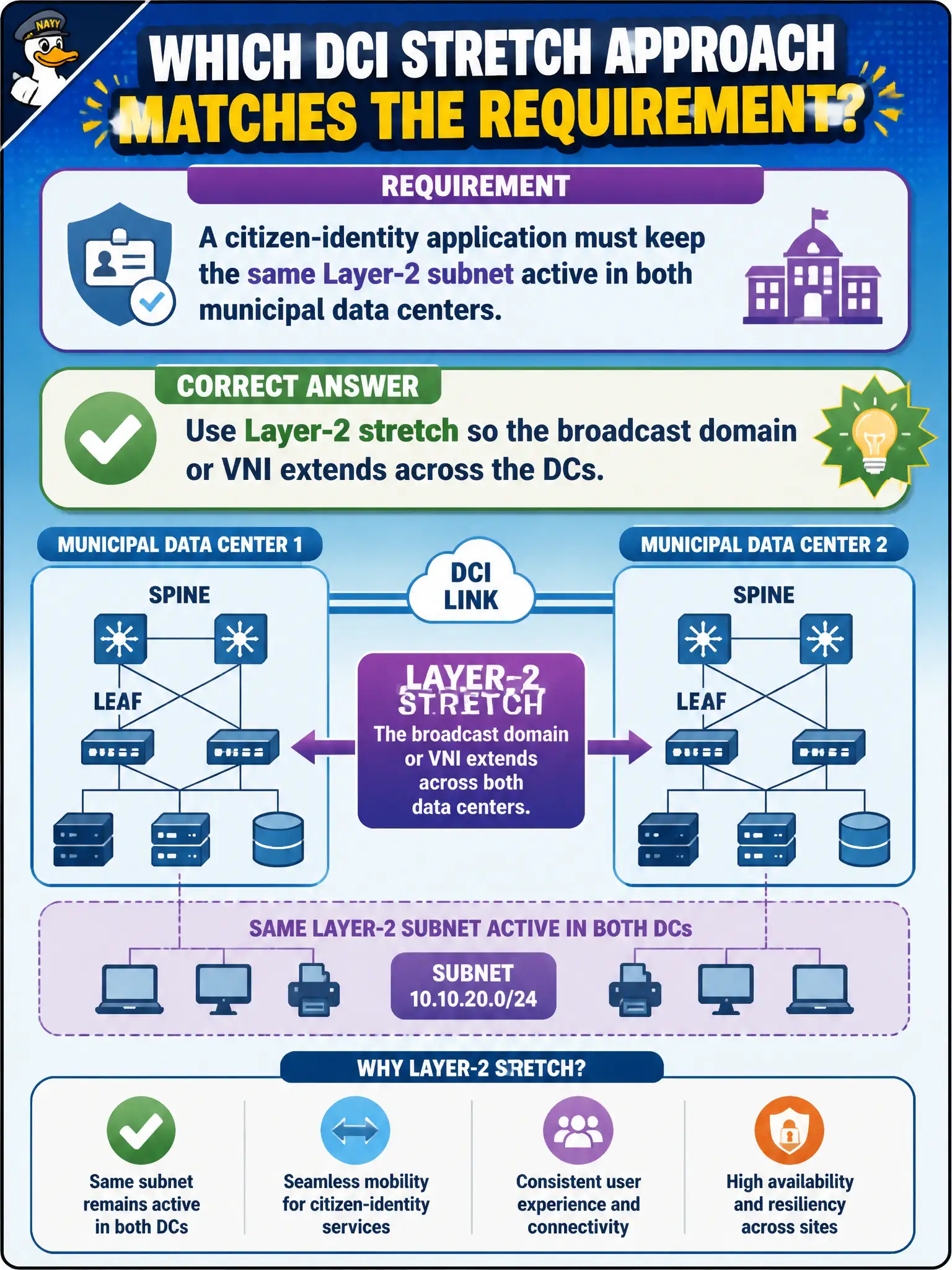
A citizen-identity application must keep the same Layer-2 subnet active in both municipal data centers. Which DCI stretch approach matches that requirement?
Select an answer to reveal the explanation.
Short Explanation
Same subnet alive in both halls means the Layer-2 neighborhood has to stretch. That is L2 DCI stretch extending the broadcast domain or VNI—not Type-5-only routed prefixes.
Full Explanation
Keeping the same Layer-2 subnet active in both municipal data centers for a citizen-identity application requires Layer-2 stretch so the broadcast domain or VNI extends across the DCs and hosts can retain L2 adjacency. Advertising only Type-5 IP prefixes while blocking MAC routes provides L3 reachability, not a shared subnet broadcast domain. Duplicating the subnet in each DC without stretch and relying on longest-match alone creates overlapping addressing conflicts rather than a stretched subnet. Replacing the subnet with Group-Based Policy tags and removing all EVPN signaling does not meet a same-subnet L2 requirement by itself. Exam caveat: L2 stretch enables the requirement but enlarges failure domains—pair it with EVPN controls, careful BUM handling, and a clear justification versus re-IP. Operational check: enable L2 stretch for that VNI between city borders, confirm Type-2 MAC learning across sites, verify ARP/ping on the shared subnet across halls, and monitor BUM on the DCI. Limit shared-subnet L2 stretch to named citizen apps that truly need it, with BUM monitoring on the DCI from day one. Limit shared-subnet L2 stretch to named citizen apps that truly need it, with BUM monitoring on the DCI from day one.