
A municipal fabric design places MPLS PE routers between two data centers as the DCI underlay. How should that interconnect network type be treated?
Select an answer to reveal the explanation.
Short Explanation
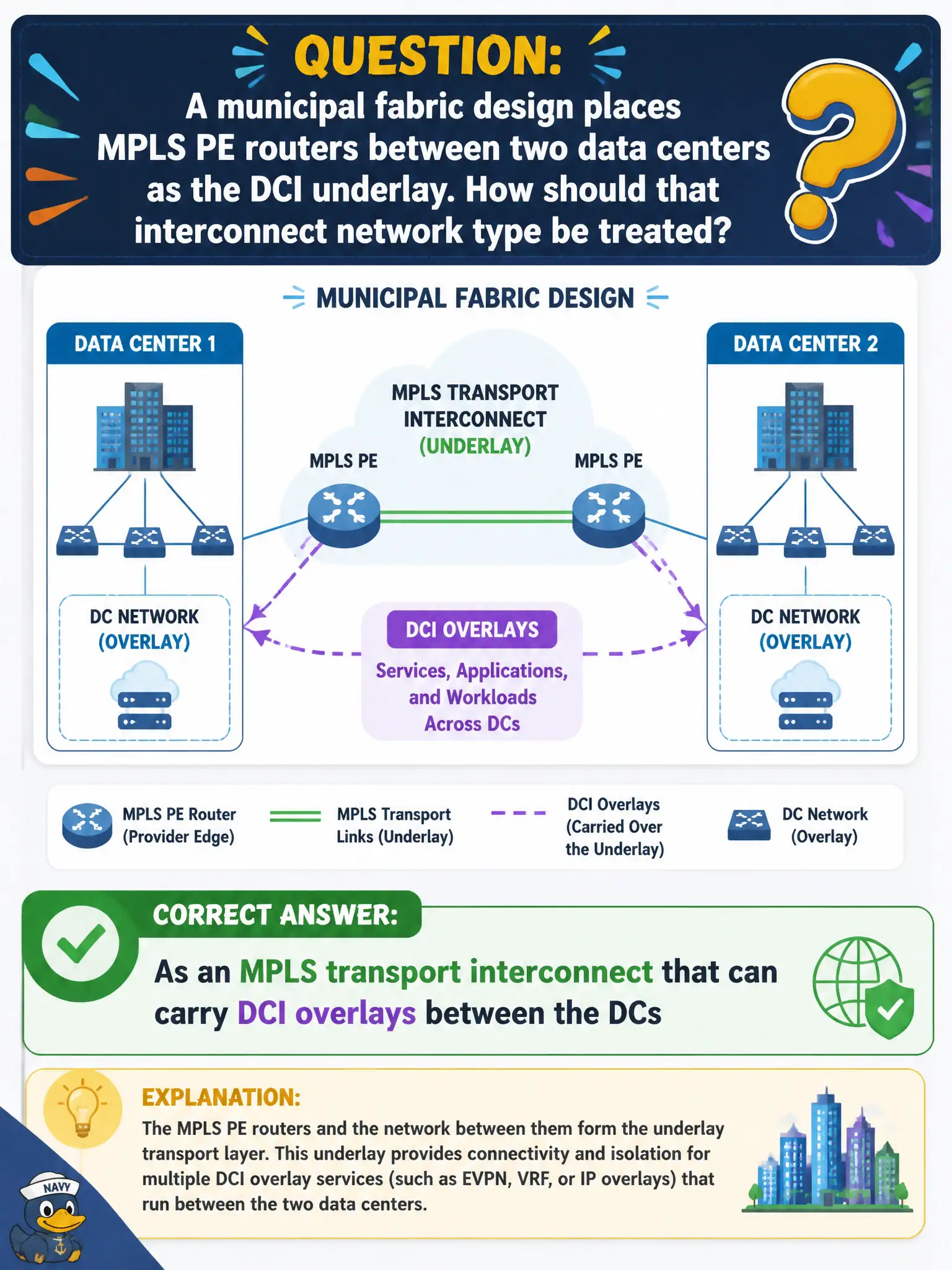
MPLS PEs between DCs are the transport underlay, not a magic "delete EVPN" button. Treat MPLS as an interconnect network type that can carry your DCI overlays between sites.
Full Explanation
MPLS PE routers between two municipal data centers should be treated as an MPLS transport interconnect that can carry DCI overlays—EVPN-VXLAN or other overlay handoffs—between the DCs. MPLS is the underlay/transport style, not an automatic replacement that removes all overlay signaling. It does not prove dark fiber is required before any DCI overlay can form. It is not an Apstra blueprint object that bans border gateway roles on Junos switches. Exam caveat: whether you map EVPN over MPLS or terminate VXLAN onto MPLS/IP borders depends on platform and design; classify the interconnect as MPLS transport first, then specify the overlay. Operational check: verify LSP/reachability between DC borders across the MPLS core, confirm overlay DCI sessions or tunnels form over that transport, and ensure tenant route exchange (for example Type-5 or L2 EVPN) matches the stretch plan. Treat MPLS DCI as a transport checkbox in designs, then validate overlay EVPN adjacency and tenant isolation on top of the LSPs. Treat MPLS DCI as a transport checkbox in designs, then validate overlay EVPN adjacency and tenant isolation on top of the LSPs. Treat MPLS DCI as a transport checkbox in designs, then validate overlay EVPN adjacency and tenant isolation on top of the LSPs.