
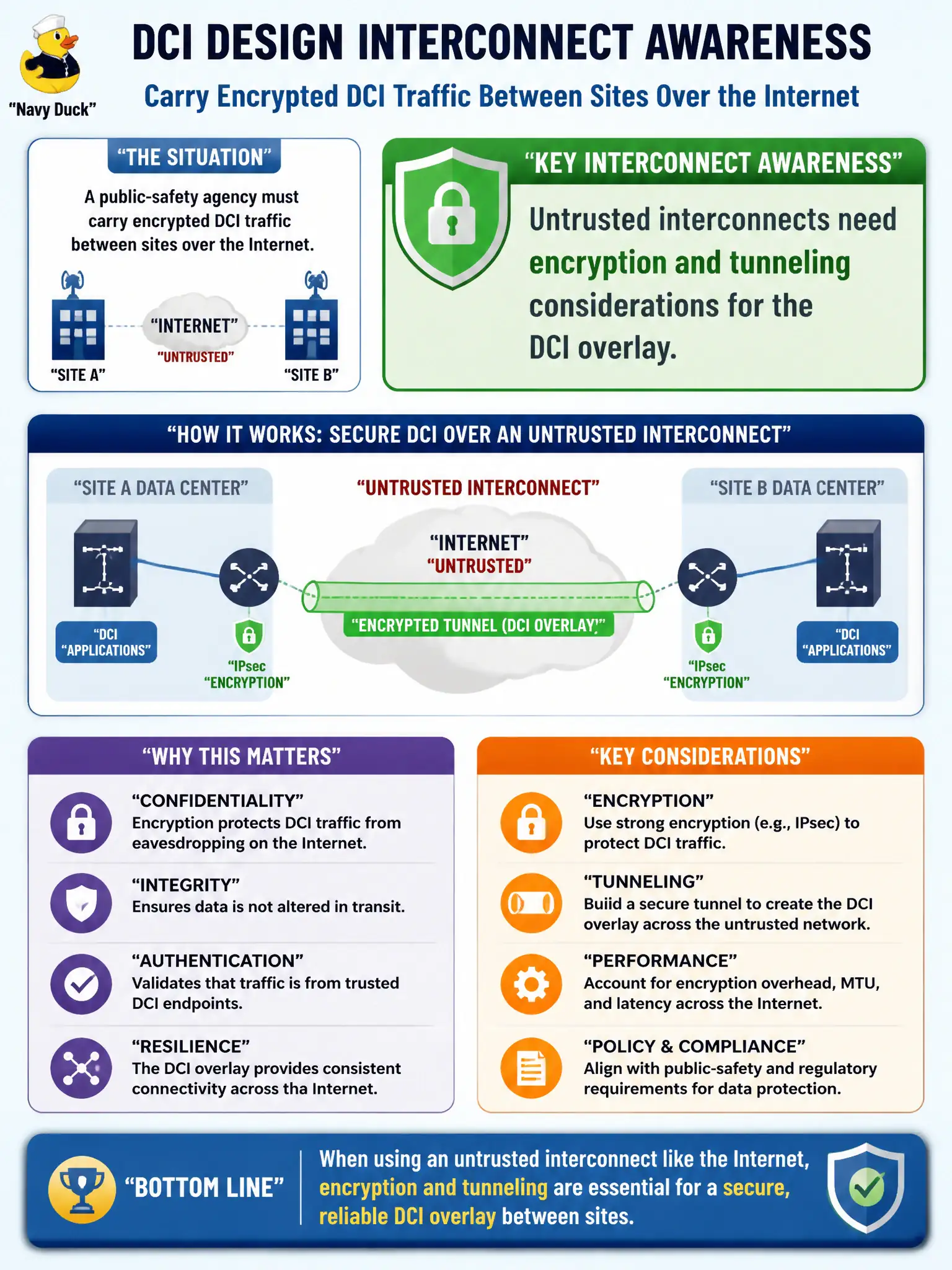
A public-safety agency must carry encrypted DCI traffic between sites over the Internet. Which interconnect awareness is most appropriate for the DCI design?
Select an answer to reveal the explanation.
Short Explanation
Sending DCI over the open Internet is like shipping vault keys through the public mail—wrap them. Untrusted interconnects need encryption and tunneling in the DCI plan, not a shrug that security is "someone else's exam."
Full Explanation
Carrying DCI over the Internet for a public-safety agency means the interconnect is untrusted: encryption and tunneling considerations for the DCI overlay are mandatory design inputs, not optional cosmetics. Internet interconnects do not provide native L2 stretch without tunnels. Encryption is not only a JNCIP-SEC topic to ignore in DCI interconnect planning—JNCIP-DC DCI design still expects awareness of untrusted transport. Internet DCI does not require merging both fabrics into one shared underlay ASN. Exam caveat: encryption solves confidentiality but not routing MTU, performance, or failure-domain questions—still choose L3 versus L2 stretch wisely on top of the tunnel. Operational check: place IPsec or an equivalent secure tunnel between municipal borders over the Internet, clamp MTU for overlay headers, validate EVPN/L3 DCI adjacency through the tunnel, and test failover when the Internet path degrades. Pair Internet DCI encryption with MTU and loss runbooks so public-safety overlays survive real Internet path behavior. Pair Internet DCI encryption with MTU and loss runbooks so public-safety overlays survive real Internet path behavior. Pair Internet DCI encryption with MTU and loss runbooks so public-safety overlays survive real Internet path behavior.