
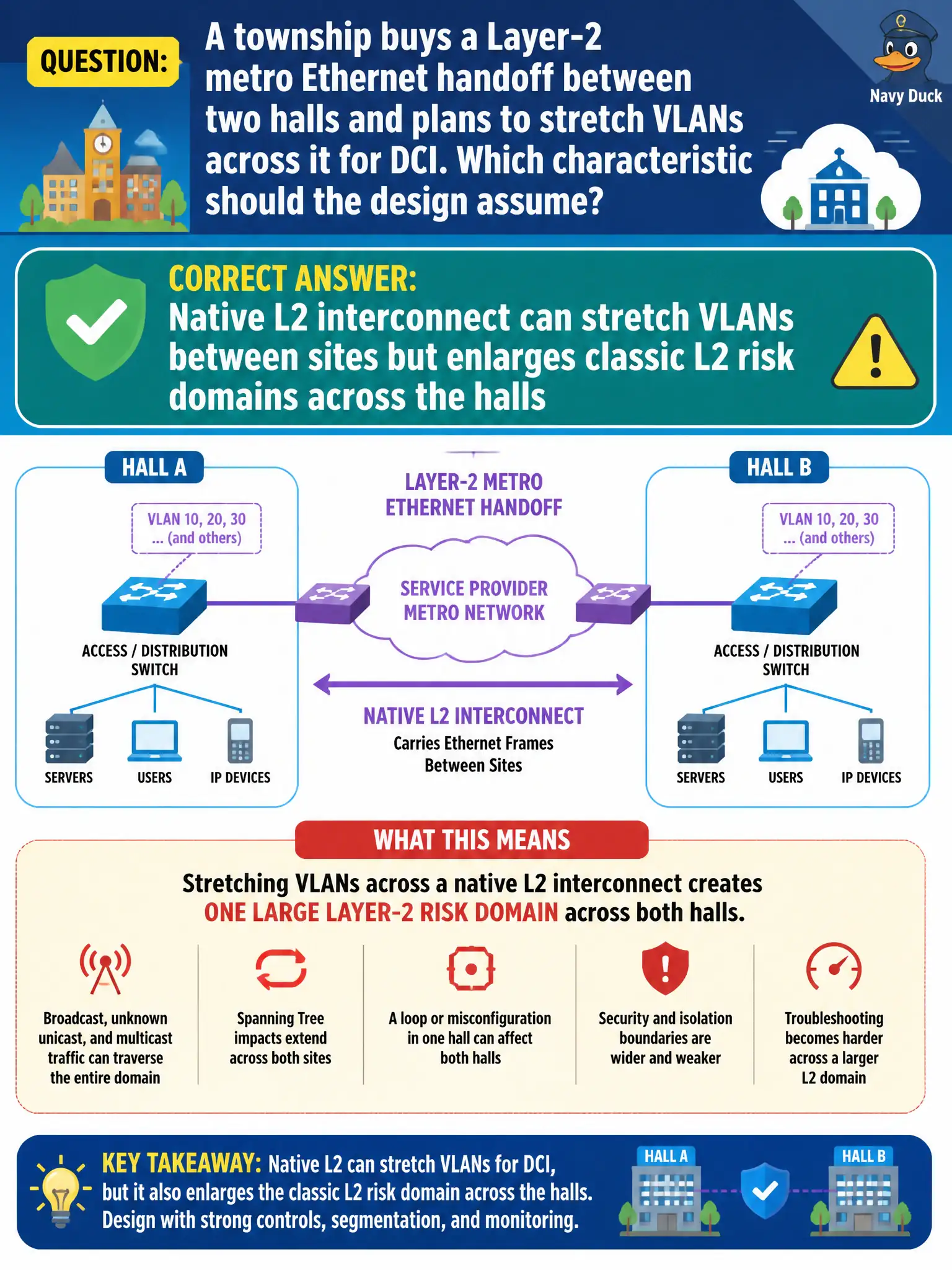
A township buys a Layer-2 metro Ethernet handoff between two halls and plans to stretch VLANs across it for DCI. Which characteristic should the design assume?
Select an answer to reveal the explanation.
Short Explanation
A Layer-2 metro handoff is like wiring two rooms onto the same hallway—handy for VLAN stretch, noisy for failure domains. You gain adjacency and you inherit classic L2 blast-radius risk across both halls.
Full Explanation
A Layer-2 metro Ethernet handoff can stretch VLANs between township halls, but that native L2 interconnect also enlarges classic Layer-2 risk domains—broadcasts, loops, and STP-like behaviors can span sites if not carefully controlled or replaced with EVPN discipline. Designs must assume extended flood-domain risk, not assume metro L2 is free isolation. Native L2 interconnects do extend broadcast domains when VLANs are stretched. Metro L2 handoffs do not automatically encrypt BUM without tunnels or crypto services. L2 metro interconnects do not force Type-5-only EVPN or block MAC routes; L2 stretch may use MAC/EVPN L2 constructs. Exam caveat: even on metro L2, many municipal teams still run EVPN-VXLAN between borders for control-plane MAC learning and loop avoidance rather than raw VLAN stitching alone. Operational check: if stretching VLANs across metro L2, measure BUM across the handoff, validate loop prevention, compare against an EVPN L2 stretch alternative, and document the enlarged failure domain in the DR runbook. If metro L2 is unavoidable, require EVPN controls and an explicit failure-domain acceptance signature from the township risk owner. If metro L2 is unavoidable, require EVPN controls and an explicit failure-domain acceptance signature from the township risk owner.