
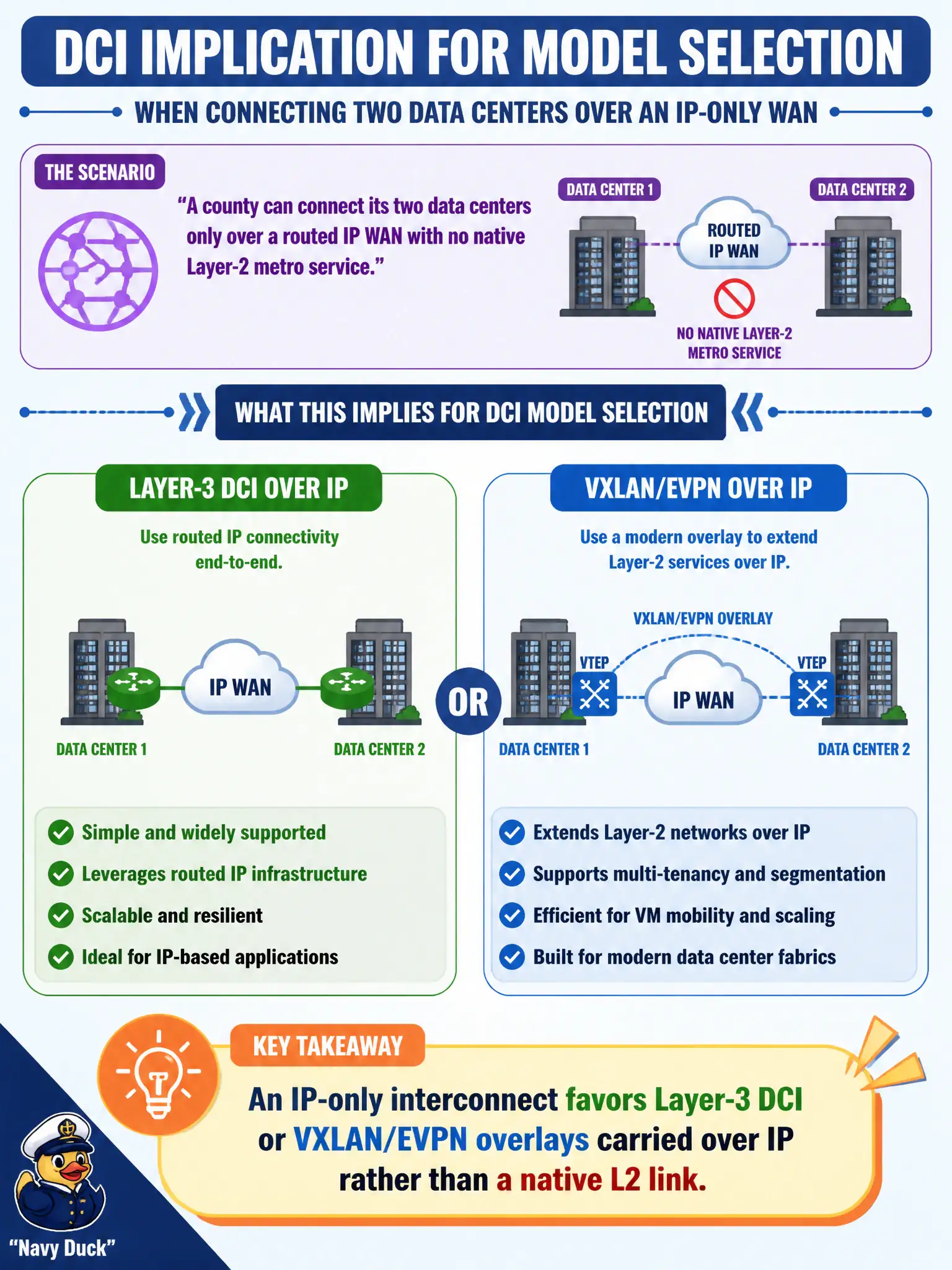
A county can connect its two data centers only over a routed IP WAN with no native Layer-2 metro service. Which DCI implication follows for model selection?
Select an answer to reveal the explanation.
Short Explanation
If the only road between halls is a routed IP WAN, you do not get a free Layer-2 bridge. Overlay or L3 DCI rides that IP path; native VLAN stretch needs a real L2 handoff. Plan the model for the road you actually have.
Full Explanation
When a county can connect data centers only over a routed IP WAN without a native Layer-2 metro service, interconnect reality favors Layer-3 DCI or VXLAN/EVPN overlays carried over IP rather than pretending a native Ethernet stretch exists. That implication guides model selection: build overlays or L3 handoffs that fit IP transport. The sites must not casually merge into one underlay ASN and flood all VNIs as local VLANs across the WAN. Native Ethernet stretch is not required for all DCI; waiting indefinitely for dark fiber is unnecessary if IP DCI meets the applications. Moving all tenant isolation solely to filter-based forwarding on the WAN PE abandons EVPN tenant constructs. Exam caveat: IP-only still needs adequate MTU for VXLAN and careful routing between borders—underlay IP reachability is necessary but not sufficient for healthy overlay DCI. Operational check: confirm WAN MTU and routing between county borders, choose Type-5 L3 or EVPN overlay DCI per tenant, prove tenant isolation across the IP WAN, and avoid bridging raw VLANs across the routed cloud. Prefer EVPN/L3 overlays on county IP WANs and forbid raw VLAN bridging across routed metro clouds in the security standard.