
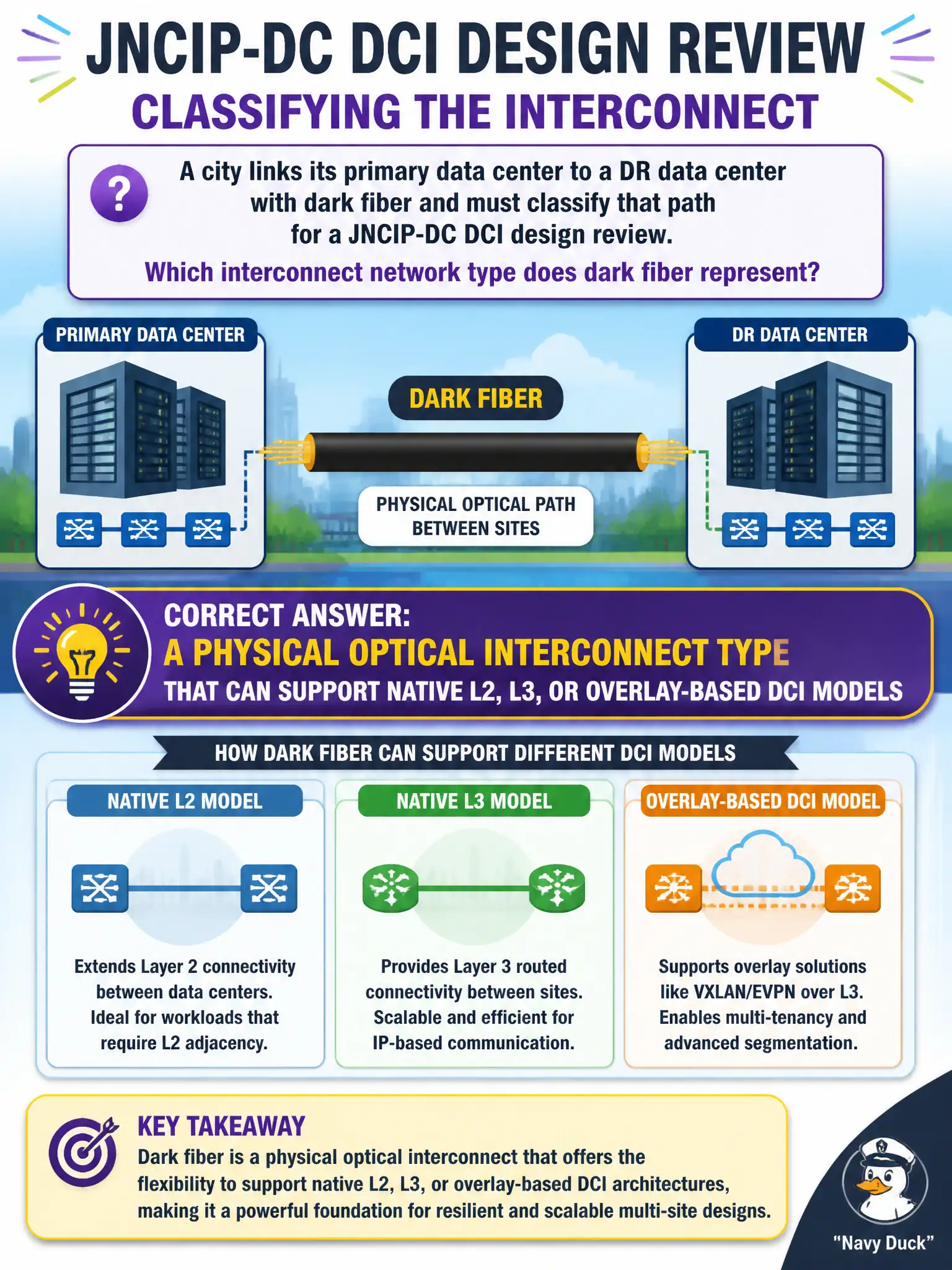
A city links its primary data center to a DR data center with dark fiber and must classify that path for a JNCIP-DC DCI design review. Which interconnect network type does dark fiber represent?
Select an answer to reveal the explanation.
Short Explanation
Think of dark fiber as the raw pipe between buildings, not a finished bus route. It is a physical interconnect type you can dress up with L2, L3, or overlays. Calling it "Internet-only" or "just another leaf-spine link" misses what DCI interconnect types actually are.
Full Explanation
Dark fiber between a city's primary and DR data centers is a physical optical interconnect type. It can underpin native Layer-2 handoffs, routed Layer-3 adjacency, or overlay-based EVPN-VXLAN DCI depending on how border devices are configured—classification starts with physical optical capacity, not with a single mandatory overlay SKU. It is not a managed Layer-3-only Internet transit handoff that cannot carry EVPN overlays; dark fiber is optical capacity you light yourself. It is not a mandatory MPLS VPN product SKU that replaces border leaf roles. It is not an intra-pod leaf-spine underlay link inside a single fabric ASN; true DCI spans data centers or sites. Exam caveat: dark fiber availability does not decide L2 versus L3 stretch by itself—SLA, failure-domain tolerance, and application mobility still drive the DCI model on top of the optical path. Operational check: document the dark-fiber path diversity, confirm border optics and underlay reachability between municipal DC loopbacks, then verify whether the overlay uses L2 stretch, Type-5 L3 DCI, or both per tenant before go-live. Classify dark fiber as transport only in architecture docs, then separately record the overlay stretch model each civic tenant uses on it.