
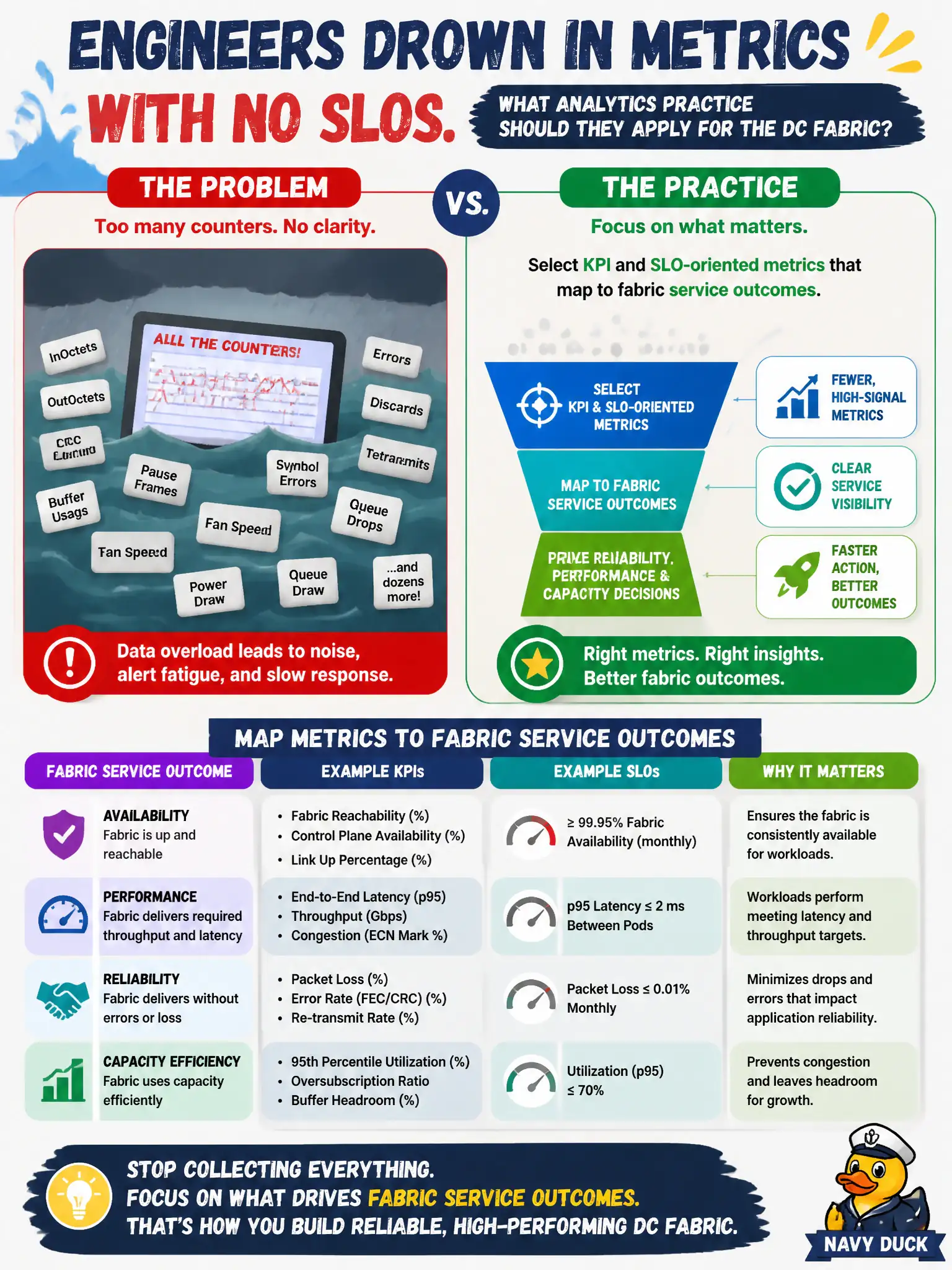
Engineers drown in metrics with no SLOs. What analytics practice should they apply for the DC fabric?
Select an answer to reveal the explanation.
Short Explanation
Collecting every counter with no SLO is like weighing every grain of sand and still not knowing if the beach is open. Pick the KPIs that prove the fabric meets citizen-facing outcomes, then alert on those. More sand does not equal more clarity.
Full Explanation
Select KPI and SLO-oriented metrics that map to fabric service outcomes instead of collecting every counter blindly when engineers drown in noise. Maximum-cardinality collection without success criteria creates alert fatigue. Deleting dashboards removes measurable ops discipline. A weekly anecdote email is not a substitute for metrics. Exam caveat: Tie alerts to citizen-facing outcomes such as drop budgets, session availability, or latency targets. Operational check: Publish a short fabric KPI list with SLOs and verify each has a dashboard and alert. In civic data-center operations, record the expected CLI or collector evidence for this concept so the next on-call engineer can validate fabric behavior without re-deriving the design under incident pressure. In civic data-center operations, record the expected CLI or collector evidence for this concept so the next on-call engineer can validate fabric behavior without re-deriving the design under incident pressure. In civic data-center operations, record the expected CLI or collector evidence for this concept so the next on-call engineer can validate fabric behavior without re-deriving the design under incident pressure. In civic data-center operations, record the expected CLI or collector evidence for this concept so the next on-call engineer can validate fabric behavior without re-deriving the design under incident pressure.