
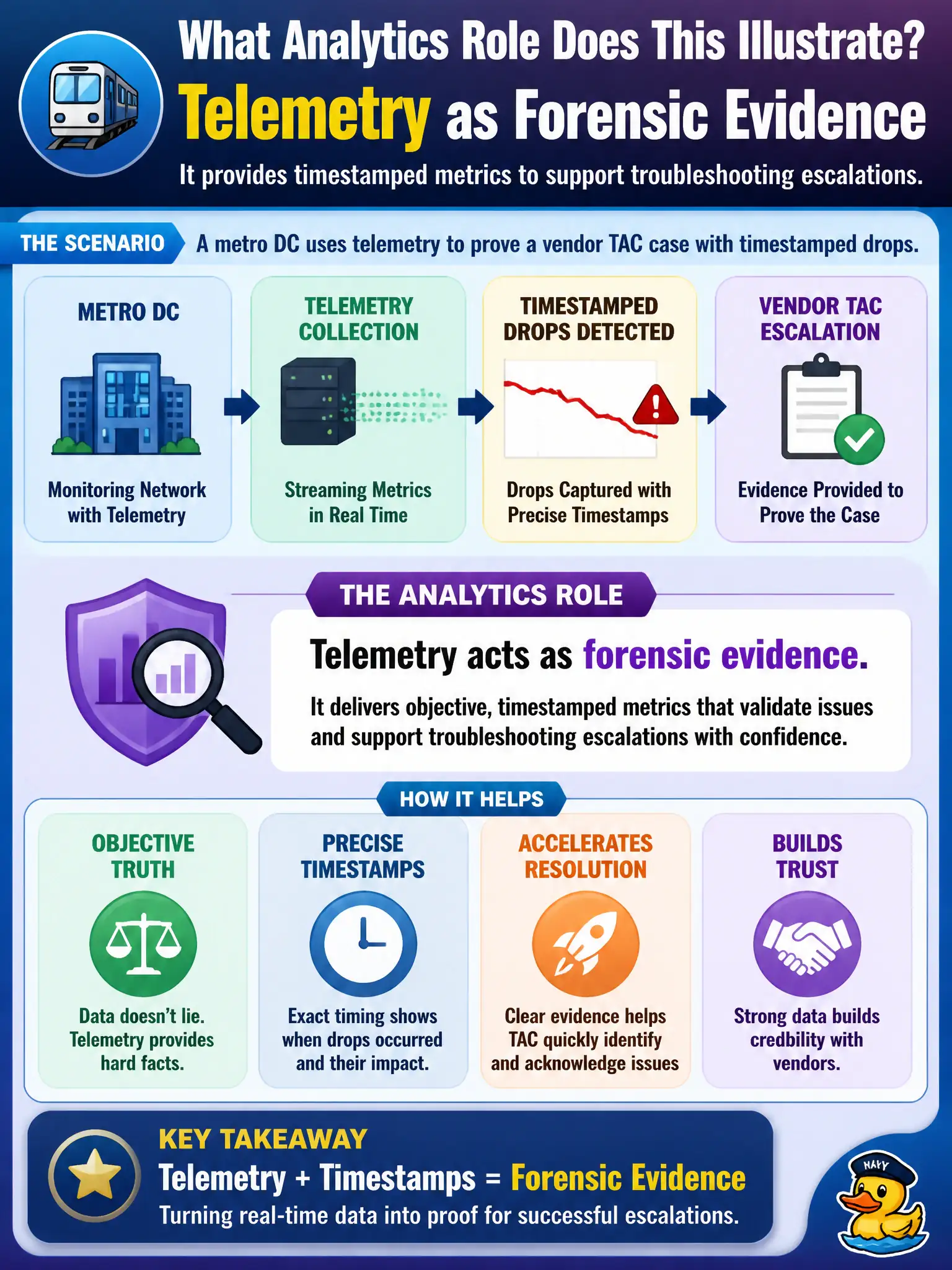
A metro DC uses telemetry to prove a vendor TAC case with timestamped drops. What analytics role does that illustrate?
Select an answer to reveal the explanation.
Short Explanation
Timestamped drop graphs are the receipts you slide across the table to TAC—hard evidence, not 'it felt slow Tuesday.' Good telemetry turns a he-said debate into a timeline. Verbal-only escalations leave everyone guessing.
Full Explanation
Telemetry as forensic evidence provides timestamped metrics that support troubleshooting escalations—illustrated when a metro DC proves a TAC case with timestamped drops. Telemetry is not useless for escalations. Telemetry’s role is not to change device hostnames during TAC calls. Verbal-only cases are weaker than metric-backed timelines. Exam caveat: Retain enough resolution around the incident window to show onset and recovery. Operational check: Attach time-aligned drop/error graphs with interface names to the vendor case notes. In civic data-center operations, record the expected CLI or collector evidence for this concept so the next on-call engineer can validate fabric behavior without re-deriving the design under incident pressure. In civic data-center operations, record the expected CLI or collector evidence for this concept so the next on-call engineer can validate fabric behavior without re-deriving the design under incident pressure. In civic data-center operations, record the expected CLI or collector evidence for this concept so the next on-call engineer can validate fabric behavior without re-deriving the design under incident pressure. In civic data-center operations, record the expected CLI or collector evidence for this concept so the next on-call engineer can validate fabric behavior without re-deriving the design under incident pressure.